when you dread summer (and not for the obvious reasons …)

I’ve been procrastinating this post for awhile. It feels like if I don’t write it, it won’t be true. Yet we all know that’s about as effective as saying you’re not hungry when your favorite dessert shows up on the after-dinner tray. (I caved and totally ate the peanut-butter pie while out for dinner last night.) Sometimes I wonder if I’m too negative or brooding. But, hey, that’s what writers are known for, right? And add “counselor” to my job description, and it’s a wonder I don’t spend all my moments looking at/being weighed down by the dark side of life. For there is much darkness that is real. And yet the light wins in the end, and I have hope that it’s already breaking into this broken-down world. 

But sometimes the weight of all the burdens catches up with my soul. And I’ve felt like I can’t quite rise to the occasion of being fully present in my life lately. Part of it may be “compassion fatigue,” experienced by full-time caregivers, health providers, and ministers. That would fit my life description since as a mom to 4-year-old twins, pastor’s wife, and counselor, I am all of the above. So I’m sure that’s a portion of the mist that seems to shroud the days.

Yet I’m also a girl who *loves* summer and all that it means. Beach days, bright sunshine, late sunsets, crickets’ songs and lightning bugs. This year I cannot seem to rise to my usual “summer love.” And it bothers me. Winter blues? Well, I always expect those. But summer doldrums? They’re foreign to my existence. Sure, summer is different now since having children because these are weeks and months without the break of preschool for them. My summer reading (and project) list must be shorter now than the fall-winter one, because I actually have less time alone rather than more. But this alone doesn’t seem to explain the low-grade numbness I feel (if numbness can be felt).

Then I consider our recent history – the history of my church community. And tragedy seared us about midway through last summer. I find myself cringing within, emotionally bracing for impact as the season turns and it’s summer again. It was a beautiful, typically-bright July afternoon when trauma struck through the deaths of a mom and her daughter, leaving darkness in its wake for the surviving husband/father and daughter/sister. It was one of the greatest privileges of our lives for my husband and I to be able to be first responders to their grief. To sit and cry with them when it was all so fresh and so confusing. To simply offer our presence and our tears. It has been beautiful to watch our community of faith surround them and carry them through this past year. It has been evidence of God’s grace to witness the strength of these two as they have learned how to do life anew together.

And because of the carrying-with of their grief, traces of those tears still remain in my heart and soul. I would have it no other way. That combined with a year of nonstop everything and insufficient rest is probably contributing to the distancing I feel from what’s good and true and beautiful of life, and of summer particularly.

What will be the path of finding my way back to joy? Of refusing to let darkness write the story of this summer through the never-ending dread? It will be simple yet difficult. Putting one foot in front of the other. Speaking of my struggle while it’s in the present (not waiting for the retrospective – “it’s all over and here’s how God met me”). Creating structure for my soul and our family that includes lots of rest, refreshment, and fun. Soaking my soul in the words of hope whether I feel like it or not. Words like,

“In this world you will have trouble. But, take heart, I have overcome the world.” – John 16:33

Yes, dread is a normal emotional response to past trauma, and yes, compassion fatigue calls for rest and a break, but no, it won’t have the last word. Jesus has overcome whatever it is you and I dread. This is reason for hope. Hope that looks like walking out of the mist and embracing what’s good and real and true about life, especiallysummer.

Five Minute Friday: tomorrow

We arrived home yesterday from a great several days’ getaway/conference in Orlando at The Gospel Coalition. More on that in a future post. Too much to process for now! Let’s say that returning home has been equal parts wonderful (twin 4-year-olds’ enthusiastic welcomes are the best!) and rough (where are the tropical breezes and the deep conversations?). Parenting is not for the faint of heart … I might have said that once or twice before?

I come here to Five Minute Friday, sliding in before midnight … to write in my favorite of regular blog activities. Five minutes of free writing on a given topic, hosted by Kate Motaung.

****

photo from macstuff.net

photo from macstuff.net

Tomorrow.

Cue the theme song from Annie here. No, really, let’s talk about tomorrow. Tomorrow is when I will not be plagued by the sin and shame of parenting struggles. Tomorrow I will get organized, and work out, and write more, and be more loving. It is the holding place for all of my attempts at self-improvement and hoped-for answered prayers. 

No wonder tomorrow can feel so uncertain. Yet it is also hope-filled.

I lost it tonight when she kept crying uncontrollably, insisting on her way when I kept telling her she could not have it. I was patient and calm for about all of one minute, and then I unleashed my anger in a tirade of frustrated words. A parent at her wit’s end. A parent who feels out of control, as out of control as her daughter does. She was tired, up way past her bedtime; and I was tired of parenting (as was my husband). I just wanted her in bed and out of the way. And yikes, that sounds awful. That is (and was) raw emotion.

But I stepped away for a minute. Prayed, took a deep breath, and came back to her forgiving arms. We cuddled in close and I heard her whisper “‘give you” in response to my request for forgiveness. And I whispered to her about the promise of mercies that are new tomorrow. Strength for obedience that we both need. Grace to forgive that we’ll both need, too. And freedom not to be tied to today’s failures. 

Only in that hope can I face any of life’s tomorrows.

***

Five Minute Friday: relief

My favorite of Friday activities: Five Minute Friday, hosted by Kate Motaung. Five minutes of writing on an assigned prompt each Friday – a lovely community of writers across the world gathering to reflect and encourage each other this day.

For this week: “relief.”

****

It feels like water on a hot summer day; like sleep after another weary day when you’re running, running, running without resting; like the comfort of a hug from a friend or a shared laugh with one who’s known you for decades. Relief is hard to come  by in our desert-weary world. There is brokenness everywhere, and my heart is covered in scars. So is yours.

We need relief. A break. A time-out. A respite.

We have it. Freedom to rest from what plagues our hearts most deeply – questions of am I enough? Does my life matter? Will this suffering ever end? Yes, yes, and yes. You are more than enough. You have dignity and mission and purpose perhaps beyond what you can understand. Suffering is always terminal. The cancer that’s terminal? Well, it doesn’t have the end of the story. There is Life beyond Death. We have One who went before us, who walked the hard, long road of suffering without relief. So that we would never have to. 

photo from theguardian.com

photo from theguardian.com – from Haiti relief efforts in 2010

There is no better hope. No better relief. It’s the motivation for us who have so much to share with those who have so little. It’s what keeps me listening when it feels my heart may break with your sorrow. It’s what sends you into the war-torn places of homes and countries, risking harm as you offer the relief that your presence brings. 

Relief. It’s certain. Let’s offer it to one another.

****

The perplexity, fear, and joyful disbelief of Easter morning

Perplexed. Frightened. Startled. Disbelieved for joy. Alarmed. Astonished. Afraid.

All of these describe the response of those who witnessed Jesus’ resurrection. Joy is our primary emotion on Easter morning, but fear overshadowed all else on that first Easter morning. Fear and astonishment. Nestled in the middle of the gospel accounts is this, “disbelief for joy,” and that seems to make the most sense to us. It’s what we can connect to as ones who eagerly proclaim resurrection hope.

I wonder what it would be like to stop and sit in the other responses: perplexed at how this could be – at what this could mean. Frightened, startled, alarmed, astonished to find the tomb empty. This shook those first witnesses to the core. We expect it because we know the end of the story, and we can’t bear to sit with the weight of the grief of Good Friday for long. (I was all too happy that we did a pre-Easter celebration with my daughters yesterday – like skipping the uncomfortable scenes of a movie, we press fast-forward to today’s joy.) But what would it have felt like to go to the tomb early on a Sunday morning, while it was still dark, fully expecting to pay homage to the memory of beloved Jesus, and to find instead that it was empty? Of course Mary’s first response is that someone has stolen the body (John 20:2):

“They have taken the Lord out of the tomb, and we do not know where they have laid him.”

That makes sense. But that Jesus is alive? It is too good to be true. If it’s true, everything changes. And that is perplexing, frightening, and alarming. What will happen next if resurrection has happened? It interrupts with discomfort the order we depended on (even the grief inherent in the old order of things can feel comfortable because it is familiar). If Jesus is alive, what else will change? Do we dare to hope that freedom from Roman oppression will also happen? What does this mean for our mission? Will we die, or will Jesus bring us with him to heaven immediately?

No wonder there are numerous letters written to the early church discussing the implications of Jesus’ resurrection. It changes everything.

What has it changed for you, and for me?

I have hope that I will meet again those who have died. Bethany, Nancy Leigh, Beverlee, Uncle Ashby, Grandmother and Grandfather Davis, Papa, a sister-in-law I never knew (Sarah), Lynn, Karla, Katharine. And you who have lost beloved family and friends will see them again, too – Nan; Liz; Jill; Megan, Kelli, & Patti; Mike & Shelby; the Rodriguez family; Kimberly & Erick; John – thinking and praying for each of you particularly this Easter morning.

I have courage to enter into the messy and broken places of my heart and others’ lives as we grieve to live in between resurrection and full restoration when Jesus returns. I can weep with those who weep, who miss their beloved ones, whose hearts are breaking because of the brokenness of this world. I can sit and mourn without having answers. I can listen and be impacted by the grief of life in a world that’s not yet what it should be. 

I can ask my questions and doubts, and create space for you to do the same. Jesus compassionately showed doubting Thomas his scars. He did not berate him for his disbelief. (For disbelief might be one of the most honest first responses to the reality of resurrection.)

sad untrue quote

photo from poetrystoryteller.blogspot.com

I can choose joy (belief in a bigger purpose, a deeper reality) in the middle of suffering and heartache and frustrations. I have an unshakeable hope waiting for me, guaranteed by the Resurrection. “Everything sad will come untrue,” writesSally Lloyd-Jones in The Jesus Storybook Bible.

I’ll close with one of many teachings on “what now, in light of Jesus’ resurrection?” This one penned by the apostle Paul in 2 Corinthians 4:16-18

“So we do not lose heart. Though our outer self is wasting away, our inner self is being renewed day by day. For this light momentary affliction is preparing for us an eternal weight of glory beyond all comparison, as we look not to the things that are seen but to the things that are unseen. For the things that are seen are transient, but the things that are unseen are eternal.”

beauty in darkness: what’s good about Good Friday

Another repost from a year ago. It still stops me in my tracks to slowly traverse the painful path filled with shame unimaginable – and to realize that Jesus walked this path for ME. For me who too often tramples on the gift of redemption I’ve been given by taking it for granted, or thinking that I did something to earn it. Love led him through the agony we remember today. Don’t forget that love is behind all of the horror of “Good” Friday. (And don’t forget that our sanitized, decorative crosses are far from its original horror – public execution of the most shameful kind.)

***

I had skimmed over the verse countless times in the 30+ years I’ve read and meditated and studied this familiar account. Good Friday is the time to read the crucifixion story. A story of horror turned beautiful. Yet if you’re like me, too often I jump to the “turned beautiful” part without staying with the horror of what Jesus endured. It’s uncomfortable to sit with the events that culminated in the most gruesome of deaths on a Roman cross. But this week – this Holy Week – asks us to do just that. To sit. To see. To hear. Because in the horror, we are saved. We are deserving of all that the King of Glory endured innocently. And we who bear his name are called to endure similar suffering for the sake of love. Love enters into the messy, the broken, even the so-gruesome-you-can’t-bear-to-hear-it and Love takes it. Love endures. It does not run away. It stays. It shows up.

What feels impossible for you to endure today (and yet you must because of Love)? How can Good Friday become truly “good” for you today? What brokenness do you run from in your own heart and in the lives of those around you?

In my calling as a counselor, I often sit with those who have endured stories of abuse that are too difficult to name. And to think that what I have a hard time hearing is what they lived through. Well, that causes you to pause. To pray. To beg for redemption, for healing, for a Justice to make it all right. 

On Good Friday, we are given just that. Not only in the cross, but in the events leading up to the cross. Here’s the verse that stopped me in my tracks this morning (from Matthew 27:27):

Then the soldiers of the governor took Jesus into the governor’s headquarters, and they gathered the whole battalion before him.

Do you know how many soldiers are in a battalion? I didn’t either, so I checked the footnote and saw that a battalion is “a tenth of a Roman legion; usually about 600 men.” 600 men. Quite different than movies who portray this portion of the scene with a couple soldiers kicking Jesus around. That’s bad enough, but this has an arena quality to it. 600 soldiers. That’s a very full auditorium hall. And what did they gather to do? Well, read on:

And they stripped him and put a scarlet robe on him, and twisting together a crown of thorns, they put it on his head and put a reed in his right hand. And kneeling before him, they mocked him, saying, ‘Hail, King of the Jews!’ And they spit on him and took the reed and struck him on the head. And when they had mocked him, they stripped him of the robe and put his own clothes on him and led him away to crucify him.

Utterly shameful. Shameful if it’s an audience of one, but for these horrors to happen before an arena-size audience of 600? Shame magnified. Shame too great for words. Twice he was stripped of his clothes. In addition to the emotional abuse of this mockery, there was the physical abuse of being “crowned” with thorns and beat on the head with a reed. What is striking is Jesus’ response. Nothing. The one who was God incarnate – who could have called down fire from heaven to devour these fools – stayed still and endured. That is the miracle. The miracle that turns bad into good, abuse into redemption, mockery into honor.

Centuries before, a prophet called Isaiah wrote about this and puts words to the what and the why of all that Jesus endured on “Good” Friday:

Surely he has borne our grief
and carried our sorrows;
yet we esteemed him stricken,
smitten by God, and afflicted.
But he was wounded for our transgressions;
he was crushed for our iniquities;
upon him was the chastisement that brought us peace,
and with his stripes we are healed. …
He was oppressed, and he was afflicted,
yet he opened not his mouth …

Because Jesus did not open his mouth when enduring abuse, we can open our mouths and beg for healing and redemption. Healing from our own abuse and from the ways we have abused and oppressed others through our sin – through our brokenness seeking false healings.

In the place of your abuse, there is healing. Because he took the shame for you.

In the place of my sin, there is peace. Because he carried the guilt for me.

In the places where you and I have been silenced, our voice is restored. Because his was silenced this Good Friday.

So go. Walk as one who is healed, who is at peace, who can speak up and speak out and speak of darkness turned beautiful on this most good of Fridays. 

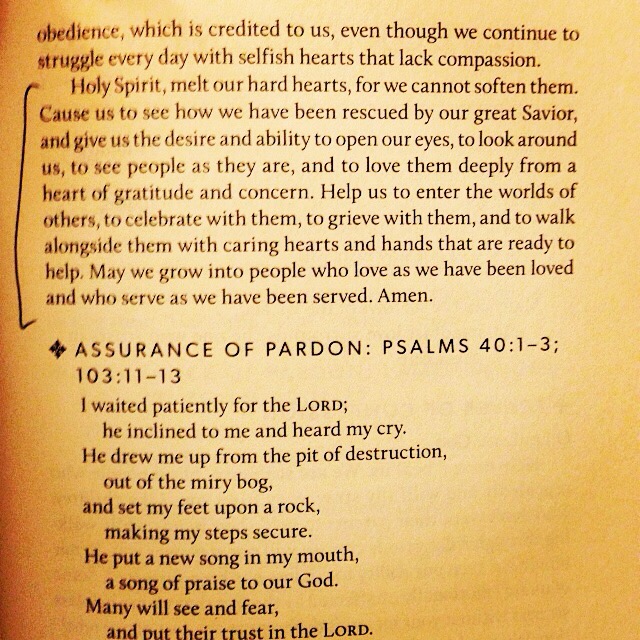
A Lenten prayer: prone to wander

This prayer is from a favorite book that I “happened” to be gifted with by dear friends just as Lent was beginning: Prone to Wander, by mother-son co-authors Barbara Duguid and Wayne Houk. I have found its call to worship, specific gospel-saturated prayers of confession, and then assurance of pardon to be spot on for my heart this Lenten season (and really any time!). I also love that there are suggested songs listed at the end of each entry. It’s been a personal worship guide – although written to be for a church, there are multiple uses to be sure.

And having some bit of personal interaction with both Barbara and Wayne through CCEF courses we’ve been a part of together makes the writing sing even more so. They are both tremendously gracious, and incredibly gifted at putting gospel truth to words.


living with the heat in your life (a biblical understanding for life’s weather)

how people changeOur church’s Sunday school is studying “How People Change” as one of the two classes offered for adults. [Insert shameless plug here: my pastor-husband has done an incredible job over the past five years of revamping our Sunday school so that it’s now something worth attending for an extra hour each Sunday – there are usually two classes offered, one that’s a biblical-theological track with a team of professors and educators from our church teaching through the Bible and one that’s practical theology] I introduced the DVD yesterday, and the topic was focusing on the “heat” aspect of CCEF’s model for change. [CCEF, the Christian Counseling and Educational Foundation, is where I did my counseling internship, and their counselor-professors taught the counseling courses I took as part of my M.A. in Counseling from Westminster Theological Seminary.]

Identifying the “heat” in your life, or the weather, as I think it would be more aptly named, is the first place to begin in the process of change. Sadly, I’ve observed all too often that this is where ministry, friendships, and counseling/therapy can stay. And we are missing so much! The “heat/weather” in our lives is important, and there are equal dangers of either maximizing or minimizing it, but more often than not, we cannot change the “weather” of our lives in a similar way that we cannot determine the weather of our days. We learn to identify it, even understand it and possibly predict it, but at the end of the day, the weather is one of life’s givens. Our response to life’s weather is where change happens, or not. Where there is growth, or stagnation. Where there is joy mined through the depths of suffering, or a heart becoming bitter and resentful. And if we are honest, we have observed both tendencies in our lives. Right now, there are life situations I’m responding to with bitterness, and there are also life situations I’m responding to with hard-fought joy.

Without further ado – my intro to the DVD is below:

***

What is “heat”? Of the following scenarios, raise your hand if you think that it would qualify as “heat”:

  1. Discovering that raccoons have been nesting in your attic for several months
  2. Going on vacation to the Caribbean
  3. Being sick with strep throat
  4. Finding out that you got a job promotion
  5. Moving across country for a new assignment
  6. Having a baby
  7. Getting asked out on a date by someone you’ve admired from afar for a long time
  8. A break-up of a dating relationship
  9. Your child getting first place in a competition
  10. Winning the lottery

Most likely, it was easier for you to identify the “bad” things than the “good” things as “heat,” but heat refers to both. I think a broader way of describing heat would be “what’s the weather in your life?” Sometimes it’s beautiful and sunny; other times (like this week!) it’s cold and rainy and cloudy. Weather can last for days on end, or shift from hour to hour. And so do the circumstances in our lives, and the opportunities for our hearts to be revealed shift constantly. In fact, I think this constant shifting is part of the “weather/heat” that reveals our hearts! Just when you’re enjoying a very pleasant season with your children, one of them gets sick – and then you get strep – and then she stays sick and you’re isolated and frustrated and angry with God. (True story of our past month in the Nelson household!)

And isn’t that how we view our “heat”? The circumstances in our lives? The biggest problem I face in my own heart and that I’ve observed through my years of counseling ministry is this tendency to blame the weather for my heart’s response. It’s why parents get such a bad rap – we’re always blaming them for every bad quality in our lives. It’s why I expect in marriage counseling that it will take a few weeks (at least) to begin to get down to work – because both of them tend to blame the other as the problem. It’s why I can get sucked into complaining as my primary mode of communication: I really do see my primary issues as my circumstances … and if only my kids would get well, my work schedule would calm down, my husband would listen better, summer would come, then I could live the godly life I know I should be living. Or at least be happy.

As you watch this video and discuss it afterwards at your table, and then reflect on it personally, think about the ways that you tend to blame the “heat” for your problems.

In many ways, this is the easiest week of Sunday school because “heat” is the easiest and first thing that we recognize in our problems. Let me present to you two tendencies that you may find in yourself – and consider this as we dive into this week’s lesson:

  • Over-focus on (maximize) the heat: This is the M.O. for most of us. It’s why we blame our spouses for marriage conflict, and why I think that if I lived in a bigger house, life would be easier. It’s why I think that once my kids are older and better behaved, I’m going to enjoy them more and be able to fully be “myself” again.
  • Under-focus on (minimize) the heat: This is less common, but just as distorting. There are some of you who tend to blame yourself so much that you never take into consideration the “heat” of your life as something that’s contributing to your heart’s response. You assume that your struggles today are always because of the sin in your heart. An example of this is someone who’s experiencing panic attacks. As she begins to tell me about them, and I am hearing the stress of her past year (moving, job change, parenting and marriage difficulties, health problems), it seems obvious to me why she’s having a panic attack. It’s her body’s reaction to so much external stress/heat. When I point this out, she has an “aha!” moment – she didn’t see it because she discounted the real impact of the circumstances of her life. This may also be your tendency if you’ve been abused – you tend to take on the shame of your perpetrator’s sin against you, and you assume the abuse occurred because you deserved it, or you were/are a bad person, or you didn’t lock your door at night, or you wore something inappropriate on a first date. Absolutely not! Part of the “heat” of a victim’s life is the way he/she takes on what’s not meant for him/her to take on – and part of believing the gospel truth will be the ability to disown the shame handed to you by the abuser, and to say, yes, the abuse was/is a major part of the “heat” of your life but it’s not the whole story nor is it the end of the story/your story.

This is inherently a hopeful message – to realize that “heat” is just that – the occasions/circumstances in your life that reveal your heart – because none of us can change much of our life’s weather anyway. To focus on changing what’s unchangeable brings great frustration. You usually cannot significantly change your “weather” – the past abuse, even the good things like job promotions or vacation – but you can always by the power of grace and the Spirit change your response to the weather. Naming heat as “heat” frees you to start focusing and prayerfully engaging your part – what can change – instead of getting frustrated by being stuck in what you cannot change (or what may never change –  e.g., you can’t rewrite your past).

****

from contentment and celebration to complaining and despair

photo from zionsvillelutheran.org

photo from zionsvillelutheran.org

Isn’t it always like this? Our grandest moments of life, faith, work, are closely followed by our biggest days of struggle. I think about Jonah after he experienced an epic personal rescue from the belly of a big fish, and watched God convert an entire city (Nineveh) through his preaching. The book ends with a story of the prophet’s suicidal despair because a worm ate a vine that was sheltering him from heat. It’s ridiculous. Crazy, really. And then there’s Elijah. After he watches God send fire from heaven to consume a flood-drenched sacrifice on Mount Carmel in front of a crowd of frenzied Baal-worshipers, he sits under a broom tree in the desert to die. His exact words?

“It is enough; now, O Lord, take away my life, for I am no better than my fathers.” (1 Kings 19:4)

What happened to his bold faith glimpsed just two paragraphs earlier in this prayer?

“O Lord, God of Abraham, Isaac, and Israel, let it be known this day that you are God in Israel, and that I am your servant, and that I have done all these things at your word. Answer me, O Lord, answer me, that this people may know that you, O Lord, are God, and that you have turned their hearts back.” (1 Kings 18:36-37)

What happened is that Elijah and Jonah, like you and me, are human. “Prone to wander, Lord, I feel it/Prone to leave the God I love,” the old familiar hymn goes (“Come Thou Fount of Every Blessing”). I should not be surprised that on the heels of such celebration at the end of last week with the news of Crossway’s acceptance of my book proposal, this week has felt like a battle against petty disappointment and despair. The things I have complained (bitterly) about include:

  • Our coffeemaker that broke on Monday morning [MONDAY morning, of all days?!!]
  • Twins who whine and squabble with each other over silly things, like who gets the red marker [typical for 4-year-olds, although not desirable]
  • Antibiotics that didn’t work as quickly as I wanted them to in healing a bad case of strep from last Thursday
  • A husband’s very long work day, leaving me with more-than-desired solo-parenting duties for my quickly-waning-parental-patience
  • Credit card fraud – at a random WalMart in Tennessee, of all places, for 5 consecutive purchases of $28.77. This alerted our awesome card company, who called right away. But then you have the *hassle* of switching automatic payments, waiting for the new card in the mail/etc etc

All of these could fall under the hashtag #firstworldproblems , or better, #whinymomproblems. Really they’re symptomatic of a heart fixated on self, who feels entitled to comfort and ease all the time. Diagnosing my problems yesterday didn’t really help much. In fact, it probably made it worse. Then I was better able to articulate (and unload in frustration) to my husband why he, somehow, was at fault for all of my frustration.

Ugh. (There’s a poetic word for you.) I have been blind to grace. Blinded to mercy all around me, and worse still, unable to help myself. Feeling paralyzed from taking hold in my own heart of the gospel-hope I can articulate for others through writing and counseling. Enter grace in the form of the impulse to text a friend for prayer this morning when I awoke still seething with frustration and venting it unfairly to my daughters. She then called after we dropped our kids off at preschool (thank God for this common grace!), and we talked each other through our similar frustrating moments, reminding each other of the grace we know is there. I hung up the phone feeling the slightest turn in my heart towards hope again. Hope not that things will get better, or that circumstances will change, but hope that God’s love hasn’t turned away from me in the midst of my sin and struggle and that his grace is yet deeper than my need for it. Amen?

Letter to Grief (reposted) and a book to purchase

[repost from December 21, 2014]

All is not calm and bright, is it? This time of year is more often chaotic and dark as we scurry around with our never-ending Christmas to-do lists, flitting from one festivity to another. And for many of my close friends, this Advent season brings unimaginable grief. I feel it with you. And so I jumped at the opportunity to join in a “Letters to Grief” event hosted by Kate Motaung coinciding with the launch of her book by the same name. This letter – it’s for you, my friends grieving loss this season. Whether that loss is of a parent or a child or a pregnancy or a job or a clean bill of health or a dream or a marriage – the loss of hope and community too often follows in its wake. Let this be a small reminder that no, you are not alone, and yes, it feels excruciating. Cry, and sorrow, for we are not Home yet. But grieve with hope, for Home is being prepared for all those clinging to the hope of our Redeemer Jesus Christ.

***

Dear Grief,

You have claimed many friends in 2014, and I have been touched by you as well. The worst part is that the church has too often refused to own you as she should. She has proclaimed a gospel of health and wealth instead of the message of the Man of Sorrows acquainted with grief who promised suffering for all who take up their cross to follow Him. And in those moments when the people of God feel like they have no refuge, you cackle and seem to win. You whisper lies, saying that there is no hope, and that God is as distant as the well-meaning friends who disappear after an initial rally of support. …

[read the rest over at Kate Motaung’s site where I am featured today as part of her book launch, Letters to Grief, which will be one of my first reads in 2015]

Sorrow-well-300x300