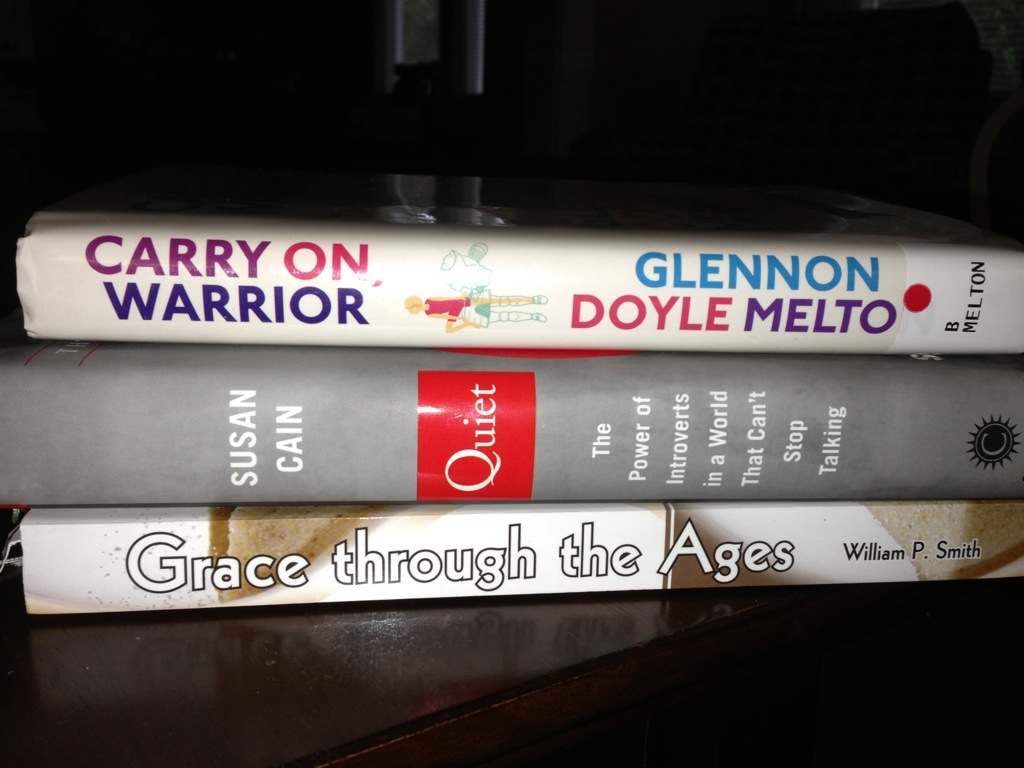
on my August bookshelf

20130806-144721.jpg

Three books, all very different from each other. I’ll start with the devotional I’ve been reading for the past several months, Grace through the Ages. Not only is this written by my former counseling supervisor and colleague, Bill Smith, whom I respect and have learned from immensely, but in his typical way, he seamlessly connects Scripture (all of it, Old and New Testament) to my day-to-day heart struggles, doubts, fears, and hopes. Every day that I pick this book up to read a one page devotional thought, I am met with a glimpse into God’s heart for me: his desire to be in relationship with his people and the great lengths to which he goes to bridge the gap of my sin and folly. Here are a few nuggets for you to savor.

On suffering: 

Suffering burns away self-deception by making us aware of what we turn to apart from Jesus to make our lives work.

On communication:

He [God] made you in his image and when you properly fill your role, you will talk to others about how to live in his world, in the same way he’s spoken about it to you.

On community: 

The same grace that embraces me also calls me to share my life with people who are dramatically different from me and to live with them in small groups of people that look remarkably like that first one 2000 years ago.

Second is Susan Cain’s book, Quiet. I’ve mentioned it on here previously, and it’s a dense book that will take some time to peruse. I was drawn to read it because I find myself both longing for quiet in a way I haven’t before (probably something to do with the constant noise involved in staying at home with twin toddlers), and I also find myself drawn to introversion as a way of re-energizing rather than big groups of people. I’m a mix of both, to be sure, but I am increasingly embracing my “inner nerd” whose ideal day would be spent in a quiet coffee shop reading a few really good books, and then writing about it. Thanks for providing me with an audience. 

The final book in my stack is along the lines of funny-parenting-real-memoir, Carry On, Warrior, by Glennon Doyle Melton of Momastery. She is telling her story, and telling it in a brave, vulnerable way that invites me to do the same. And in a way that all of us can relate to. She begins by talking about what began this journey for her: opening up about her less-than-ideal past (that included addictions and jail) to a fellow mom while at a playdate on a playground. Now how’s that for inspiration to have different sorts of conversations the next time you gather with a friend? From her intro – an invitation to all of us –

The more I opened my heart to the folks in my circles, the more convinced I became that life is equal parts brutal and beautiful. And/Both. Life is brutiful. Like stars in a dark sky. Sharing life’s brutiful is what makes us feel less alone and afraid. The truth can’t be stuffed down with food or booze or exercise or work or cutting or shopping for long. Hiding from the truth causes its own unique pain, and it’s lonely pain. Life is hard — not because we’re doing it wrong, just because it’s hard. It’s okay to talk, write, paint, or cry about that. It helps.

Five-minute Friday: “Story”

Story. There’s a popular cliche that’s well known in counseling circles: “Home is where your story begins.” I love that because it is quite true that every story begins at home – a place of nurture, for better or for worse. Yet it’s also true that the place where you’re able to begin telling your story can become home. Hence my calling as a counselor. I consider it a deep privilege to become “home” for someone’s story. Maybe the first time they’ve shared about deep wounds or fragile hope or shattered places in their heart. And story is what shapes you, as well as what you shape each choice of each day of your life.

Story. To live in God’s story for me is another way of saying to live according to God’s will. Am I living a story of God’s glory or of my own comfort/pleasure/fulfillment? Have I remembered that Christ is the HOME for my story? He is where my story begins, and ends. Christ as the place where I am free to share every detail of my story, and Christ as the ultimate Story-teller. His story gives mine meaning, depth, light, darkness. His presence assures me that my story will never be meaningless or hopeless.

Story is captivating. And it is in daring to share our story boldly, honestly, freely, that we will have connection to others. Community is about shared-story-living (and shared-story-shaping). My story is never solitary. It’s part of a whole, and touches your story in similar ways that your story will touch mine.

There is a beginning. A middle. An end. I can tell you its beginning; the middle is what I wade through daily; the end is a mystery kept by God. Maybe in remembering where I am in my story will I be able to better live out the story of who I am; who God’s making me to be; living true to the story he is writing for me.

****

I’m participating today in Lisa-Jo’s “Five Minute Friday” where you write for five minutes on a topic, unedited. Fun way to get a quick blog post and stir the creative writing process.

9 things I learned in July

This is a fun link-up I’m enjoying on a monthly basis, from Emily Freeman over at Chatting At The Sky. Love her blog, her book, her link-ups. Love that she’s also a mom of twins and that I have some teeny tiny connection to her through her friendship with my BFF, Katherine.

Drumroll please? Here you are …

1. David Kirk and Daniel Kirk are two different author/illustrators of children’s books. David  is of the “Miss Spider’s Tea Party” fame; Daniel created “Sam the Library Mouse” series. Both series are favorite picks from the library for my girls (and for me to read – please, no more Dr. Seuss, can I get an “Amen?”).

2. I am really obsessed with lost things. Although I had already bought a replacement pair of Target Crocs for Lucia because we thought one of her pink ones was missing, when I found the “lost shoe,” I spent about 30 minutes searching everywhere for the original un-lost one. Alas, I had thrown it away already. This scenario repeats itself daily when we have (gasp) lost a lovey or a Lego piece or a doll outfit or … I wish I could say that there was something spiritual about my obsession, as per the Father who awaits the prodigal (lost) son, or the woman searching for her lost coin, or the shepherd searching out his lost sheep [seek Luke 15]. Usually I am more frustrated in my search for the lost thing than inspired by the value of what’s lost. I think it’s more about me wanting to be on top of life and have it in order than my passion to seek what’s lost.

3. If I’m starting something new I don’t mind leading (prefer it actually), but if I’m joining something that’s been in existence for a while I prefer to watch and observe before jumping in with both feet. Definitely seeing echoes of this tendency in one of my twins.

4. My cross-cultural experience helps me in counseling, friendships, and marriage because every relationship involves bridging the gap of individual cultures. For example, I learned in training and experience of a few summers overseas in Mexico and Ireland that it’s important to listen first before talking, to contextualize truth to the shape of that particular culture, and not to rush in too quickly with my own ideas.

5. There’s a local gym membership that includes a monthly parents’ night out for free! You better believe we joined it, and have already used this privilege once.

6. Proclivity to express yourself better in writing points to introverted tendencies. My personality finally explained – outgoing yet processes life best when writing. Thank you, my new favorite book, Quiet

7. I like to trash pick. My husband doesn’t. I’ll let you imagine how I found out that little tidbit. Let’s just say it involved a large dresser on the side of the street that I spotted next door to a friend’s house, and then asked [begged] him to return to pick it up in our car at 9:30pm. We don’t have the dresser. We still love each other and have our marriage. I will not trash pick in the future. Enough said.

8. Lulu.com is a self-publishing website. So perhaps my dream of publishing my own book doesn’t have to be so far off after all? Any writers out there want to give tips on how to get published v. self-publishing?

9. “Peacock” is a term that refers only to the male variety. A female f.k.a. “peacock” is actually a “pea-hen.” In the plural, they are “peafowl.” Thank you, Ann, for that enlightenment at the zoo this afternoon.

Mind the gap

This is how I imagine my kitchen to be:

Serene, beautiful, spotless. Could be on the cover or a feature story of “Real Simple.” The countertops gleam; all dishes are put away; there are matching Method hand soap and dish soap containers; and the lit candle signals that it smells as nice as it looks.

Instead, this is the typical end-of-the-evening scene in my kitchen:

20130729-214126.jpgAnd what you can’t see in this image is the dishwasher that still needs to be unloaded (it’s 9:30pm), and a pot on the stove that has another pot nested within it (both dirty, of course).

There’s quite a gap between “ideal” and “real.” To be honest, this particular gap doesn’t really bother me that much because I know it’s only a matter of about 30 minutes before the dishes will be put away and it will at least *look* clean even if it doesn’t smell clean or gleam radiantly. These photos illustrate a deeper gap I wrestle with almost daily. I know that I am not alone in this, because I’ve talked to many of you about it and read your blogs where you also honestly wrestle through the gap. The gap between who you want to be – “ideal you” – and who you really are day-to-day. 

In a conversation with my mom last week, she was telling me about a book she’s read lately in which the thesis is, “We all feel like we need to be perfect like everyone else because we compare our insides to their outsides.” Meaning that you don’t see me yelling at my kids and berating them to get dressed with proper shoes (slippers don’t count) and use the bathroom and get buckled into their car seats and etc etc … before you see us walk into the grocery store all smiles, me holding each of their hands.  Nor do I see your inward struggle with what to wear and does your hair look ok and what about this makeup and do these earrings really match. I simply see the beautiful well-dressed woman who walks into church with confidence and style, leading her equally well-dressed and smiling children behind her. And I’m intimidated by you. I feel less than.

I care so much because it could be that your image gives a picture to the ideal in my head. The who-I-want-to-be-but-feel-like-I’ll-never-be. Emily Freeman in Grace for the Good Girl describes it like this:

I am struck by how I have lived in a constant state of high expectation. I compared my current life to the one I thought I would be living.

What do we do with this? First of all, I mind the gap. I remember that my ideal self and who God created me to be are two different people. And who God wants me to be is who HE is making me to be as Jesus’ life overflows through mine. Which includes me being honest about weaknesses and struggle and confessing and repenting of sin. Secondly, I remember that you’re real, too. So I don’t envy you or judge you or distance myself from you because you seem perfect in ways I’ll never be. I befriend you, because you need friends, too, and you have messy places just like I do. I ask how you’re doing, and really listen. I don’t force honesty, but I offer you the real version of me – hoping that will invite you to do the same in case you’re also feeling suffocated and in need of the space to be real as well.

Five Minute Friday: “Broken”

I think of hearts metaphorically speaking. Broken after a severed relationship, severed by grief or a break-up or moving or death or relational discord.

And bones. I’ve had a few in my day – two broken arms when I was younger; a broken ankle when in college. Nothing since. (thank goodness!)

Broken implies a need to be healed. Waiting for restoration. Gently cradling and nursing the hurt place, the hurt bone, stabilizing what is broken so that healing can come. It will come. But it takes time.

It was six weeks of a cast on my arm. And you begin to get used to it before finally you’re free. But being healed and being whole feels strangely light after being broken. The process is painful but the result is beautiful. Getting that cast off my arm, and my arm felt like it was light as air. Same with the one a few years later; and then several years later at college. I was only too glad to say farewell to the cast and the crutches.

Now as to hearts after being broken. Well, that’s a different story. There is no six week cure. But the healing is just as sure. Just as certain. There’s simply more waiting involved.

****

I’m participating today in Lisa-Jo’s “Five Minute Friday” where you write for five minutes on a topic, unedited. Fun way to get a quick blog post and stir the creative writing process.

Thankful Thursdays

{I’m thankful for} the wisdom of God shown through the “foolish” love of a crucified Jesus. Really looking forward to exploring more of the depths of this wisdom as I prepare two retreat talks – “God: The Source of All Wisdom” and “Love: Wisdom in Action.” 

{I’m thankful for} the opportunity to speak at WRPC‘s fall retreat on “Get Wisdom” and the great team of women I get to prepare and brainstorm with throughout the process.

{I’m thankful for} a fun new tradition-in-the-making of gathering neighborhood moms for “happy hour” once a week during what’s usually otherwise known as cranky hour or what I’ve heard termed “arsenic hour” – yep, post-nap, pre-dinner period between 3:30 – 5pm.

{I’m thankful for} new neighbors who are good friends who moved in a few houses down from us last weekend.

{I’m thankful for} a break in the oppressive summer heat and humidity.

{I’m thankful for} a royal baby! How fun to hear the news of this new real-live Prince George and see the excitement generated around the world.

{I’m thankful for} finishing a really great novel, The Thirteenth Tale, about twins and story and writing … many familiar subjects to me.

{I’m thankful for} a quiet weekend ahead, full of beautiful beach days (I hope) and good family memories built – especially excited to see some of Seth’s cousins who are in the area. I *heart* living in a place people like to visit in the summer.

********

Want to join up with me for “Thankful Thursdays”? If so, grab the button above; leave your blog address in the comments below, and link back to this post. I’m thankful for “Loved and Lovely” for such beautiful artwork that I’m using. No rules on this as far as how many “thank you’s” or that it needs to be profound and deep. Let’s practice together opening our eyes to the grace that we’re showered with daily.

shame and its antidote

After listening to Brene Brown’s first TED talk a few weeks ago on vulnerability, it was time to listen to the second one on “listening to shame.” Shame is different from guilt, guilt meaning the feeling that tells you, “I did something bad.” Shame’s message is much more pervasive and insidious, telling you, “I am bad.” Ed Welch in his excellent book Shame Interrupted says this:

Shame is the deep sense that you are unacceptable because of something you did, something done to you, or something associated with you. You feel exposed and humiliated. … Guilt can be hidden; shame feels like it is always exposed.

Are you beginning to feel it? Beginning to feel the places in your own life where you hear the insidious whisper of shame, telling you that you’re not good enough; you aren’t holy enough; you don’t have the right friends; your possessions aren’t sufficient; that you deserve only bad and not good, and it goes on and on and on.

Brown discusses the way that shame is defined differently for men and women. For women the definition is “conflicted, unattainable expectations of who we should be.” And so I feel shame that I’m not working enough nor am I home enough, for example. Or shame that I’m not more like the perfect mom/wife/friend in my head who’s always available, always loving, always putting others’ needs above my own, always feeding my family organic food straight from our garden …. you get the picture.

For men, it’s a bit more complicated. A bit more hidden. Shame for men is being perceived as weak, according to Brown’s research. And we as women unconsciously support this sense of shame any time we pressure our husbands, fathers, brothers, boyfriends to always be the strong one for us and to never fall apart. Do I give space to my husband to be weak – or am I always expecting him to be together, thus supporting the idea that he can’t be anything but strong? If you are a man reading this, do you have someone you can be weak with? When was the last time you allowed yourself to be weak?

“How do we get back to each other?” Brown asks. A good question, that she answers by saying that shame’s antidote is empathy. Because shame grows in secrecy, silence, and judgment, to be understood and known in our place(s) of shame will eradicate its presence. Brown says –

Vulnerability is the way back to each other.

Who can you be vulnerable with? Knowing that vulnerability takes courage and brings community – how essential vulnerability is yet how unattainable it can feel! I have found that the only way I can be vulnerable with others or even reach out in empathy towards others is experiencing this in my own life. It is in relationships with brave ones who have loved me when I was unlovable; who have entrusted me with their shame-laced stories; who have stood with me without turning away as I began to speak about my own places of shame that I have learned how to empathize and connect. Yet even these ones have not done so perfectly or completely. I have both disappointed others and been disappointed. Where do you go then?

Try the one who carried all of the hurts and shame and guilt of the world. The one described as –

… he had no form or majesty that we should look at him, and no beauty that we should desire him, despised and rejected by men; a man of sorrows and acquainted with grief; and one from whom men hide their faces …

Read on about this man.

Surely he has borne our griefs and carried our sorrows; yet we esteemed him stricken, smitten by God, and afflicted. But he was wounded for our transgressions; he was crushed for our iniquities; upon him was the chastisement that brought us peace; and with his stripes we are healed.

And what’s your connection to him? That shame that was so disfiguring to him? It was yours and mine. Those dark places that you can’t bear to speak about, much less for someone to know? He was there, and he knows, and he will redeem – if not in this world, in the one to come. His is the empathy that heals both shame and guilt as we say “yes! I need you!” to this one. It is in intimate connection with Jesus Christ, who knows us intimately and loves us completely, that we are free to risk vulnerability to fellow shame-laden travelers. It is in relationship with him that we are free to relate to one another; to offer the empathy that is shame’s antidote. 

beach or desert: a matter of perspective

We had a beach day this morning. One of several we have been able to enjoy this summer now that our daughters are better able to enjoy sand-castle building and wave jumping (rather than sand-eating and rushing-too-far-into-the-ocean as they’ve done previously). It was perfect beach weather: 90 degrees, with a breeze coming off the ocean, hot but with the cold refreshing ocean to dip into as needed. And our girls had so much fun with the other family we met there, who have a teenage daughter whom they adore and who is SO great at playing with them. I even had a chance to read two whole chapters in the novel I brought (which before has been merely wishful thinking). It was fabulous. Like turning over a new page of the seasons of our family’s life, pun intended.

But then there was the walk back. And it felt like a desert because of the wide, wide beach. The sand we had all enjoyed playing with now felt hot and sticky and magnetic as we trudged the dozens of yards back to the boardwalk, and then to our car. The refreshing saltwater had dried out my skin, leaving a salty-sticky residue in its place. Beach flies had bitten my ankles. And there was all of our gear to haul back. The beach chairs, the snacks, the towels, buckets, shovels, even (yes) a portable/foldable potty for our potty training rock stars. And one of the girls began wailing. The. Whole. Way. Back.

I was annoyed until I realized that I felt the same way. I love the beach, but there reaches a point where all I really want is to be clean and dry and un-hot. And the only way to get there is trudging back through the sand, over the dunes, into the car, driving on the very long highway until we reach our house. In that long walk back, I felt like the beach turned into a desert. I couldn’t see the ocean; the breeze was nonexistent; miles upon miles (or so it felt) of nothing but sand stretched in front of me. And it could have been the desert, for all I knew.

The desert brings different feelings than a beach day. Connotations of scarcity, drought, survival, complaint, wandering all fit with the desert. And isn’t that how I choose to see life at times? With my “back to the ocean,” as it were, it feels like the desert. Nothing but sand and heat and miles of it stretching in front of you while your child wails and whines the complaint you feel in your own heart. All I had to do was turn around and remember the beautiful morning we had enjoyed there; to catch a glimpse of the crashing waves. To remember that even when it feels like a desert, it’s really a beach if I can see the bigger perspective.

Motherhood particularly challenges me in this way. So many desert moments to trudge through in a given day, week, month, year. But so many beautiful “beach” moments to savor and relish as well. If I have eyes to see, and if I ask God to help me see. His presence with me always transforms deserts into beaches. Because he is Life itself, and there is no scarcity in his presence. 


ordinary happiness, Saint Therese, and faith

In continuing to read through The Happiness Project, I’ve come to the chapter about happiness and faith. I was particularly curious to read Gretchen Rubin’s thoughts on this since she writes from a perspective that’s not necessarily Christian. Imagine my surprise when she begins talking about “imitating a spiritual master,” and then chooses Saint Therese. A lesser known saint who lived a relatively quiet life, dying at age 24 from tuberculosis. How did such a woman become a saint? And then capture Gretchen Rubin’s attention?

It was her ordinary happiness. Meaning that Rubin was impressed that her achievement of sainthood happened “through the perfection of small, ordinary acts.” She quotes Therese’s famous spiritual memoir Story of a Soul as follows:

Love proves itself by deeds, so how am I to show my love? Great deeds are forbidden me. The only way I can prove my love is by … every little sacrifice, every glance and word, and the doing of the least actions for love.

Rubin says, “Therese’s example shows that ordinary life, too, is full of opportunities for worthy, if inconspicuous virtue.” And the theme of Therese’s life is a happiness motto Rubin’s sought to adopt for herself: 

I take care to appear happy and especially to be so.

If Rubin, who by all accounts is a wonderful woman and writer and person but seems to be without a saving faith in Jesus Christ, can make her life happier by imitating this quiet saint, how much more can we who have THE source of happiness that Therese herself knew? One particularly striking story Rubin shares is of a nun whom Therese disliked and was annoyed by, yet made an especially strong effort to appear happy around. It worked to the point that this nun thought that she was closest to Therese of all the nuns! Little did she know …

I’m not advocating being fake. A “pick yourself up by the bootstraps and paste a happy face on” kind of happiness. But perhaps there is something for us to consider – that we should ask God for the grace to choose happiness, and kindness, and love, even when we don’t feel any of those things. That we could choose to be happy, dwell on what’s positive about our situation, instead of always focusing on the negative. I am so guilty of this as a “natural pessimist” and one who as a counselor by profession has witnessed some very hard realities of life in a fallen world.

Another point Rubin makes is that when “the call” comes – meaning the one that will change our lives forever, because it’s the cancer diagnosis or the bad news or the fill-in-the-blank – we then appreciate what we had. She quotes William Edward Hartpole Lecky:

There are times in the lives of most of us when we would have given all the world to be as we were but yesterday, though that yesterday had passed over us unappreciated and unenjoyed.

And so we are to live as though we’re dying. Because, well, we are. And this doesn’t bring pessimism but a greater appreciation for each day and what’s precious about now. We will not always have today, nor what we take for granted today. 

A moment happened today to bring this all into focus. One of my daughters unexpectedly tumbled out of the back of our SUV onto hard pavement. A friend “happened” to break her fall a bit, but she still got a pretty large bump on her head. It could have been so much worse. And in that instant I forgot about my petty complaints about how whiny she can be or how hard it is to get her to stay in bed. I was simply thankful to wrap my arms around her and give her the comfort she longed for as she repeated over and over again, “Mommy, I love you so much!” in between sobs. That’s a moment that makes me happy, though mixed in with a minor catastrophe. Have you had a moment like this recently? How did it change your perspective – and even your happiness?

why completion is harder to write about than the struggle

When Sammy the plumber made his last visit to our newly renovated bathroom yesterday, I breathed a sigh of relief. First of all, please note that we know our plumber by name. We should. He has become a household name to my daughters over the past 4.5 months that we [Seth] has been working on renovating our master bathroom. This is because we live in a house built in the early 1900s and one that was remodeled by someone proud of their DIY mentality yet with little skill. Or maybe they just became lazy along the way. This “master bathroom” was one of their projects, and each stage of remodeling uncovered another layer of poor workmanship and shoddy structure. Such as the clothesline that held a few of the bathroom pipes together. Or the prefab shower that wasn’t actually attached to any structural part of the house – simply nailed up to the drywall. And the icing on the cake was the fact that they had actually cut through a load-bearing supporting beam of the house in this “remodeling” project.

All of this added up to what should have been a relatively quick and easy “re-do” becoming a long and arduous process. Thank goodness I am married to a man who is a perfectionist about these things, committed to persevering through details and behind-the-scenes-structure in order for it to be done right. At one point, he asked a structural engineer friend from church to consult with him as he worked on rebuilding the floor joists. After their brainstorming session, this friend graciously volunteered to come help Seth with that foundational work – which included building a temporary wall in our kitchen to support the floor above while they reinforced it. Wow.

I could go on and on about Seth’s work; my frustrations; interrupted naptimes; living in a construction zone. Etc. Etc. In fact, it would be easier to talk to you about the struggle of this process of rebuilding our 4′ by 8′ bathroom. It’s easier to describe the process with its highs (choosing a good paint color; finding a picture that perfectly complemented this bathroom; how the glass doors came in just in time) and lows (see paragraph above) than to wax eloquent about what it’s like now that it’s completed.

Isn’t that true about life too? It is in the process of parenting that we are prolific; in the waiting of pregnancy we hope and dream and speak – the birth comes and we are speechless. I find that when I am walking through a trial, words come more easily than when that trial is done. Or if I speak about a trial in the past tense, my words sound a bit empty – a little too “tie-a-ribbon-on-it” perfect.

As a “J” personality, I am always longing for closure. (Referring to the Myers-Briggs personality test – J or P – which are you? Also closely related to type A or type B.) And yet. When closure comes, there is a sense of emptiness in it. The home project, as beautiful as it is, is never quite as fulfilling as I imagined it would be. The successfully potty trained twins don’t make life 150% easier as I had pictured it. [Enter comic relief: we now do potty RUNS wherever we go, like the Virginia Aquarium this morning when I grabbed my two-year-old by the hand after she announced she needed to go potty; and we fought crowds like it was an emergency.] I think this is life this side of heaven. The completion feels great, for a moment, but never quite all it should be. For we are still longing for a Day of Completion to come.

Meanwhile, we’re in the struggle. And let’s write about it together, giving words and hope and meaning to the waiting.