Five Minute Friday: “mess”

Ah, the irony of writing about “mess” as I’m in my favorite coffee shop, surrounded by happy chatter and no mess except that of my own creation … which right now, is nothing. But here goes. Jumping into Five Minute Friday for my favorite of blog activities. It’s been a long week, one where I didn’t recover from last weekend’s illness till Thursday really. One of feeling drained, exhausted, “just making it.” I don’t like weeks like this, yet they seem inevitable to living in this cracked-jar world. Meaning I’m a cracked-jar of humanity whose weaknesses show up even when I try to glaze them over, and yet whose glory shines through in the midst of those places. There’s a verse about that in one of Paul’s letters (2 Corinthians chapter 4, verses 6-7) …

For God, who said, ‘Let light shine out of darkness,’ has shone in our hearts to give the light of the knowledge of the glory of God in the face of Jesus Christ. But we have this treasure in jars of clay, to show that the surpassing power belongs to God and not to us. …

Ok – on to five minutes about “mess.”

****

Many days I feel like that’s all I am – a manager of mess.

“Clean up the toys! Put those shoes in the basket! Take your plate to the sink! Where do the Legos belong? How many times do I have to tell you not to throw your food on the floor?!”

But, really, what’s wrong with mess? Yes, orderliness breeds peace and calm. Clean creates mental space. A messy home for me is visual chaos (and thus mental as well).

photo credit: homestrong.net

But what’s wrong with mess, if mess is evidence of life lived fully and creatively? If mess is evidence of life? For, true, our home pre-kids certainly had less uncontainable mess. I’m sure my husband’s rooms pre-me were much more organized, picked up, neat. His car certainly was clutter-free before I came along.

And my desk, when rarely used, is immaculate.

Life requires mess though. Art requires mess. Life is living out the art of who we are, therefore it’s inevitable that life will be/look/feel messy. And I haven’t begun talking about the relational mess all of us create and contribute to when seeking to love and be loved. That will be for another post … or maybe another retreat … or my next counseling session?

****

On my bookshelf

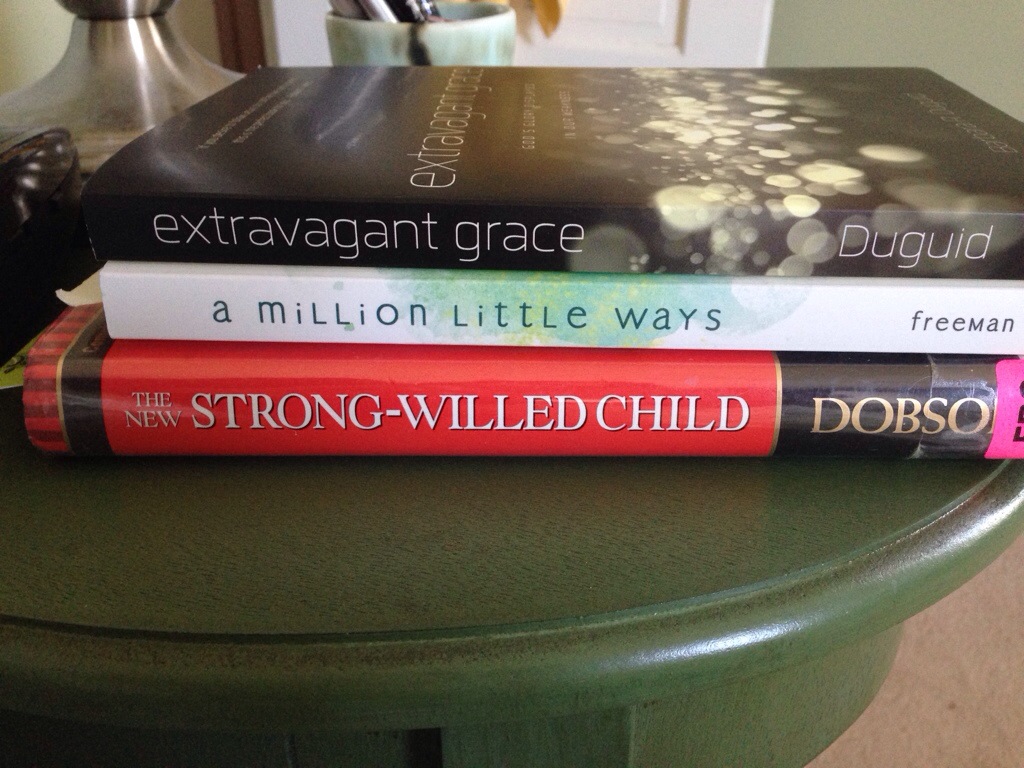
20140227-134653.jpgIt’s been awhile since I’ve written about what’s on my bookshelf, and as I have picked up two books recently which I absolutely love, I thought that today’s a good time to pick up the “on my bookshelf” series. Without further ado …

1. Extravagant Grace by Barbara Duguid is one I haven’t yet started. But I have heard so many raving reviews about it, both on Amazon and through friends, that I am featuring it in faith that I’ll also love it. Another reason I’m confident that I’ll love this book is because the author was one of my distance-ed students through the Christian Counseling and Educational Foundation. The class was no easy one – “Counseling and Physiology,” taught by Dr. Mike Emlet, exploring the connection between soul and body through a variety of counseling situations including bipolar disorder, OCD, and depression. Her papers were the top of the class – beautiful writing, grace-infused, thoughtful and our emails back and forth were characterized by the same gracious quality. I cannot wait to read an entire book by her. Want to join me? Leave a comment – and/or send me your thoughts/review for a future post (counselinginhope[at]gmail[dot]com).

2. A Million Little Ways by Emily Freeman is no surprise to those of you who have been following my blog for at least the past year. I loved Grace for the Good Girl (it was my #1 for favorite books read in 2013), and this one is following suit. Her honest writing and poetic invitation to “uncover the art you were made to live” is compelling and finds me (yet again) right where I am in life. It’s in the category of “books I wish I had written but someone beat me to it.” I hardly know where to begin, so here are a few of my favorite quotes so far:

Perhaps those who make art in the ways we traditionally think of art give the rest of us a framework from which to live our lives. They offer a gift of knowing what life could look like if it were handled more like a mysterious piece of art rather than a task-oriented list. We may not all have the same skill or training as do the painters or the musicians, but we all bear the image of a creative God.

…being an artist has something to do with being brave enough to move toward what makes you come alive. … Art is what happens when you dare to be who you really are.

For me right now in this season, I’m seeing that nurturing my art and moving toward what makes me come alive has hundreds of applications including:

  • being brave enough to say “yes” to speaking at a women’s retreat or teaching a difficult passage of Romans at our women’s Bible study
  • being brave enough to say “no” to what isn’t my art or to distractions from the art of living
  • blogging even when I doubt I have anything new to say
  • taking time and space to BE with my family and friends and listen to their stories and help them make sense of them, or at least let them know I want to be with them there in the midst of the confusion or the joy or the sorrow
  • stopping the tendency to schedule-to-the-brink-of-every-hour so that I can have an afternoon where I enjoy my children, laughing at their preschool jokes and delighting in their imaginative play and reading stories with silly voices

3. The New Strong-Willed Child by Dr. James Dobson. The title truly says it all. I love my daughters dearly, but parenting them has been one of the biggest challenges of my adult life. I think simply being three-years-old and being twins qualifies them for strong-willed, because that’s how it feels when they conspire on some new “project” that results in a mess (like using diaper cream to “paint” their nursery or writing their “signature” on every item of white furniture using red marker – thankfully the washable type). They’re spirited; they’re stubbornly independent; they want their way all the time. Kind of like me. In the first few chapters I’ve read, I think there will be many good nuggets of how-to’s as well as insight and understanding into what to expect of them and what makes them the way that they are. If you live locally and want to read along, let me know! I mentioned this book to another friend, so we may end up doing a one-shot book club in a few months …

Ok, back to reading!

wisdom starts with listening

I am preparing for a retreat I’ll be speaking at in a few weeks on the topic of wisdom (a slight modification from the one I did in September 2013 at WRPC), and I am struck again with how important listening is. I’ve been looking at the verse in James 1:19 which says –

“Know this, my beloved brothers, let every person be quick to hear, slow to speak, slow to anger …”

Whew. There’s the trifecta of what I’m not good at. I am slow to hear, quick to speak, and quick to become angry. Just come be a fly on the wall any morning in my kitchen to see my folly on full display. It happens with regularity. One of the twins begins demanding something (they take turns with this, I swear); I get frustrated because I’m already busy trying to do something else they were asking/demanding the minute prior; and I don’t hear them or pay attention. I am quick to spout off with how frustrated I feel; and then it becomes full-blown anger before too long. Refrigerator doors are slammed, their food is slapped onto their plates with vehemence, and I become the martyr-mother-with-a-cause. Not only am I far from a picture of serving with love, but I am empty of self-control and wisdom. My reaction causes theirs to intensify. And so we sit down to eat breakfast as three very foolish women, one who’s old enough to know and act differently.

How do I get wisdom in that scenario? What is my hope? It starts with listening. Being quick to hear God’s voice of love and the truth of His presence and acquired wisdom given to me down from the ages. I need to learn to be quick to hear his compassion for me, the tired-in-the-mornings mom who needs her coffee and doesn’t wake up quickly. He is speaking to me through the “wisdom of the ages,” which often sounds like this:

  • Stay calm, and they may not become calm immediately, but at least you won’t escalate things.
  • You can only be in control of you; don’t try to be in control of them. Realize what you can control, and provide consequences calmly. Such as sending the tantrum-ing three-year-old to her room until she can calm down.
  • Catering to their demands will only increase their whines; so will blowing up in frustrated anger in the face of all their complaints.
  • Look at your own heart – you’re just as whiny and demanding of those around you and God, but you’re just better at masking it.
  • Continue to serve with love, confident that God sees the faith it takes to continue to do so when bombarded with two demanding preschoolers.

Once I silence my own angry demands in order to tune in to the wisdom of the Spirit speaking to my heart, then I am able to move on to speaking what needs to be spoken, and slowing down my anger. It really is a self-perpetuating cycle. Start with being quick to anger, the words will spill out too quickly for anyone’s good, and there will be no listening. But reverse this and begin with listening. Then you’ll be calm enough to speak and you keep anger in its place. The question really is who I am listening to – if it’s my selfishness, then I’ll be quick to speak and get angry; if it’s my Creator, I can afford to be slow in speech and allow his words to mollify my angry heart before it spews onto another.

Countdown to 2014: top 10 books read in 2013, part 2

The countdown continues from yesterday. Without further ado, here are the next three:

goodreads.com

#7 Gospel in Life by Tim Keller (2010)

Our community small group from church did this study together this fall, and it was excellent in every way – from the “homework” to do on your own each week to the DVD we watched together and discussed each week. We were challenged to see how faith in the life, death, and resurrection of Jesus Christ should make a difference in our hearts’ affections and attentions, resulting in a changed perspective in our work so that we would make noticeable, positive differences in our neighborhoods and cities. Keller began with the thought-provoking idea that as much as our cities need the gospel,  we Christians need the city in order to more deeply and fully live out the gospel in our own lives (through meaningful engagement in the issues of our city, especially regarding mercy and justice). Well worth a read!


goodreads.com

#6 Seven by Jen Hatmaker (2012)

This book talks about ways to be engaged in social justice and pursuing less – rather than the “more” I assumed I’m entitled to when I live by the American dream.  Hatmaker takes readers along on her journey through seven radical experiments of “less is more” including these particularly hitting-close-to-home areas for me: clothing, waste, spending, and technology. I wish I could say that I’ve continued to live up to these ideals she discusses, but I haven’t. What I have started is being mindful about small choices in all areas, and to begin considering how to make “less” on earth translate into “more” for the kingdom of heaven. I probably should re-read this one every year to be shocked out of my comfort zone and reminded of a bigger perspective. 

One quote from her that bears repeating (from my initial reflections when reading this book earlier this year):

Jesus’ kingdom continues in the same manner it was launched: through humility, subversion, love, sacrifice; through calling empty religion to reform and behaving like we believe the meek will indeed inherit the earth. We cannot carry the gospel to the poor and lowly while emulating the practices of the rich and powerful. We’ve been invited into a story that begins with humility and ends with glory; never the other way around.

goodreads.com

#5 Carry On, Warrior by Glennon Doyle Melton (2013)

Not many books are laugh-out-loud funny, deeply insightful, and thought-provoking all at the same time. Glennon has done this beautifully in stories from her own life that are real and honest and brave, as she calls her readers to do the same. “We can do hard things,” is a favorite line that I need often, and that I try to give to my daughters, too. Equally important, if not more so, is how she talks about the practice of being kind (in contrast to how we often teach our kids: “be right! at all costs! no matter who gets in your way!”). My friend-in-real-life who’s also a talented blogger, Mary, gave a favorite review of this book on her blog here


Stay tuned for more of the countdown tomorrow …


Countdown to 2014: top 10 books read in 2013

Those of you who follow my blog and know me in real-life know this about me: I love to read and am constantly reading something. The books I finish compared to those I start is a bit disproportionate. I am usually reading at least 5+ books at any given time, of various genres and topics – parenting how-to, Chrstian faith, marriage, counseling, fiction, cultural reflections, etc.

My goal for 2013 Goodreads was to read 40 books this year. And wouldn’t you know, out of all of my 2013 resolutions, this is the one of the *few* I completed (ok, maybe it’s the only one completed). So I thought it would be fun to do a countdown to 2014 of a review of my top 10 books read in 2013. Without further ado – here are #’s 10, 9, and 8:

#10 – Bringing Up Bebe by Pamela Druckerman (2012)

Expect to be challenged if you are an American parent reading. Expect to laugh out loud and also scratch your head at how different French parenting is. And expect to be insanely jealous about how well-behaved French children are described to be. For example, take Druckerman’s observation that all French babies “do their nights” (meaning sleep 8-9 hours at a stretch) by 4 months old, at the latest. And that they know how to eat multiple course meals in public as toddlers tantrum-free. Then there’s the idyllic “creche,” a government-subsidized childcare option for ages 3 and under that’s a far cry from our public daycare systems. They serve the children 3-course-meals including a “cheese course,” that are prepared by in-house chefs who take great pride in their meal plans. This book made it to my top 10 list because of what an entertaining, informative, and thought-provoking read this was in our American parenting culture that seems too characterized and defined by competition, comparison, and perfection (expected both of ourselves and our children).

photo credit: goodreads.com

#9 – Making the Terrible Two’s Terrific by John Rosemond (1993) [note-I just saw that there’s an updated version from 2013 available here. I’m sure it’s even better than the original!]

The best book I’ve read on specifically parenting two-year-olds, of which we had TWO for over half of 2013. (And to be honest, I haven’t found age 3 to be that much easier yet …!). He’s down to earth and practical and keeps in balance a parent’s authority and the developmental reality of age 2. Such as saying it’s more about “containment than correction” at this age. It’s made me think of how I can be more proactive in parenting instead of reactive. He gives a variety of suggestions for parenting and natural consequences that I found helpful to implement (not easy but helpful to at least have a game plan!).

#8 – Desperate by Sarah Mae and Sally Clarkson (2013)

What a great book on motherhood that balances both its reality and joy! I appreciated hearing the two stories weaved throughout of Sarah Mae who’s “in it” (with 3 young kids) and her mentor, Sally Clarkson, who’s been through motherhood (and thrived).  Sarah’s perspective resonated with me since this is where I am, too, and it gave me hope to hear of someone struggling in motherhood in similar ways (while loving her children). Reading of their interaction gave me a vision for being this type of mentor when I am out of this young kids stage, and it reminds me that the first steps to take when feeling desperate as a mom is to admit you are and to reach out for help. I am thankful for so many mentors and fellow young moms past and present who have been there for me in these moments of desperation to remind me that I am not alone. Reading this book in the beginning of this year when I did feel more desperate than I do today was a significant part of helping me to carry on. (speaking of that last phrase “carry on” … ok, spoiler alert for the next segment!)

what keeps me from creativity

In reading through Brene Brown’s book, The Gifts of Imperfection, her chapter on creativity was particularly thought-provoking and inspiring. [The mark of a great author is to do both, and Brown does this so well!] I began last week with my thoughts on “why a non-crafty mom needs creativity” and wrote it as “part 1” of my creativity thoughts. Here is part two.

First, my experiments with creativity over the past week:

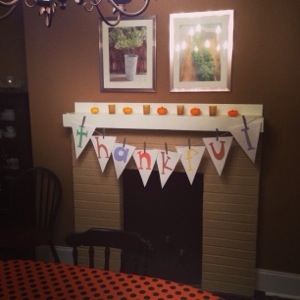
a “thankful” banner for this Thanksgiving season20131030-142731.jpg

I ventured into the mess; bought craft paint for my girls to paint a pumpkin with; and let them go to it. We all had fun, and the mess was less than I thought it would be.

I also bought glue sticks for them. (yes, small step – but really a big leap forward for me) They are the look purple-dry clear type. Which meant my girls used them as paint. And while I sipped my morning coffee on Sunday, I looked up to find purple glue everywhere. On the tile floor, on the refrigerator … you get the picture. I was reminded why I often don’t venture into the arts and crafts realm with twin three-year-olds. The good thing is that they’re old enough now to consider it fun to clean up their mess. Which they did.

And then perhaps a less conventional expression of creativity happened when I stuffed the dirty pots and pans into the kitchen cabinets because I had 12 dinner guests from my neighborhood bunco group arriving in 2 minutes. When I texted my mom this picture, she said – “See, look! You are creative, Heather!”20131030-142809.jpg

But back to my original question – of what keeps me from creativity? Fear of mess is an obvious one, but that really isn’t the main obstacle. Brown speaks about creativity’s opposite as depression. And quite frankly, I think that depression can cause lack of creativity just as much as lack of creativity can cause depression. One is a symptom of the other. The motherhood season between 18-month-old and two-and-a-half year old twin girls was not my favorite. Along with living what felt like a depressed version of myself, there was an accompanying lack of creativity. Survival seemed to be all I could do day-in and day-out, trying to muster up enough energy to make it till naptime was my daily goal. Creativity? Forget it! I couldn’t even “creatively” choose anything besides the same exact lunch every day.

Yet slowly, surely, quietly, step-by-step, God brought me out of that hard season. And as depression dissipated, I noticed the resurgence of creativity. In small ways, like being spontaneous instead of needing to plan every minute of every day, and in returning to life-giving creative pursuits. For me, highest on that list is writing. And so I began to blog regularly, starting with my personal June challenge of daily blogging inspired by Grethen Rubin’s The Happiness Project. As I wrote more, I began to notice and savor life and those I love more. And then I had more to write about, and on and on it goes …

The one thing that still can threaten my creativity is what Brown identifies as the trap of comparison. When we begin comparing to others, we cease creating. I feel either false pride in being “better than” or (way more often) paralyzed by my perception of another’s creativity as much more inspired/better/talented than mine. Take this small example of doing a group craft project at a friend’s house a few weeks ago. We were painting wooden spoons, using painting tape to make stripes/etc. Overall, I had a great time. Making art is fun; getting to chat with other friends while doing so – even better. But then the insidious lie of comparison crept into my head. I looked at the other spoons and concluded that theirs were better – more creative – more beautiful. Mine just seemed so … plain. 

How ironic that is was the day after, in my “post-comparison hangover,” that I first read these words that Brown wrote in reflecting on how creativity slowly dissipated in her home as her parents shifted focus from living to acquiring:

My parents were launched on the accomplishments and acquisitions track, and creativity gave way to that stifling combination of fitting in and being better than, also known as comparison.

I’ll close here for today, as a poignant reminder to us that begs the question: am I focused more on fitting in with others or creating as an outflow of who I am, where I am?

why it’s hard to find lost things

Yesterday was a Monday in every deserved aspect of that oft-dreaded day. It began with lots of whining and tears and complaints (mine and theirs, at least the complaints). In my attempts to herd us out the door to get to the grocery store, we kept losing things. Shoes and socks that seemed to be mysteriously repelled by my daughters’ feet. The favorite shirt we/they wanted to wear. The water ink pen which is a “necessary” in-car entertainment. When calling my husband to vent, I absent-mindedly touched my earring – and realized the pearl was gone. He had given me this set of pearls to celebrate a birthday and the pending birth of our twins. A pearl could be anywhere! So then, naturally, the next thing I lost was my temper. If only I could never lose that in response to all the lost things.

When I calmed down, and could think and breathe at last, I began thinking about why lost things get me so much. It’s more than the fact that we seem to always be looking for something lost these days – the beloved lovey that we looked for in every aisle of the grocery store yesterday, for instance, only to find that it was safely at home after all – but it’s how much TIME it takes to find what is lost. It takes time. A lot of time. Patience. Detailed searching, often. And I don’t have much patience naturally. I feel like I have less time. And I am not a girl who loves details.

But in this calling as a mom to three-year-old girls who have beloved objects, short memories, and a propensity to misplace those objects, I am also called to search for lost things often. Probably daily is not too much of an exaggeration. Love for my girls means that I’ll search for what they love even if I don’t share their valuation of it. This kind of looking for lost things doesn’t come naturally for me, as I’ve shared above. And yet I think it’s one of the small sacrifices of motherhood – to take the time necessary to look for what’s lost.

In so doing, I am imitating no less than God the Father’s love for me and for all of us who are lost. He takes time to search me out; to find me. He used the parable of finding lost things to describe what his heart is all about – what the Kingdom of God is essentially. A lost sheep, a lost coin, two lost sons in Luke 15 tell the story to answer the complaints of the self-righteous grumbling about why Jesus spent so much time with those who were so obviously “lost.” In all three stories, there is much rejoicing and celebration when what is lost is found. Jesus is inviting the self-righteous to not only join in the celebration of those lost being found but also to join in the search of the lost. And the place this begins is realizing they, too, are lost. The last story of the prodigal son illustrates this so vividly. It ends abruptly with the father of the story inviting the older brother to celebration (he’s angry over the party for the younger prodigal brother who’s returned home). And it leaves us hanging. What happens next? We don’t know. It’s a question the self-righteous need to ask and then to answer. Will I come in, counting myself as a lost one found by my Father and thus able to rejoice when another lost one is found? 

Why don’t I think I have time to search for lost things? Sad to say, I haven’t even looked for the lost pearl earring for yesterday. What kept me from it?

  • I doubt that it can be found.
  • I don’t know quite where or how to look.
  • I’d rather spend time doing something else.
  • As valuable as the earring is, I know that it is replaceable.

My daughters with their lost loveys have a lesson to teach me, yet again. For the Kingdom belongs to such as these [children]. In the face of my unbelief, they remind me:

  • To have confidence that what’s lost will be found
  • To start looking wherever you are now
  • When something’s lost, that IS your #1 priority until it’s found.
  • What’s lost is irreplaceable.
  • There is no rejoicing like the joy over finding what’s lost.

Oh, that I’d share their passion and confidence for finding lost things when it comes to searching and finding for my lost peace of mind, for a lost friendship, for a world that’s lost its way. And maybe I could find a lost pearl earring as I do so?

an open letter to my daughters: reflections on three-years-old

To my favorite girls ever,

It’s hard to believe that our lives together began three years ago (yesterday) in a hospital room where you were delivered remarkably fast after 10 weeks of bed rest and waiting and hoping you wouldn’t arrive too early. You came right on time, 35 weeks and the day after I said to a friend, “I just don’t think I can wait much longer. I’m big,uncomfortable, and bored.” Well, now. That was certainly the last time I said I was bored (no comment on the other two). The past three years have been anything but boring. Four days after you were born, when we were nicely settled at home, you girls had to head back to the hospital for a week to gain weight and stabilize. It ripped out my mommy’s heart to watch you being poked and prodded, and to only be able to touch you through the holes of an isolette. Even the word itself is so isolating. You both rallied under the watchful, kind care of the nurses and doctors at CHKD, and that week allowed me to get a little bit of rest (a whole 5 hours each night) and to manage my post-partum pre-eclampsia that had caused me swelling, fatigue, and increased blood pressure. My mom and OB/midwife took care of me while I tried to take care of you, and Daddy tried to take care of all of us. And finally we were all home (again).

Then begins the happy-yet-exhausting blur of the next six months of feedings, pumpings, diaper changes, middle-of-the-night smiles, little laughs, gazing into each other’s faces, learning each other. Lots of help from grandparents, aunts and uncles, our church community, and faraway friends who showered us with prayers and welcome gifts. And then you were six-months-old, and it was time to teach you to sleep through the night (ugh) and for you to be baptized (beautiful).

The next six months were a bit calmer; and I blinked and you were turning one with a ladybug party; and I blinked again and you were walking and talking and throwing tantrums and getting into trouble and I felt overwhelmed. The period of time between 18-months-old and 2 ½ years old was not my favorite, I’ll have to admit. I felt quite out of my element; baffled by all of the advice from different approaches on all of the variousmajor transitions you were experiencing (together): transitioning out of a crib, dropping the morning nap, potty training, solid food, becoming independent thinkers, developing wills of your own that were tested in opposition to mine. And I felt all of this more intensely because I tried to do too much. I was missing “life before kids” and the time when I felt “sidelined” during pregnancy and the first year, and I tried to jump back in too quickly. That didn’t help my dilemmas and my exhaustion and my anger in response. I needed space and quiet and rest. Soul rest. Heart refreshment, but I wasn’t sure how to get it in the 60-90 minutes you might simultaneously nap in a day.

And so God rescued me, a long and slow process during the past year or so.* You have been very patient with me, often much more so than I’ve been with you. You have been quick to forgive me when I’ve blown it yet again. You have accepted the times when “Mommy needed a break” and I escaped into a coffee shop or my room or a friend’s house for a chat, to write, to read, to breathe and exhale and make sense of me as a mom and you as my daughters. I began saying “no” to things outside of my main calling to be your mommy and Daddy’s wife. I had to remember. To bring life into focus again. To say “yes” cautiously to what God was leading me to instead of jumping in toescape what felt difficult at home. And I learned to say “yes” to what I needed from God to be refreshed so that I could say “yes” to being the mommy you needed. A mommy who wasn’t angry all the time and frustrated constantly. A mommy who, instead, sought to lean in to this stage of unpredictability, to trust God as the one controlling my time, to listen to God and to you and to friends, to go slower and be more intentional. A mommy who’s learning that writing helps me process and savor these days with you, days that do go by fast when glanced at retrospectively in terms of years but which sometimes seem to creep along immovably when experienced as minutes on a sick homebound winter day. For both the fast and the slow moments, there is grace. Amen, Hallelujah, and Cheers. Here’s to the next 30 years together …

Love,
Mommy

*posts that describe this process more fully:

Confessions of an Angry Mom, part 1, 2, & 3
A Prayer for Potty Training
Tears and Transitions
For the love of poetry
Identity lessons from “Angelina Ballerina”
The one voice that matters most
Mind the gap

on the eve of preschool

Tomorrow. Tomorrow it begins. Enter the song from “Annie,”

Tomorrow, tomorrow,
I love you, tomorrow;
you’re only a day away!

Tomorrow my almost-3-year-old twins will enter preschool. This DAY I’ve longed for, that felt too far ahead into that distant Future which I couldn’t see through the hazy, sleep-deprived gaze of newborn days and toddler tantrums. Friends who’d journeyed there said the oft-repeated and often-frustrating-when-you’re-in-the-midst-of-it cliche of, “the days are long, but the years are short.” I find myself repeating that phrase myself to friends with weeks-old newborns, who are struggling with finding their way through the maze of feedings, advice, sleep(lessness), diapers, and colic. I’ve said it to friends who are still a few months away from welcoming their first babe into their hearts, and who feel alternately daunted and excited by such a venture.

As I thought about this post, I wasn’t sure whether to camp out in nostalgic-how-did-my-babies-get-so-big, or to join Glennon in the ranks of “hallelujah! Free at last!” I offer my story, which is a combination of both. Only this morning, I have felt both extremes. When my blue-eyed blonde beauties look up at me and say, “I love you, Mommy!” followed by a melt-my-heart hug; when one says, “Daddy is my best Daddy ever!”; when I see them creatively playing and sweetly cooperating with one another, I think that I am going to miss this. Granted, I will still have plenty of it (they’re only going two mornings a week), yet I know this is sort of the beginning of School. We are probably not going to go the homeschool route personally (and I have great respect for those of you who are), so School will likely mean that the next 15 years will include fostering their academic pursuits outside of the home. That’s terrifying when I realize that I am giving over the reigns of control to someone else, even for six hours a week. Will they be ok? What will I miss in terms of small moments you can’t capture? What if they are holy terrors for their teachers or their fellow students? [disclamor: I have no reason to believe that they will be since they are always MUCH better behaved with those other than us … but you never know …] Who will help her if she can’t figure out how to get her lunchbox open or if she skins her knee? Can I bear the thought that it will be someone besides me?

Well, yes. I can if I remember the part of me that can’t wait for tomorrow. I am looking forward to preschool because I want them to learn to play with other kids, to do wildly messy and creative art projects that I won’t have to clean up, to learn to be under another authority besides me, to be guided in their curiosity about this world by teachers trained to do so. This sounds quite noble, and I wish I could stop there. But I won’t. Because I bet there are others out there who, like me, also cannot WAIT for the break. The break from being a referee/personal chef/activities director for two seemingly impossible to please toddlers. Parenting has been as much my journey of finding out who God’s made me as it has been nurturing my children into who God’s making them. And a few things I’ve learned about myself these parenting years set me up for preschool being a lovely break at precisely the right time:

  • I don’t enjoy arts and crafts. In theory, yes, but the actuality feels too messy and frustrating most of the time.
  • I’m not naturally a playful mom, meaning that getting on the floor and doing lego towers for hours (or even 10 minutes) can feel tiring. I do it still because I love the girls who love legos, but it’s just hard for me. Same reason that I don’t really like playgrounds either.
  • I am most refreshed by time alone or with a few friends with whom I can connect on a deep level. To say that’s been a scarcity in these first three years as a mom is an understatement.
  • I am passionate about what God’s called me to outside of my home, too. I enjoy teaching women the beauty of the gospel found in God’s Word; mentoring younger women in their faith journeys; counseling those in difficult places; and writing. The freedom of two mornings a week without my children will free me up to pursue these a tiny bit more than I’ve been able to before now.
  • I am a better mom when I have a regular break to anticipate and in which to find refreshment. I’m not saying that God has not met me in the midst of the trenches of these past few years, but I am saying that I’ve found that I am able to love my husband and children better with regular breaks. This may not be your story, but this has been mine. And I suspect there are many of you in the church especially who have not felt free to admit this. Admit it; ask for grace in the midst of each day; don’t demand breaks in order to be a better mom but DO take breaks as you can, for spiritual and emotional refreshment. Take a break in order to re-engage those God’s called you to in self-sacrificial love.

Will I be a tearful mom tomorrow as I send off my big girls with their tiny backpacks? Of course. Will I be a joyful mom who will feel like three hours is a blissful luxury not to be squandered lightly? Equally so. I expect crying and rejoicing to each be present in this mom’s heart. And for both aspects, I am thankful for a God who weeps with me and rejoices with me and who goes with me and with my daughters as we’ll part for three hours. I imagine that I’ll blink and be writing a similar post about college. Oh my. That may really get the tears going, so I’ll stop while I’m ahead.

laundry and grace

I fold laundry
in my weary attempt
to organize my thoughts
hoping they will be sorted
so easily
into piles

tidy, categorized by type
with shelves, drawers, or cabinets
to call home
and rest there
till they’re needed.
Then back through the cycle
of use, wash, dry, fold, return.

Is this what your grace is meant to do?
Restore, cleanse, sort out my heart
When I am used up by love?