beauty in darkness: what’s good about Good Friday

Another repost from a year ago. It still stops me in my tracks to slowly traverse the painful path filled with shame unimaginable – and to realize that Jesus walked this path for ME. For me who too often tramples on the gift of redemption I’ve been given by taking it for granted, or thinking that I did something to earn it. Love led him through the agony we remember today. Don’t forget that love is behind all of the horror of “Good” Friday. (And don’t forget that our sanitized, decorative crosses are far from its original horror – public execution of the most shameful kind.)

***

I had skimmed over the verse countless times in the 30+ years I’ve read and meditated and studied this familiar account. Good Friday is the time to read the crucifixion story. A story of horror turned beautiful. Yet if you’re like me, too often I jump to the “turned beautiful” part without staying with the horror of what Jesus endured. It’s uncomfortable to sit with the events that culminated in the most gruesome of deaths on a Roman cross. But this week – this Holy Week – asks us to do just that. To sit. To see. To hear. Because in the horror, we are saved. We are deserving of all that the King of Glory endured innocently. And we who bear his name are called to endure similar suffering for the sake of love. Love enters into the messy, the broken, even the so-gruesome-you-can’t-bear-to-hear-it and Love takes it. Love endures. It does not run away. It stays. It shows up.

What feels impossible for you to endure today (and yet you must because of Love)? How can Good Friday become truly “good” for you today? What brokenness do you run from in your own heart and in the lives of those around you?

In my calling as a counselor, I often sit with those who have endured stories of abuse that are too difficult to name. And to think that what I have a hard time hearing is what they lived through. Well, that causes you to pause. To pray. To beg for redemption, for healing, for a Justice to make it all right. 

On Good Friday, we are given just that. Not only in the cross, but in the events leading up to the cross. Here’s the verse that stopped me in my tracks this morning (from Matthew 27:27):

Then the soldiers of the governor took Jesus into the governor’s headquarters, and they gathered the whole battalion before him.

Do you know how many soldiers are in a battalion? I didn’t either, so I checked the footnote and saw that a battalion is “a tenth of a Roman legion; usually about 600 men.” 600 men. Quite different than movies who portray this portion of the scene with a couple soldiers kicking Jesus around. That’s bad enough, but this has an arena quality to it. 600 soldiers. That’s a very full auditorium hall. And what did they gather to do? Well, read on:

And they stripped him and put a scarlet robe on him, and twisting together a crown of thorns, they put it on his head and put a reed in his right hand. And kneeling before him, they mocked him, saying, ‘Hail, King of the Jews!’ And they spit on him and took the reed and struck him on the head. And when they had mocked him, they stripped him of the robe and put his own clothes on him and led him away to crucify him.

Utterly shameful. Shameful if it’s an audience of one, but for these horrors to happen before an arena-size audience of 600? Shame magnified. Shame too great for words. Twice he was stripped of his clothes. In addition to the emotional abuse of this mockery, there was the physical abuse of being “crowned” with thorns and beat on the head with a reed. What is striking is Jesus’ response. Nothing. The one who was God incarnate – who could have called down fire from heaven to devour these fools – stayed still and endured. That is the miracle. The miracle that turns bad into good, abuse into redemption, mockery into honor.

Centuries before, a prophet called Isaiah wrote about this and puts words to the what and the why of all that Jesus endured on “Good” Friday:

Surely he has borne our grief
and carried our sorrows;
yet we esteemed him stricken,
smitten by God, and afflicted.
But he was wounded for our transgressions;
he was crushed for our iniquities;
upon him was the chastisement that brought us peace,
and with his stripes we are healed. …
He was oppressed, and he was afflicted,
yet he opened not his mouth …

Because Jesus did not open his mouth when enduring abuse, we can open our mouths and beg for healing and redemption. Healing from our own abuse and from the ways we have abused and oppressed others through our sin – through our brokenness seeking false healings.

In the place of your abuse, there is healing. Because he took the shame for you.

In the place of my sin, there is peace. Because he carried the guilt for me.

In the places where you and I have been silenced, our voice is restored. Because his was silenced this Good Friday.

So go. Walk as one who is healed, who is at peace, who can speak up and speak out and speak of darkness turned beautiful on this most good of Fridays. 

Holy Week: Wednesday (and a repost from 2013)

Everything I wrote two years ago is still true. Not the specifics of my Lenten fast, but my heart exposed through the season of Lent. I offer it to you again as a call to repentance, an invitation to come and feast on the good news of a body broken for you and a body raised to life for you during the next concentrated days of Maundy Thursday and Good Friday.

****

Lent.

The period of 40 weekdays that in the Christian Church is devoted to fasting, abstinence, and penitence.

I chose what I thought would be four hard but do-able items for my Lenten fast this year. Call me an overachiever, or more accurately, an over-estimator of my own strength. A month ago I posted about my hopes for Lent. How hard could it really be? And how refreshing and empowering could it be! In taking away many of my heart’s distractions – phone apps, Target, sweets, t.v. – I assumed that God would replace my heart’s misplaced affections with a renewed love for Christ and the people around me.

About three weeks in, I broke Lent. Fully and completely. Not just one day, but I think it was about every day of the week and I broke every single “fast” multiple times. I rationalized why for each of them.

  • Going to Target will help me stick to our family budget on some key grocery items like Kashi cereal and goldfish.
  • “Non-essential” phone app category expanded dramatically. I started Lent with 6 icons on my home screen that I deemed “non-essential.” I’m ending Lent with twice as many.
  • Television is the only way that my husband and I can really share down time together after busy days in the midst of a busy week
  • I really just “need” a quick pick-me-up. Nothing like a bite of chocolate to do that.

My response to breaking Lent? First, my typical pull-yourself-up-by-your-boot-straps approach: “Just try harder, Heather. Get it together. You can do it!” As this failed, I descended to self-blame, punishment, guilt and shame. “This is really not that hard. There are millions of people in the world who LIVE without these things daily, and you can’t just go without for 40 days?? What is wrong with YOU?” That also got me nowhere fast.

And then I realized that maybe this is the real purpose of Lent. To reveal (again) that I cannot fulfill the Law. Any law – of God’s eternally perfect law, other people’s expectations, or my own standards. Maybe Lent is meant to show me how little I can do in my own strength, and therefore how MUCH I need Jesus and His life, death, and resurrection that we celebrate at Easter. Truth echoed in these verses from Romans 3:19-20 –

Now we know that whatever the law says it speaks to those who are under the law, so that every mouth may be stopped, and the whole world may be held accountable to God. For by works of the law no human being will be justified in his sight, since through the law comes knowledge of sin.

Breaking Lent is one way that the law breaks me. It’s a beautiful breaking, for it leads me to the One who restores and makes new. If I didn’t practice a Lenten fast this year, I would be that much less aware of my helplessness to gain eternal life and a relationship with God on my own strength or efforts. And so, in an upside-down backwards way, breaking Lent has broken me of trying and pointed me in desperate hope to Jesus whose death we remember this week and whose life we celebrate next Sunday. Listen to this hope found in Romans 5:6 and 21 –

For while we were still weak, at the right time Christ died for the ungodly. … so that … grace also might reign through righteousness leading to eternal life through Jesus Christ our Lord.

As we round the final corner of Lent, walking into Holy Week’s somber reflections, let us remember that we cannot earn Easter on our own merit. Our best trying leaves us hopeless. Let us fall in our weariness and allow Jesus to pick us up and bring us with Him to the cross and then the hope of the empty tomb this week and always.

Holy Week: Monday

It sits just on the other side of triumphant Palm Sunday, and days before the remembering, mourning, and celebrating of Thursday through Sunday. It can feel lost – this “Holy Monday.” (And is that an oxymoron? How can Monday ever be holy? More often “mundane” is an adjective of choice.)

I wonder if “Holy Monday” (and “Holy Tuesday” and “Holy Wednesday”) are needed so that our hearts are ready for the sobriety of Maundy Thursday and Good Friday. For something shifted in the crowd who welcomed Jesus with palm branches waving, surrendering their outerwear as a pathway for their donkey-saddled King. Something shifted between this “Triumphal Entry” and the angry crowds begging for his execution on Friday. It was the overlooked days of “Holy Monday/Tuesday/Wednesday.”

The days when I overlook – or fail to look – at my king, humbled and riding on a donkey, but riding nonetheless TO ME; the days when I overlook the tears Jesus wept over this city (and symbolically, over every city in which any of us dwell); these days are the ones when my heart can go rogue. It slips out beneath my notice and goes after its old lovers. The ones promising quick satisfaction without waiting for long promises to be fulfilled. The lovers who tell me I’m beautiful (especially if I use their line of clothing and beauty products). The ones who lure my restless heart with excitement and adventure (forgetting to highlight the fine print warning of: use only at great risk to your soul). It was these false lovers who won over the hearts of the crowds in the four days between Palm Sunday and Good Friday. The false lovers were clothed in religious garb. They planted questions like –

“How dare he claim to be the Son of God? Who does he think he is?”

“We were promised a Messiah to rescue us. We are still under Roman oppression. Jesus cannot be the promised one.”

“This Jesus is not what we really want. He is working too slow – or not at all.”

And these same religious leaders were at work behind closed doors making deals with an insider who would betray Jesus (Judas). They were plotting his death while the crowds went about their business on Monday, Tuesday, Wednesday, and Thursday. They were stirring up the crowds, with insidious doubts at first and then with explicit commands.

Holy Monday can become “Holy” only when I first admit how similar I am to these fickle crowds. I want a king who comes on my terms, to deliver me in my way, and to make me powerful with him. A king who calls me to follow after him, deny myself, and lose my life to save it? No, thank you. I think I’ll go find someone else. Holy Monday becomes holy when I look at the God who has won me wholly. Even (especially) in the days when my heart feels prone to wander.

A Lenten prayer: prone to wander

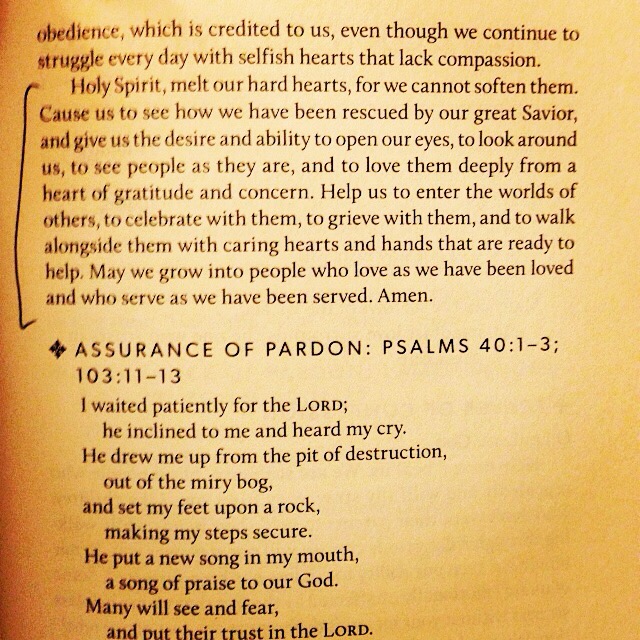
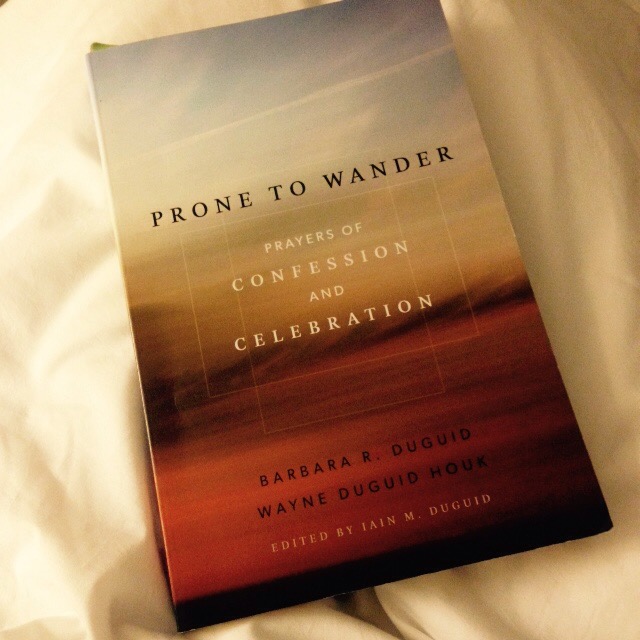
This prayer is from a favorite book that I “happened” to be gifted with by dear friends just as Lent was beginning: Prone to Wander, by mother-son co-authors Barbara Duguid and Wayne Houk. I have found its call to worship, specific gospel-saturated prayers of confession, and then assurance of pardon to be spot on for my heart this Lenten season (and really any time!). I also love that there are suggested songs listed at the end of each entry. It’s been a personal worship guide – although written to be for a church, there are multiple uses to be sure.

And having some bit of personal interaction with both Barbara and Wayne through CCEF courses we’ve been a part of together makes the writing sing even more so. They are both tremendously gracious, and incredibly gifted at putting gospel truth to words.


from contentment and celebration to complaining and despair

photo from zionsvillelutheran.org

photo from zionsvillelutheran.org

Isn’t it always like this? Our grandest moments of life, faith, work, are closely followed by our biggest days of struggle. I think about Jonah after he experienced an epic personal rescue from the belly of a big fish, and watched God convert an entire city (Nineveh) through his preaching. The book ends with a story of the prophet’s suicidal despair because a worm ate a vine that was sheltering him from heat. It’s ridiculous. Crazy, really. And then there’s Elijah. After he watches God send fire from heaven to consume a flood-drenched sacrifice on Mount Carmel in front of a crowd of frenzied Baal-worshipers, he sits under a broom tree in the desert to die. His exact words?

“It is enough; now, O Lord, take away my life, for I am no better than my fathers.” (1 Kings 19:4)

What happened to his bold faith glimpsed just two paragraphs earlier in this prayer?

“O Lord, God of Abraham, Isaac, and Israel, let it be known this day that you are God in Israel, and that I am your servant, and that I have done all these things at your word. Answer me, O Lord, answer me, that this people may know that you, O Lord, are God, and that you have turned their hearts back.” (1 Kings 18:36-37)

What happened is that Elijah and Jonah, like you and me, are human. “Prone to wander, Lord, I feel it/Prone to leave the God I love,” the old familiar hymn goes (“Come Thou Fount of Every Blessing”). I should not be surprised that on the heels of such celebration at the end of last week with the news of Crossway’s acceptance of my book proposal, this week has felt like a battle against petty disappointment and despair. The things I have complained (bitterly) about include:

  • Our coffeemaker that broke on Monday morning [MONDAY morning, of all days?!!]
  • Twins who whine and squabble with each other over silly things, like who gets the red marker [typical for 4-year-olds, although not desirable]
  • Antibiotics that didn’t work as quickly as I wanted them to in healing a bad case of strep from last Thursday
  • A husband’s very long work day, leaving me with more-than-desired solo-parenting duties for my quickly-waning-parental-patience
  • Credit card fraud – at a random WalMart in Tennessee, of all places, for 5 consecutive purchases of $28.77. This alerted our awesome card company, who called right away. But then you have the *hassle* of switching automatic payments, waiting for the new card in the mail/etc etc

All of these could fall under the hashtag #firstworldproblems , or better, #whinymomproblems. Really they’re symptomatic of a heart fixated on self, who feels entitled to comfort and ease all the time. Diagnosing my problems yesterday didn’t really help much. In fact, it probably made it worse. Then I was better able to articulate (and unload in frustration) to my husband why he, somehow, was at fault for all of my frustration.

Ugh. (There’s a poetic word for you.) I have been blind to grace. Blinded to mercy all around me, and worse still, unable to help myself. Feeling paralyzed from taking hold in my own heart of the gospel-hope I can articulate for others through writing and counseling. Enter grace in the form of the impulse to text a friend for prayer this morning when I awoke still seething with frustration and venting it unfairly to my daughters. She then called after we dropped our kids off at preschool (thank God for this common grace!), and we talked each other through our similar frustrating moments, reminding each other of the grace we know is there. I hung up the phone feeling the slightest turn in my heart towards hope again. Hope not that things will get better, or that circumstances will change, but hope that God’s love hasn’t turned away from me in the midst of my sin and struggle and that his grace is yet deeper than my need for it. Amen?

devotionals worth reading in 2015

/home/wpcom/public_html/wp-content/blogs.dir/1bc/1176043/files/2014/12/img_7639.jpgAs this year draws to a close, I am preparing a list of my top 10 books of 2014 (drumroll, please?), as I did at the end of 2013. In the meantime, I wanted to offer you a few recommendations if you are looking for a devotional reading for 2015. What I’m referring to is a resource written to help you understand the Bible and the Christian life, giving you daily encouragement for your journey of faith. I have found a good devotional and a daily Bible reading plan to be essential to nurture my faith. It provides a space for me to bring my questions, doubts, joys, and sorrows; and I know that I am heard by God and through the Bible, God speaks to my heart. Some favorite words on the value of daily time spent in prayer and study of God’s Word from spiritual director and author, Henri Nouwen:

“When we are securely rooted in personal intimacy with the source of life, it will be possible to remain flexible without being relativistic, convinced without being rigid, willing to confront without being offensive, gentle and forgiving without being soft, and true witnesses without being manipulative. … solitude begins with a time and a place for God, and God alone. If we really believe not only that God exists but also that God is actively present in our lives– healing, teaching and guiding– we need to set aside a time and space to give God our undivided attention. (Matt 6:6) … We enter into solitude first of all to meet our Lord and to be with Him and Him alone. Only in the context of grace can we face our sin; only in the place of healing do we dare to show our wounds; only with a single-minded attention to Christ can we give up our clinging fears and face our own true nature. Solitude is a place where Christ remodels us in his own image and frees us from the victimizing compulsions of the world.”

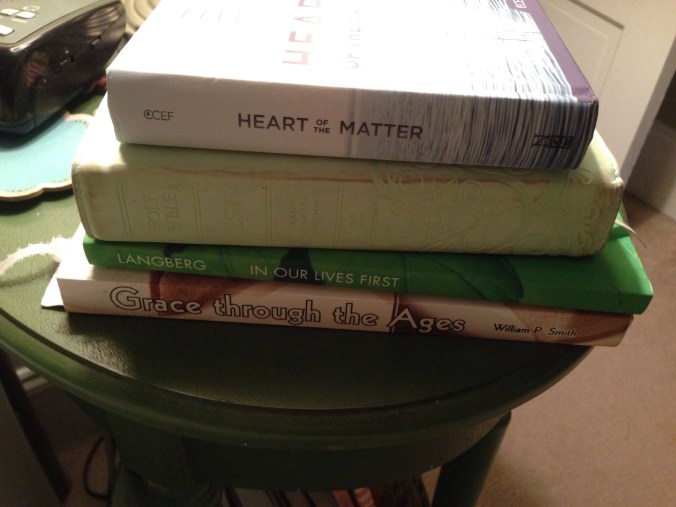
365-day devotionals (note: it usually takes me way more than one year to get through one of these!) –

  • Grace Through the Ages by William P. Smith – I’ve written about this one in the past. It’s incredibly rich, and it’s written by a friend and former counseling colleague and supervisor. I love the way Bill discusses grace, and the way he shows how grace is on every page of Scripture.
  • Heart of the Matter by CCEF – I am planning to read through this one in 2015. I’ve read excerpts here and there. It’s a compilation of writings by biblical counselors who seek to connect God’s Word to the heart.

Topical devotionals –

  • For moms – best one is Jen Hatmaker’s Out of the Spin Cycle. Witty, encouraging, practical, and short. Blessedly short.
  • For counselors/pastors/other helping professionals – In Our Lives First by Diane Langberg. Soul-refreshment that helps carry you in the burdens and dangers of  being on the “front lines” of caring for others.

Yearly Bible reading plans –

  1. A reading from Old Testament, New Testament, and Poetry for each day (you print out the three bookmarks for each section of your Bible – PDF here.)
  2. Chronological Bible Reading Plan – read the Bible in the order in which it was written. I did this last year with my friend Kiran. We both said the downside of this plan is that you don’t reach the New Testament until October though!!
  3. Read Me Bible Plan – similar to #1 above, but without the Poetry section.
  4. Customizable plan here – choose whether to do chronological, historical, or another assortment, and select whether to start on the 1st or the 15th of the month.
  5. 5x5x5 plan – 5 minutes a day, 5 days a week, with 5 suggested questions. It takes you through the entire New Testament in a year. I think I’m going to go through this plan for 2015 since I tend to fall behind a traditional (long) reading plan fairly quickly, and then the perfectionist/performance-oriented part of me feels guilty. When the main point is to spend time reading the Bible regularly so that I can soak in God’s love for me and be equipped to pour out his love to others. If a plan helps you do this, great! If not, find something else. I offer these merely as suggestions and guides.

*note: some affiliate links included (for the books – if you click on them and order them through Amazon, I’ll get a very, very small percentage of your order from Amazon)

freedom in Christ looks like love

After an incredible sermon yesterday on the topic of freedom in Christ and love and limits and knowing the limits of your story and the compulsion of Christ’s love for me, I was reminded of this piece I wrote a couple months ago that I have not yet shared here. So – here you go! And I will return to provide a link to yesterday’s sermon by my pastor once it’s uploaded.

***

When thinking about freedom in Christ, there is no better topic. Who doesn’t want to live free, with wild abandon and throwing caution and reserve to the wind? I think of my 4-year-old daughters running gleefully up and down the beach or dancing in our living room. There is a conspicuous absence of shame that is envious to us “grown-ups” who obsess too much about our appearance and what’s appropriate. Freedom in Christ is our inheritance and our identity as ones redeemed through faith, and yet so often I do not live free but fettered.

I am fettered to your opinions of me, and so I hesitate before speaking truth in love.

I am fettered to freedom of self ,and so I become enslaved to “me time” and my pursuits.

I am fettered to my idols, and so I give time, energy, and attention to the latest fashion or the next material possession on my list.

I am fettered to my rights, and so I refuse to forgive you for how you’ve wronged me.

I am fettered to fear and cannot move beyond what feels comfortable or manageable to me.

I am fettered to pleasure, and so I use you to get what I want (companionship, adulation, social position).

the-broken-chain1What will set me free? And how can I know when I am free? The words of our freedom proclamation in Galatians 5:1 come to mind:

“For freedom Christ has set us free; stand firm therefore, and do not submit again to a yoke of slavery.”

How many yokes of slavery are you lugging behind you today? Do you realize you have been set free (past tense)? All Christ asks of you is to stay in your freedom.

How can you stand firm in your freedom? Does it mean that you stop attending church, or serving, or spending time with people who drain you? It seems for me that to stay free requires that I remember what I am free to do. Which is to love. The church of Galatia must have been thinking the same thing, for Paul writes just a few verses later in 5:13

“For you were called to freedom, brothers. Only do not use your freedom as an opportunity for the flesh, but through love serve one another.”

Paul knows that too often we who try to pursue freedom can quickly become indulgent. I’ve said it myself – “I’m free not to commit to that ministry/those difficult people/that task, so I am going to say no.” There is certainly a place for setting limits – and I’ve had to learn not to be fettered to pleasing people (and leaders in my church) by saying “yes” to more than I could handle. Yet too often, I think of freedom as freedom to do what I want to do.

Quite the opposite of what freedom in Christ offers. His is a freedom to love. A freedom to “walk by the Spirit” and “not gratify the desires of the flesh” (Galatians 5:16). This is a freedom that looks like the fruit of the Spirit being produced in your life: love, joy, peace, patience, kindness, goodness, faithfulness, gentleness, and self-control (Galatians 2:23). To stand firm in my freedom in Christ is to stand firm in the truth that sin is dead to me in the cross, and the life that I live is lived by faith in my risen Savior – his righteousness that frees me to say “no” to the flesh and “yes” to Christ. Freedom in Christ is “faith working through love” as Paul describes in verse 6 of Galatians 5. If you want to know how free you are, ask yourself how loving you are. When I am set free from slavery to myself and the idols I make out of relationships and possessions, I am set free to love with abandon and delight – with no strings attached. Freedom in Christ looks like freedom to love as we have been loved.

day 27: free

Monday morning comes rough and early and with the background of a scream-crying 4-year-old who can’t find the flashlight I gave her as a reward for good behavior yesterday. {And now I wish I’d never done that.} I feel a hair-trigger anger in response. How dare you interrupt my guarded, quiet half hour? This is all I will have of that commodity [quiet] today. And you are robbing me of it. 

It’s too familiar. The anger because my agenda is interrupted, my will has been crossed, what I thought I needed for my day, for my week, is being taken away. By my child.

I hate my anger. And I hate the selfish heart from which it arises. I want to be free. Really free. And I know I am promised that in Christ, I am free. The old has gone; the new has come. … Therefore, there is now no condemnation for those who are in Christ Jesus, for the law of the Spirit of life has set you free from the law of sin and death. … Stand firm, therefore, and do not be burdened again by a yoke of slavery. 

photo credit: pixgood.com

photo credit: pixgood.com

So why do I feel the weight of the shackles still? I am in Christ by faith, and his life is in me. I am free from sin’s power, but I still live terrorized by it in moments like this. Perhaps “free” is to be the battle cry of my heart to press in to what is truer about me than my anger and my selfishness. I am free, and I will be free completely one day. Let me live in this hope in the in between place (the already and not yet).

****

Part of the 31-day writing challenge in October. {Five minutes of free writes from a daily word prompt.}

day 25: enjoy

photo credit: christianbook.com

photo credit: christianbook.com

“Taste and see that the Lord is good.” But what if I don’t sense the Lord’s goodness? Too often, my conclusion tilts toward – “well – God must not be good and the Bible isn’t true then.” Instead of the more obvious assessment that my tastebuds must be off. One of the best conversations I had with a new friend in seminary was when we discussed this verse and the fact that a prayer out of this verse must be, “Then, Lord, change my appetite! Teach me to enjoy you again.”

It’s not unlike the way my physical tastebuds can get spoiled by too much sugar and junk food, taking away my taste for what’s healthy and good. The few times that I have given myself a sugar fast, I was amazed by how much more I enjoyed all of my food – the healthy vegetables, for example, and the fresh fruit. And when I did eat something sweet at the end of the fast, I savored that even more so, too, because of the way my tastes had been “reset” as it were.

I think the proper prayer for my heart, and perhaps yours, is to ask God to help me to enjoy what is truly joyful. To reorient my joy and my attitudes to what brings eternal delight rather than merely temporary pleasure. As I lay down my life, I will discover true life.

***

Read the rest of my 31-day free writes here. Six days to go!