Isn’t this good news for your soul this weekend? We can expect God’s gracious and compassionate welcome into the rest he has prepared for us, regardless of how frantic or hurried we’ve been throughout the week. Come join me on the journey of rest by reading along in my 31-day devotional, Rest: Creating Space for Soul Refreshment.
And on the seventh day God finished his work that he had done, and he rested on the seventh day from all his work that he had done. So God blessed the seventh day and made it holy, because on it God rested from all his work that he had done in creation.
Genesis 2:2–3
Excellent stories have compelling beginnings. The story God tells in the Bible, from Genesis to Revelation, has a very good beginning. There is nothing, and then there is everything. Over six days, God speaks the entire cosmos into being—it is the most productive workweek imaginable. But what happens next is striking. God stops. Into his pattern of daily work, he weaves an entire day of rest. It’s a holy pause.
Did God stop because he was tired? The work of creating an entire universe exhausted him, and he needed to catch his breath? Absolutely not. This is the God who needs “neither slumber nor sleep” (Ps. 121:4), who is all-powerful and all-creative, who possesses a well of infinite resources and strength from which to draw for all eternity. No, God rested because he knew the creatures he had made in his image—including you and me—would need rest.
[To read the full article, click here to be redirected to P&R Publishing’s blog.]
As I took my over-eager gentle giant of a “puppy” on a morning walk today, he pulled and strained as usual. He was eager to explore the falling leaves and the group of runners and all of the hundreds of enticing dog-scents. I kept saying, “Stay with me. Stay with me. STAY WITH ME,” as I tugged his leash. I was trying to keep him near and out of the path of danger (the large trucks barreling down the road to their construction sites).
As I heard myself, I almost laughed out loud because I am so similar to my curious yet oft-misguided pup. In my relationship with God, I want to run off and explore – to chase whatever seems most compelling in the moment – and it can lead me off course straight into the path of danger. God gently reminds me in the words of John 15 of His instruction to abide. To stay with Him, not wander away. It’s so simple, and so difficult.
I think of another scene from a few days ago. It was cold outside, there were sick kids at home and a cheerful fire in the fireplace. I was settled in a comfy armchair with my Bible and journal. And where was our pup? Resting at my feet. Curled up on the hearth and quite content to stay with me. I didn’t have to instruct him repeatedly. In fact, I didn’t have to say a word. It’s what he chose.
Isn’t that so like our hearts? I’ll speak to mine. I’m content to rest and abide, to sit and learn at Jesus’ feet when protected from the distractions that too easily catch my mind and can lead my heart to stray. How can I practice the rest of abiding? For me, this means choosing to regularly go to spaces where I can focus on listening more carefully to His still, small voice. It means quieting the noise without – metaphorically and literally! It means coming away to be with Jesus, away from the demands and requests of others and my own internal distractions. It means turning off my devices, or silencing them. It means tuning in to Him through prayer, God’s Word, the Spirit, and His beautiful creation. It means heeding His words to “Stay with me!” when I find myself wandering away. And the result? It’s a soul-rest that I was created for – at the feet of Jesus, calm and at peace.
I’ve been reading through the Bible this year as part of an invitation from my church to a “Journey Through Scripture,” and it’s been so good for my heart and soul. I’ve been reminded that yep, there are parts of the Bible that are difficult to understand and that can feel a bit like hiking through the mud, but then there are other parts of the Bible that are immediately accessible and astonishingly relevant to our current day. Enter the wisdom books of the Old Testament, particularly Proverbs and Ecclesiastes. I’ve found these gems from Proverbs that made for great conversations with my tween-age kids (as I shared with them how convicted I am about how I can easily give in to anger, too):
Those who control their tongue will have a long life; opening your mouth can ruin everything.
Pride leads to conflict; those who take advice are wise.
A gentle answer deflects anger, but harsh words make tempers flare.
Better to be patient than powerful; better to have self-control than to conquer a city.
Spouting off before listening to the facts is both shameful and foolish.
Fools vent their anger, but the wise quietly hold it back.
Proverbs 13:2, 13:10, 15: 1, 16:32, 29:11 (New Living Translation)
Much, much more I could write on the themes of Proverbs, but Proverbs already gets a lot of the “limelight” in books and sermons and articles.
Ecclesiastes is a different story. Outside of the popular “A Time for Everything” passage (“For everything there is a season, a time for every activity under heaven. A time to be born and a time to die …” 3:1-8), we often don’t know what to do with the book that systematically goes through all of life’s most popular pursuits and concludes, “Everything is meaningless.” It’s a bit jarring, to be honest, leaving me with questions like, “What is the point of anything then?” and “How did this book get included in Scripture?” Yet here it is, inviting me (as all wisdom literature does) to go deeper beyond my discomfort, to trace answers to my questions and accept the uncertainty that some questions will remain unanswered this side of eternity.
And yet, I was struck by how Ecclesiastes also brings balance. For a few years now, I’ve been interested in the popularity of the Enneagram (a 9-type personality theory). I was initially skeptical at a theory that would say all people fit into one of 9 personality types, but as I’ve continued to read about it and discuss it with friends who are much more well versed in it than me, there’s a lot that resonates as I’ve learned it’s much more nuanced than a simple 9-personality-type system. What’s unique about the Enneagram distinct from other personality theories is that the nine types arise from motivations. This means that there’s no easy test to determine what your Enneagram type is (although there are many that will help you sort through what your type could be – I recommend this one by “Your Enneagram Coach” ), and you aren’t supposed to “type” other people because you can’t really know what motivates them either. If you’re into the Enneagram, you know what I’m talking about. If you’re not, rest assured that I’m not going to try to convince you to get on board “the Enneagram train.” I’m simply giving context to what I’m going to suggest – which is how different portions of Ecclesiastes seem to perfectly speak into the excesses (or “vices”) of these nine different Enneagram types. I focused on what speaks to Type Threes, Fours, Fives, Eights, and Sevens, because these are the ones I’ve studied most closely and am most intimately acquainted with (either through my own life or family). [Note: I’m using the labels crafted by Jeff and Beth McCord of “Your Enneagram Coach” as they resonate the most. Click here for their graphic and overview of all nine types.]
For Type Three – “The Admirable Achiever”
Then I observed that most people are motivated to success because they envy their neighbors. But this, too, is meaningless – like chasing the wind.
“Better to have one handful with quietness than two handfuls with hard work and chasing the wind.”
I came to hate all my hard work here on earth, for I must leave to others everything I have earned. … Some people work wisely with knowledge and skill, then must leave the fruit of their efforts to someone who hasn’t worked for it. This, too, is meaningless, a great tragedy. So what do people get in this life for all their hard work and anxiety? Their days of labor are filled with pain and grief; even at night their minds cannot rest. …
Even so, I have noticed one thing, at least, that is good. It is good for people to eat, drink, and enjoy their work under the sun during the short life God has given them, and to accept their lot in life. And it is a good thing to receive wealth from God and the good health to enjoy it. To enjoy your work and accept your lot in life – this is indeed a gift from God.
Enjoy what you have rather than desiring what you don’t have. Just dreaming about nice things is meaningless – like chasing the wind.
Proverbs 4:4, 4:6, 2:18-23, 5:18-19, 6:9 (NLT)
For Type Four – “The Introspective Individualist”
Enjoy what you have rather than desiring what you don’t have. Just dreaming about nice things is meaningless, like chasing the wind.
To enjoy your work and accept your lot in life – this is indeed a gift from God. God keeps such people so busy enjoying life that they take no time to brood over the past.
Don’t long for “the good old days.” This is not wise.
Ecclesiastes 6:9, 5:19-20, 6:10 (NLT)
For Type Five – “The Analytical Investigator”
But, my child, let me give you some further advice: Be careful, for writing books is endless, and much study wears you out.
Ecclesiastes 12:12 (NLT)
For Type Seven – “The Enthusiastic Optimist”
So I decided there is nothing better than to enjoy food and drink and to find satisfaction in work. Then I realized that these pleasures are from the hand of God. For who can eat or enjoy anything apart from him?
Better to spend your time at funerals than at parties. After all, everyone dies – so the living should take this to heart. Sorrow is better than laughter, for sadness has a refining influence on us. A wise person thinks a lot about death, while a fool thinks only about having a good time.
Finishing is better than starting. Patience is better than pride.
Happy is the land … whose leaders feast at the proper time to gain strength for their work, not to get drunk.
Don’t let the excitement of youth cause you to forget your Creator. Honor him in your youth before you grow old and say, “Life is not pleasant anymore.”
Better to hear the quiet words of a wise person than the shouts of a foolish king. Better to have wisdom than weapons of war, but one sinner can destroy much that is good.
If your boss is angry at you, don’t quit! A quiet spirit can overcome even great mistakes.
It’s the last day of the month, a month of new. Resolutions that fuel the libraries and gyms and health-food aisles of the grocery store. Resolutions that promise Life and that *this* will be the change, and *this year* will be the one when I’m that best version of myself, and change the world and my life and my waistline and my soul. And every year, I am right there in the mix of the resolutions, the promises to myself and to God and to my journal pages that I will be more, and better. I love the promise inherent in a new year, and I’ve written about that before.
But what about all of the unexpected hurdles and broken dreams that are going to be part of this year, too? Our pastor said that no one ever makes suffering part of the “resolution/goals” for the new year, and he wisely warned that suffering will be part of this year, even this new decade full of promises and clear vision. And already, this has been true. There are two young mom-friends battling cancer. My daughter got a concussion (!), which scared me to death. Other friends and family are carrying heavy burdens, and I hurt with them and want to take the burdens away. I’m recovering from a bout of severe depression, crawling back into the light of hope, but it’s not been easy.
Yet still, I want to think that my January resolutions can save me, can help re-create me. And they can’t. A resolution alone isn’t enough. So when I ask, how’s your January going? I am actually wanting to offer hope, that no matter how it’s going or how it went, that every day can be new because of new mercies. That’s the promise smack dab in the middle of the saddest book of the Bible – that mercies are new every morning, not just every January. So take hope, my friends, that whatever you are carrying, whatever resolutions you’ve failed, whatever “old” has crept into this “new year/new decade/new you,” that there are mercies that are still new every morning. Find real hope and real life in these promises:
Yet I still dare to hope when I remember this:
The faithful love of the Lord never ends! His mercies never case.
Great is his faithfulness; his mercies begin afresh each morning. …
The Lord is good to those who depend on him, to those who search for him. …
For no one is abandoned by the Lord forever. Though he brings grief, he also shows compassion, because of the greatness of his unfailing love.
Lamentations 3:21-23, 25, 31-32 – New Living Translation
I woke up this morning to all the alerts: not only my own alarm, but warnings about flash flooding and plans rearranged and then the burden of these headlines:
Another shooting and more riots in Charlotte, NC – Lord, when will this end? Heal us, Father.We pray for justice to prevail – for healing that is as real and as deep as the racial brokenness of our country. Give us ears to listen to one another in order to understand, not to judge. Break down all of our defenses through the strength of Love.
More info on the terrorist suspected of massive plots in NYC and NJ – Father, I’m afraid. It could be our neighborhood next – or our mall.
An apparently failed ceasefire in Syria – there was an attack on the aid convoy. – Lord, for all of those who need aid and help desperately, find a way. Give courage to the men and women risking their lives to deliver this aid. Let us who live comfortable Western lives not grow numb. Show us how we can help our neighbor, though that neighbor be halfway around the world, and keep us from being blind to the neighbor living next door to us or down the street from us.
This list could go on and on. And our response (or at least mine) is to feel the fear like a pit in my stomach and the instant tension in my shoulders. I want to find a refuge to run to with my family where no harm can touch us, and where we can bring everyone else who needs help with us, too.
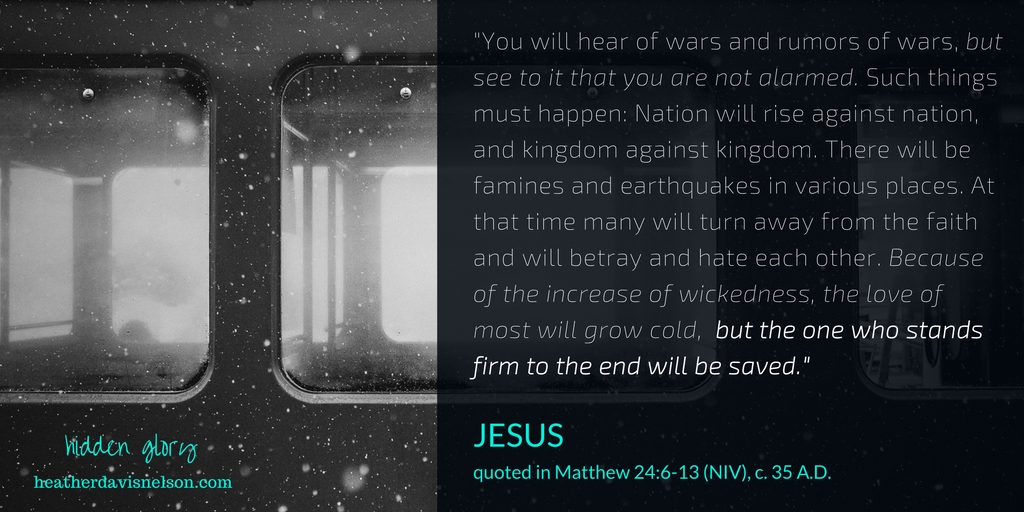
I’m not alone in this desire. And there is a refuge promised One Day. Because of this Future Hope, we take comfort in Jesus’ words from over 2000 years ago, and we can serve for justice and peace now.
I want to read the promises side-by-side with the headlines. Jesus brings perspective and best of all – his presence in the promised Holy Spirit to all who find refuge by faith in Jesus.
Because of Jesus’ Presence, I can take a deep breath, go downstairs and hug my children and cook breakfast and serve in my little corner of the world.
Because of Jesus’ Presence, I can be fully involved in the here-and-now while also seeking how I can be part of the global concerns because they affect fellow human beings worthy of dignity since they’re made imago Dei.
Where do you take refuge in these troubled times? How do you balance the reality of the here-and-now demands on your life with the global concerns impacting us?
Below is the beginning of an article featured at The Gospel Coalition blog. TGC helped to launch my writing into a larger audience by facilitating my introduction to Crossway, publisher of Unashamed. Below is the first part of When Shame Haunts You.
There was a time when shame didn’t exist. Man and woman walked freely with God and one another—perfectly vulnerable and without shame (Gen. 2:25). But then sin entered the paradisiacal landscape. And with sin came the immediate hiding of shame.
The man and woman tried to cover themselves from each other, and they hid from God when he came looking for them. As he exposed the sin, they blamed one another, then the serpent. Eden shattered, and they were expelled from paradise. But not without one seemingly small act of grace—God covered them with adequate clothing (Gen. 3:21). This act pictures the future, greater covering of shame humanity would need—clothing in robes of righteousness instead of the garments of sin that cloak us with shame.
Unclean Made Clean
Throughout the history of a redeemed and rebellious people, we see shame alongside sin and guilt. Guilt was atoned for through regular sacrifices, pointing to the Lamb of God who would be the ultimate and final sacrificial offering for a sinful people. Shame often shows up in the realm of the “unclean,” a category in Levitical law that went beyond the uncleanness brought by sin. For example, a person with various types of skin disease could be deemed unclean by a priest (Lev. 13:1–59). There were shameful consequences for being pronounced unclean: “He shall remain unclean as long as he has the disease. . . . He shall live alone. His dwelling shall be outside the camp” (Lev. 13:46). What a picture of what those of us who dwell in shame feel—an aloneness and an exclusion from “the camp,” whether that camp be defined as our family, community, neighborhood, school, or church. Shame pronounces us “unclean,” and we’re separated and excluded. …
As my first book, Unashamed, prepares to launch June 30, I’m writing a 10-part series on shame. All of them can be found by clicking here.
What does Jesus do with shame? I can tell you my story of struggling with shame (and I’ll continue to do so throughout this series), and this may provide you with some sense of connection as you feel less alone. That’s invaluable. But you need more than empathy and connection. You want healing, right?
And for that you’ll need to encounter someone powerful enough to take away your shame. To exchange it for honor – to call you “worthy.” Jesus may be the last person who comes to mind when you think about healing shame. But these stories give you a picture of why he is the only one – and the first one – to turn to when ashamed. It’s a creative retelling of three accounts in Scripture of Jesus’ encounter with those filled with shame, in this case all three women.
I saw Jesus – glimpsed him entering the home of one of the religious leaders, Simon. Simon and his cronies never look my way. They must be afraid that simply acknowledging me will make them dirty and unclean. I am a prostitute, and cloaked in shame. But Jesus – he is different. He is not afraid to look me in the eyes. He forgives women like me. It’s the talk of the town. And so tonight – I am going. I am braving the scorn and the disgrace that may await me, and I am going to Jesus.
I entered the home and began weeping at his feet. I broke my alabaster jar of perfume – rather costly – a year’s wages – and anointed his head and feet. I wiped his feet with my hair. They’re all staring at me – Simon and his friends, Jesus’ disciples. But Jesus won’t turn me away. And so I stay.
Then they begin talking. It starts with the quiet whispering as they look in my direction. Then one of them says, “Do you know who she is?” And another adds, “What a waste! She could have sold the perfume and helped the poor with it!” Their arrogance looks “good.” I tremble inside and out. The shame – it’s taking over. I shouldn’t have come. Who did I think I was? Was Jesus worth this disgrace?
And then it happens. He stands up for me. He speaks up on my behalf. He defends me. And – I can hardly believe it – he shames Simon for his lack of hospitality! He says I’ve washed his feet (which Simon failed to do), that I’ve anointed his head (also forgotten by Simon) – and he says that what I’ve done is beautiful.
They are quiet. And my heart is full. I am free and unashamed, for Jesus set me free.
They caught me with him. And while he got away, I am now here, encircled by those who are backed with the law of God – with the right to stone me to death. It’s the end. I should have known it would come to this. I feel such disgrace – such shame – to be here, to end my life like this, surrounded by their disdainful looks and critical words.
But then he comes. Jesus is his name. And he stands by me – by me – and he says, “what has she done?” And then he says, “He who is without sin can cast the first stone.”
And I wait. And I watch with wonder as they leave, one by one, the older ones first.
I’ve never been treated like this. My shame? It’s beginning to fade away. He turns to me and forgives me, saying, “Go and sin no more.”
I walk away with my head held high and my shoulders back for perhaps the first time in my life. I am free and unashamed.
I’ve been married a lot. Five times, to be exact. The other women despise me. I can’t bear to pass them when gathering water at the well, so I go when I’m assured to be alone. In the heat of the middle of the day. Then I can get the water I need and go my way without contending with their shaming words and looks.
But today was different. There was a Jewish man there. And he talked to me. That’s not done. Ever. I’m a woman. And I’m a Samaritan. But he talked to me. And I didn’t like the direction he was going in – seemed to be trying to circle in to what I was trying to hide – and so I deflected. Began talking to him about his living water, about where to worship, anything to change the subject from me and the shame I’m living with daily.
Jesus persisted. He called me on my source of deepest shame (all my marriages) – and he pointed out my multiple marriages not for the purpose of condemning me, as everyone else does, but in order to let me know I’m loved for who I am. And to offer forgiveness.
So I am telling everyone about him, the one who told me everything I ever did, and then loved the shame right out of me.
“Hear the bells ringing, they’re singing that you can be born again!” That melody floats through my head this morning. The melody that drew me into salvation as a child of 4-years-old who inquired what it meant to be born again, and then was … Keith Green’s invitation set to music.
Another phrase that seems to capture what Easter means for me this year, today:
Be free and have fun!
I overheard these words spoken by a grandmother sending her grandson off to play at a park a few weeks ago. And they have reverberated through my mind and heart ever since. Not only as such a good (different) parenting focus, but the words I need to hear from a resurrected Jesus this morning, every morning.
Easter means I am free and so are you who are united to Jesus by faith. Free from sin, free from slavery to the effects of my sin and others’, free from anxiety and worry, free from performance on the treadmill of perfection, free from my past and my failings, free from others’ judgments or opinions, free to say “no” to doing too much, free to love – to serve wholeheartedly – to create.
Free to have fun in the truest sense of fun. To be creative, to delight in a world that can be as delightful as it is broken. To have fun with my daughters and not only be a disciplinarian. To have fun with my husband and in so doing make both of our loads lighter. To take myself more lightly and laugh a little easier. To have fun doing what I don’t give myself permission to do in my quest for achievement and success: to have fun painting, reading novels, blogging, sharing a cup of coffee with a close friend, making life and our home beautiful.
What about you? What could it mean to live in the light of Easter morning? Of the empty tomb calling out to you – “be free! and have fun!”? Where are you still living under the weight of “Silent Saturday”? Of the agony of Good Friday?











 hidden glory