Five Minute Friday: “keep”

How does one follow such a month of such important, heavy, deep posts about one of the greatest injustices in our world (human trafficking)? That question has paralyzed me this week. That, and the fact that I haven’t had my usual writing time due to sick children for the better part of the last few weeks. I say this often, but it bears repeating – motherhood is *not* for the faint of heart. You have to be both scheduled and flexible (planning what you think will be best for each day/willing to flex with the needs as they arise each moment); gentle and firm; compassionate and consistent when it comes to limits/boundaries/discipline; taking the long view for your child while knowing in the short-term what you need to make it to the long view (i.e. – a half-hour of TV when you can’t take your 4-year-old twins’ whining anymore; or a night out with your husband even when your children beg you not to leave; or a Saturday morning coffee-date with a good friend who can listen and laugh about the antics and struggles of motherhood with you).

I have missed this (blogging) space this week. And it is good to be here again, joining the Five Minute Friday writing community who does just that – they keep me writing most Fridays! Five minutes of free-writing on a given topic. Certainly worth giving it a try: head over to Kate’s site to link up here.

****

photo from homedit.com

photo from homedit.com

I’ve taken the rather ambitious and predictable January task of purging our home of unneeded clutter and things and toys and random-stuff-that-you-haven’t-used-since-you-got-it-as-a-wedding-gift-8-years-ago. Over and over again, I have been evaluating what is worth keeping, and what should be tossed, given away, or stored for the future. My list of what’s worthy to keep includes these qualities:

  • Quiet toys (i.e. – no loud sounds or flashing lights, if I can help it)
  • Staying power – timeless quality to it
  • I like it. You may laugh, but I realized that the first step for me in clearing the clutter is realizing how many things I’ve kept in our house because I felt like I should, or I’ve had it since third grade/etc. Silly, really. So I’m giving myself permission to get rid of what I don’t like in our home. Down with the thousands of mismatched picture frames and only-used-once appliances, and throw pillows I’ve held onto since college.
  • It serves a purpose now.

What if I likewise evaluated my life and my heart like this? If I looked to nurture qualities of my soul worth keeping, and sought God’s expulsive mercy and grace to be rid of what’s not? How would that change the way I spend my time? How I talk to my children and my husband? The way I engage in my church and my neighborhood? What would and would not be on my schedule?

Questions worth pondering. I would love to hear your answers as you have them.

****

How You Can Help Fight Human Trafficking (Unabridged Version)

photo from pixgood.com

photo from pixgood.com

For the final day of January, Human Trafficking Awareness Month, I am posting the full unabridged version of what OnFaith posted yesterday as “10 Ways You Can Help Fight Human Trafficking.” I also want to direct you to Heidi Carlson’s excellent (shocking) guest post, “The Trafficker Next Door,” and her story of her experience helping with an adventure camp for rescued women with Freedom Firm in India last November, “Thank You and the Art of Henna.”

****

“How You Can Help Fight Human Trafficking” (Unabridged)

I did not hear the phrase “human trafficking” until well into my 20s. (And I am only mid-30s now.) The first few times I brushed it off because honestly I could not bear to carry in my mind the reality of such atrocities. But God has been kind and patient with me, and he has taught me – is teaching me – the importance of awareness as a first step to engagement. This is the step where many of us get stuck. As a counselor, I first want to say that there can be very good reasons to be stuck in the place of not-able-to-hear. Hearing about this type of sexual abuse and trauma may dislodge your own memories of abuse with overwhelming emotional effects. Please hear me say that you need to get help for yourself first before engaging in further awareness. Reach out to a trusted friend and/or seek out a local counselor to work through your own trauma and abuse. It’s the “put on your own oxygen mask first before helping others” principle.

If this isn’t your experience, then ask the question of why is this hard for me to hear? Maybe you can identify with one of these:

  • It’s viscerally uncomfortable to read about these atrocities.
  • It challenges my trust in humanity to choose what’s good more often than not.
  • Its existence seems to fly in the face of a good God who is over all things.
  • I feel scared – for my own safety and that of all those I love, especially my daughters.
  • I feel powerless to help.

I vacillate between all of the above, and it has kept me thus far from deeper engagement despite being years past the time when I first heard about human trafficking. What have I personally done? Basically nothing. But the beauty of realizing our passivity is that it can change in this moment. The fact that you have continued to read this post says something. You want to know more. You want to be engaged more than you have been.

Take a deep breath, and be willing to feel repulsed as you read and educate yourself for the sake of prayer, awareness, and engagement. The words of Dr. Diane Langberg, a Christian psychologist, counseling professor, and member of Biblical Theological Seminary’s Global Trauma Recovery Institute, are instructive here:

“The things we cannot bear to hear about are the atrocities that he/she has had to live through.”

When this sinks in, there is no choice but to repent of our passivity and beg God for strength to engage in what is close to his heart.

Consider these verses about who God is from Psalm 146

Blessed is he whose help is the God of Jacob,
whose hope is in the Lord his God,
who made heaven and earth,
the sea, and all that is in them,
who keeps faith forever;
    who executes justice for the oppressed,
who gives food to the hungry.

The Lord sets the prisoners free;
    the Lord opens the eyes of the blind.
The Lord lifts up those who are bowed down;
the Lord loves the righteous.
The Lord watches over the sojourners;
he upholds the widow and the fatherless,
but the way of the wicked he brings to ruin.

Have you ever wondered how the Lord can do such things? How does the Lord set prisoners free, open blind eyes, lift up those who are bowed down, watch over the weak? It is true that there are abundant accounts of God’s direct intervention both in the Bible and presently. The story of freeing Paul and Silas from prison comes to mind. In a miracle, their chains literally broke and the doors were opened (Acts 16).

Yet much more often, God invites his people into his mission. The theological term is “human agency.” What comes to mind is the too-oft-told joke of the man waiting for God to rescue him and when he gets to heaven, God says – “I sent you a helicopter and a boat!” – but the man refused these sources of rescue because he was awaiting God himself.

Consider a few examples throughout the Bible:

  • God provided for Jacob and his sons during famine by putting Joseph in a high place in Egypt where he managed storehouses of grain
  • God raised up Moses and Aaron to lead his people out of slavery in Egypt
  • God preserved the Jews from Haman’s evil plot through Esther’s courageous intervention as queen
  • God warned his people of coming exile because of their persistent spiritual adultery through the words and actions of prophets (Hosea, Jeremiah, Isaiah, etc.)

And then the greatest mystery of all: God took on human flesh itself, became a baby, and Emmanuel was born – God with us. Through a physical human body, the Divine healed diseases, had feasts with outcasts, challenged self-righteous leaders, and then did the otherwise-impossible: perfection became imperfection, Jesus carried our sin to the cross and triumphed over death, sin, and Satan through the resurrection. He now intercedes for his people at the Father’s right hand.

And he empowers us to be part of his justice mission of reconciliation and redemption through the indwelling presence of the Holy Spirit.

It doesn’t mean that all of us will be on what I term the “front lines” of human trafficking. But it does mean that to be united to Christ by faith implicates us to be engaged in his mission.

Dr. Langberg calls us to action in her book In Our Lives First (2014):

“ ‘The issue of trafficking desperately cries out for a firm, committed leadership; it has to be made a global concern.’ [Victor Malarek, author of The Natashas: Inside the Global Sex Trade] and others state that it is the human rights issue of the 21st century. … However, when you look at the record, you see darkness and corruption everywhere – money, power, and politics speak louder than the crushed lives of thousands of women. Governments have not answered the call. And though there are many organizations working tirelessly in this area, Malarek is correct when he says it must be made a global concern. The scope of the problem is so vast that a worldwide response is necessary.

What about the Church? She is global and she has a long history of confronting plagues and freeing captives. It is clear … that God has called her to serve as a humanitarian force in this world for those who are without help and resources. If Wilberforce and other Christians could stop the African slave trade in the 18th and 19th centuries, why can’t we follow their example today? What if, in one of the darkest hours on the planet, the global Church rose up united and became known for her charity to those who are being sold like chattel? …

What do you suppose would happen if the Church in every part of the world fell down on her face and pleaded with God on behalf of these women and girls? What if she began to seek out what He would have her do for these females? What if she became the global, committed, ethical, and moral leadership that is needed to fight this battle?”

Where do you start in the light of such a call to action?

Start where you are:

  1. Seek to be educated and aware, so that you can be engaged through prayer. For an overview, read 10 Things You Didn’t Know About Slavery, Human Trafficking at the Huffington Post. As a Christian, there’s no better place to start than the International Justice Mission. I also found this site which gives an overview of organizations and how to pray: Freedom Summit .
  2. Be willing to give what you have – whether that’s time to pray, financial resources, skills to offer victims who are being rescued, administrative support to organizations overwhelmed by the vast need, a voice raising awareness through your words, blog posts, Facebook statuses, Tweets, conversations with friends and family, and places of influence in your business, community and church.
  3. When you’re buying gifts or goods, purchase them from one of the many micro-enterprises who are giving rescued victims an alternative from the sex trade. Sari-Bari offers many beautiful items, and it’s one of many similar organizations. Others are listed at “buy for good” at “half the sky movement” here.
  4. Stop feeding the demand through viewing pornography (see the post from my friend Heidi here).

The worst thing you can do is nothing. To assume (as I have for years to my shame) that other people have this covered; that it’s too big for me to deal with anyway; that it’s really pretty extreme and does not occur in my city. By God’s grace, that changes in 2015. Not for my glory as “The All-Great Rescuer” but for God’s glory as the One who rescued me …. and through me, offers rescue to others from sin and all manner of atrocities resulting from sin’s evil corruption of human hearts.

from contentment and celebration to complaining and despair

photo from zionsvillelutheran.org

photo from zionsvillelutheran.org

Isn’t it always like this? Our grandest moments of life, faith, work, are closely followed by our biggest days of struggle. I think about Jonah after he experienced an epic personal rescue from the belly of a big fish, and watched God convert an entire city (Nineveh) through his preaching. The book ends with a story of the prophet’s suicidal despair because a worm ate a vine that was sheltering him from heat. It’s ridiculous. Crazy, really. And then there’s Elijah. After he watches God send fire from heaven to consume a flood-drenched sacrifice on Mount Carmel in front of a crowd of frenzied Baal-worshipers, he sits under a broom tree in the desert to die. His exact words?

“It is enough; now, O Lord, take away my life, for I am no better than my fathers.” (1 Kings 19:4)

What happened to his bold faith glimpsed just two paragraphs earlier in this prayer?

“O Lord, God of Abraham, Isaac, and Israel, let it be known this day that you are God in Israel, and that I am your servant, and that I have done all these things at your word. Answer me, O Lord, answer me, that this people may know that you, O Lord, are God, and that you have turned their hearts back.” (1 Kings 18:36-37)

What happened is that Elijah and Jonah, like you and me, are human. “Prone to wander, Lord, I feel it/Prone to leave the God I love,” the old familiar hymn goes (“Come Thou Fount of Every Blessing”). I should not be surprised that on the heels of such celebration at the end of last week with the news of Crossway’s acceptance of my book proposal, this week has felt like a battle against petty disappointment and despair. The things I have complained (bitterly) about include:

  • Our coffeemaker that broke on Monday morning [MONDAY morning, of all days?!!]
  • Twins who whine and squabble with each other over silly things, like who gets the red marker [typical for 4-year-olds, although not desirable]
  • Antibiotics that didn’t work as quickly as I wanted them to in healing a bad case of strep from last Thursday
  • A husband’s very long work day, leaving me with more-than-desired solo-parenting duties for my quickly-waning-parental-patience
  • Credit card fraud – at a random WalMart in Tennessee, of all places, for 5 consecutive purchases of $28.77. This alerted our awesome card company, who called right away. But then you have the *hassle* of switching automatic payments, waiting for the new card in the mail/etc etc

All of these could fall under the hashtag #firstworldproblems , or better, #whinymomproblems. Really they’re symptomatic of a heart fixated on self, who feels entitled to comfort and ease all the time. Diagnosing my problems yesterday didn’t really help much. In fact, it probably made it worse. Then I was better able to articulate (and unload in frustration) to my husband why he, somehow, was at fault for all of my frustration.

Ugh. (There’s a poetic word for you.) I have been blind to grace. Blinded to mercy all around me, and worse still, unable to help myself. Feeling paralyzed from taking hold in my own heart of the gospel-hope I can articulate for others through writing and counseling. Enter grace in the form of the impulse to text a friend for prayer this morning when I awoke still seething with frustration and venting it unfairly to my daughters. She then called after we dropped our kids off at preschool (thank God for this common grace!), and we talked each other through our similar frustrating moments, reminding each other of the grace we know is there. I hung up the phone feeling the slightest turn in my heart towards hope again. Hope not that things will get better, or that circumstances will change, but hope that God’s love hasn’t turned away from me in the midst of my sin and struggle and that his grace is yet deeper than my need for it. Amen?

Five Minute “Friday”: share

It’s been a good week. Dare I say, even one of the *best* weeks of my life because of thrilling news: Crossway accepted my book proposal! I have been dreaming of writing a book since I was a girl who loved to get lost in the worlds (and words) of Anne of Green Gables, Laura Ingalls Wilder, and Nancy Drew. It’s been a dream I have been afraid of naming, much less pursuing, until the last few years as my writing/blogging grew and so did my courage. But in June at The Gospel Coalition Women’s Conference, God opened doors that led to a contact with one of Crossway’s acquisitions editors. He patiently walked me through the process of creating a book proposal over the last 5 months, and then he delivered the happy news of its acceptance on Thursday afternoon! Now my real work begins of *writing* the book … but I’ve never been more ready in my life. And you, dear readers, are a large part of my growing courage to venture so greatly. So thank you for your support, and for reading, and for your comments, and for your cheerleading all along the way. I am excited to have *you* on this journey with me!

Ok – now on to Five Minute Friday and today’s word: “share.”

****

2015/01/img_7822.jpg

She offers her homemade gift with eager hands and a shy smile. It’s a picture of me with her and her twin sister – “to help you feel better, Mommy!” [I’ve been sick in bed with strep since Thursday.] It is easy for her to share this – but ask her to share her favorite toy with her twin? How dare I suggest such a thing!

And isn’t that how it is for me, too? I am eager to share on my terms, in my way, with what I’m willing to give. When God asks me to share past the point of comfortable, well, now, I am not sure I am so excited about this whole concept. I can think of many reasons to hoard my resources. I feel entitled to “my” rights and “my” time and “my” things. But God is patient. He gently unfurls my clenched fist, reminds me that all that I have is a gift from him. He assures me that I can never out-give his ability to provide for me, his ability to generously restore any “loss” on my part. Even if it’s not a material restoration – it will be better. Treasures in heaven. And the joy that comes with giving beyond what duty requires.

***

Five Minute Friday is an online writing community who writes for five minutes on a given topic every Friday – unedited, simply for the joy of writing. Hosted by Kate Motaung here.


Five Minute Friday: send

I woke up excited to remember that today is Friday. Not only because it means the beginning of our weekend [since my husband is a pastor, he takes a day off to replace Sunday – and for him, it’s Friday], and the end of what’s felt like an unusually intense week, but also because it’s Five Minute Friday. Five minutes of writing unedited, prompted by a word and link-up hosted by Kate Motaung. It’s fun to simply write for five minutes without thinking too much about it, and it’s wonderful to read what others have written across the blog-world on the same topic.

So … here goes: “SEND”

****

envelopeI remember when the only mail I opened was what came in a carefully addressed envelope, sometimes decorated with stickers, and always carefully written by virtue of the fact that it was a letter. Kristin wrote me after we met during my first campus visit of Wheaton College, and she answered my questions about college life as well as encouraged me in my high-school faith. She had artistic print and a beautiful way of addressing each envelope that made me feel like I was opening a personal work of art. (Which I was – it was created just for me.)

When my next-door best friend neighbor, Kristen Warnke, moved away when I was in third grade, we kept up correspondence via letters back and forth for years. She told me about her family vacation to Alaska – that it wasn’t all cold and icy as everyone imagined. Her addressed changed many times over the 10 years we wrote to one another because of her dad’s job. Mine changed once. But we always found each other. We were able to see each other in person perhaps once over all of that time … but the relationship stayed close because of the pen-and-ink bond between us.

I can’t help but think with nostalgia on those days, and wonder if in our electronic click-and-send culture of communicating via screens, we have lost something of great importance almost impossible to recover.

****

The Trafficker Next Door (guest post by Heidi Carlson)

Warning: this post will be convicting, and uncomfortable, and shocking. It’s for an important cause: human trafficking awareness month. It is a modern-day injustice we want to turn a blind eye from because it feels easier to have the ostrich posture of “bury my head in the sand” rather than sit with the powerlessness and horror inevitable when facing its reality.

Allow me to introduce my friend, fellow Wheaton alum, and gifted writer-blogger, Heidi Carlson. On a play date with our exuberant (wild) kids a few months ago, we discussed what it could mean to be missional in our writing and our blogging. In the ensuing time, she went with our church on a mission trip to India where they helped to run a camp for women who had been rescued from the sex trade. I prayed for this team, and began researching local opportunities to get involved (later post to come on that). I also read Diane Langberg’s devotional which concludes with a call for Christian counselors and psychologists to be on the front lines of this modern-day injustice. And I knew I needed (am called) to be more involved.

Today is a beginning. I give you the gift and challenge of Heidi’s words now.

Born near the front range of the Rockies, Heidi grew up in Portugal, Mozambique, Kenya and a few other places here and there.  A graduate of the U.S. Air Force Academy with a Masters in African Security Affairs, Heidi served as an officer in the U.S. Air Force for five years, including a tour of duty in Iraq.  With a lifestyle that includes moving every 18-36 months, she enjoys making home and putting down roots wherever the family goes.  She currently resides in Virginia with her husband and three children, ages five and under, where she enjoys exploring the history of the local area, educating her children and roasting coffee at home.  The issue of sex trafficking became very personal for Heidi when she volunteered at a camp for sex trafficking victims in southwest India in 2014.  She regularly writes at www.willtravelwithkids.wordpress.com.

image from stockarch.com

image from stockarch.com

It’s Trafficking Awareness month. . . or something like that.  That’s right up there with Domestic Violence Prevention month, Child Abuse Prevention Month and whatever other month the government decides to tell us about.  The slavery and human trafficking issue, like so many other issues raised by the news, the government, Facebook shares or forwarded emails, make us gasp and wish the morally abhorrent practices would naturally work themselves into oblivion without us – you, me – getting involved.  But slavery and human trafficking, compared to those other issues, seem far more removed from our everyday lives.  I know a  police officer stops at the house down the street to respond to a domestic violence case.  I know children are in foster care in my neighborhood because of parental abuse or neglect.  But slavery or trafficking, in my neighborhood?  My social circle? My city? Surely that activity does not take place around here.  After all, a society that turns a blind eye to human bondage, for whatever purpose, is not my society.

Or is it?

Consider this:

– As of 2012, human trafficking is the fastest growing criminal industry in the world, surpassing drugs and arms in its rate of growth.*

– 80 % of human trafficking cases in the United States occurred for the purposes of sexual exploitation, including forced engagement in sexual acts for the purposes of creating pornography**

– Four of every five sex trafficking victims in the United States are American citizens**

– Nearly 90% of victims in the United States are under the age of 25

– Los Angeles, San Francisco, and San Diego, California have the highest rates of trafficking in the nation.

You don’t have to live in the slums of Thailand to be a stone’s throw away from a trafficker or trafficking-enabler or trafficking client.  These individuals work with you, live on your street and sit next to you in church.  You know them.  Maybe you are one of them.  A sex trafficking client. A user of pornography.

Consider this:***

– In the United States, 1 in 8 online search queries is for erotic material.  The odds increase to 1 in 5 on personal mobile devices.

– 9 out of 10 internet porn users only access free material. [I’m not paying for it, so it’s not hurting anyone, right?]

Nevertheless, the U.S. porn industry generates $13 billion a year

– Nearly 70% of young men view online porn at least once a week (nearly 20% for women)

– “There are higher percentages of subscriptions to porn sites in zip codes that are. . . more urban, have higher than average household income, have a high proportion of people with undergraduate degrees and have higher measures of social capital (i.e. more people who donate blood, engage in volunteer activities or participate in community projects).”

Sounds like the same kind of people who might run a 5k to raise funds to combat sex trafficking are the same people who, after checking their race time on their personal mobile device will, 5 seconds later, view porn.

Sounds like the same average, middle-class urbanite who has a blogroll is the same kind of person who plans to view porn as part of their daily “checking my websites” routine.

Sounds like this is something common, considered almost normal, that no one wants to talk about.

Every January in the United States is National Slavery and Human Trafficking Prevention month, as authorized by the President.  The month is intended to not only raise awareness, but action.  Slavery and human trafficking are complex issues that could be crassly distilled into economic terms – supply and demand.  Eighty percent of human trafficking takes place for the sole purpose of sexual exploitation, including forcing victims to participate in creating pornography.  The demand for pornography is insatiable, thus suppliers continue to find ways to create and distribute their ‘product.’  Suppliers want even more individuals, including me, to desire their product.  I did some research online for this short piece and quickly became concerned that my very carefully worded research terms and emails to others concerning this issue would generate unwanted advertisements on my email and search engine sidebars.   A friend who studies and speaks on the topic of pornography has been targeted by advertisers as a result of what he types on his personal computer.  Suppliers are seeking you out.  They want to create more demand.

I remember the first time I was exposed to pornography.  I was in elementary school and a friend said, “Hey, look what I found in my dad’s closet.”  I looked.  My young mind never imagined something like that would be photographed and distributed in print.  Twenty-five years later, the pervasiveness, accessibility and social acceptance of pornography has risen to new levels.  Forget magazines.  The demand exists because we simply click buttons on our screens. We may not even pay a dime, but someone pays with their freedom.

We can rail on law enforcement for not intervening.  We can condemn law-makers for loopholes in the Communications Decency Act that has the side effect “of rendering law enforcement ineffective at identifying and interdicting ads and solicitations for illicit sex” (24).*  Like the drug trade, we arrest the dealers, though we all know the dealers/suppliers wouldn’t exist without the demand.  We are the demand. 

Pornography is not a victimless affair.  This month, don’t just talk about the evils of human trafficking, but talk about the realities of pornography – in your home, your social circle, your work and your neighborhood.  Those who campaigned against the explicit slavery of centuries ago counted the social cost of their beliefs and outspokenness.  Are we willing to do the same for the slaves of today?

Recommended Resources

  1. Chester, Tim (2012-06-11). Closing the Window: Steps to Living Porn Free (Kindle Locations 299-304). InterVarsity Press. Kindle Edition.
  2. The Connection Between Pornography and Sex Trafficking.  7 Sep 2011. Covenant Eyes Internet Accountability and Filtering.
  3. ***Covenanteyes.com. Pornography Statistics.
  4. Human Trafficking Facts. National Coalition Against Domestic Violence.
  5. *Kuzma, Abigail. The Communications Decency Acts Promotes Human Trafficking. 2012. Originally published in the Children’s Legal Rights Journal, Vol 34:1.
  6. ** U.S. Department of Justice, Bureau of Justice Statistics. Characteristics of Suspected Human Trafficking Incidents, 2008-2010. 

2015 word of the year: focus

My parents knew I needed glasses because I complained that I could not read the daily homework assignments in fourth grade. I squinted often, come to think of it. When they took me to the eye doctor, he confirmed what they suspected: I needed glasses. Badly. Once I slipped on my first pair, I could not believe the high-definition that existed in the world around me. What had been obscure was now crystal clear. 

Life is not so dissimilar. It is easy to lose focus, easy for the world to become blurry in my fast-paced crazy busyness as I jump from one task to another. When life moves at the speed of a high-speed train, the landscape around me becomes obscured, and I forget where I’m going and why I am here. To-do lists rule my daily agenda, and tasks can loom larger than people. My mission too easily shifts to “put out another [relational or logistical] fire” in a life of full-time ministry – which is not unique to me, since all of our labor as Christians is ministry regardless of profession. The contours of my life specifically exacerbate this tendency: part-time counselor, full-time mom to 4-year-old twins, wife to a full-time pastor, daughter-in-law to aging parents recently moved to town. Crises arise with some frequency and with varied degrees of perceived urgency. It is hard to decide what should be shifted to accommodate the need of the week (or day or hour).

What I need is focus. I need my world to stop racing around me in a blurry whirl and to be able to focus on the one thing that is needed, like Mary as she sat at Jesus’ feet. In this moment, what do I need? Who is before me? How can I ask God and others for help to lift heavy burdens? Where is the joy that I might miss right now if I’m focused on the stress of tomorrow or tonight or next month or next year? And how does remembering the big picture – the long-term – bring focus to the immediate so that I don’t get caught in the urgent, neglecting the important?

I need focus, and I need to focus. Focus is the word of my year for 2015. Not as poetic as last year’s light or 2013’s new. But oh so needed! I love that focus is both what I do (verb) and the object I am looking at (noun). And I sense God inviting me to to allow space [white space/margin/boundaries] to help me to focus better on what I profess to be my priorities, both in how I spend my time (what I do) and what I give my attention to (my focus). Focus implies intense gaze and intent – direction. It’s where you’re going and how you are going to get there.

I am indebted to a few great thinkers and writers who have helped me in mulling this over – Kevin DeYoung’s book Crazy Busy being the top of my list, followed by Brene Brown’s Gifts of Imperfection and Emily Freeman’s A Million Little Ways, and one that brought it all into focus as viewed through the lens of parenting is Kim John Payne’s Simplicity Parenting.

Most of all, I am indebted to my Redeemer, who is patient to continually draw his distracted-by-many-things daughter back to the one thing needed: sitting at his feet, focusing on the one whose love is constant and whose gaze never leaves me (as many times as mine leaves his). These passages of Scripture are prayers for me in 2015. Join me?

“Be still, and know that I am God. I will be exalted among the nations, I will be exalted in the earth!” (Psalm 46:10)

“Therefore, since we are surrounded by so great a cloud of witnesses, let us also lay aside every weight, and sin which clings so closely, and let us run with endurance the race that is set before us, looking to Jesus, the founder and perfecter of our faith, who for the joy that was set before him endured the cross, despising the shame, and is seated at the right hand of the throne of God.” (Hebrews 12:1-2)

“And a woman named Martha welcomed [Jesus] into her house. And she had a sister called Mary, who sat at the Lord’s feet and listened to his teaching. But Martha was distracted with much serving. And she went up to him and said, ‘Lord, do you not care that my sister has left me to serve alone? Tell her then to help me.’ But the Lord answered her, ‘Martha, Martha, you are worried and upset about many things, but only one thing is needed. Mary has chosen what is better, and it will not be taken away from her.” (Luke 10:38-42)

Letter to Grief (reposted) and a book to purchase

[repost from December 21, 2014]

All is not calm and bright, is it? This time of year is more often chaotic and dark as we scurry around with our never-ending Christmas to-do lists, flitting from one festivity to another. And for many of my close friends, this Advent season brings unimaginable grief. I feel it with you. And so I jumped at the opportunity to join in a “Letters to Grief” event hosted by Kate Motaung coinciding with the launch of her book by the same name. This letter – it’s for you, my friends grieving loss this season. Whether that loss is of a parent or a child or a pregnancy or a job or a clean bill of health or a dream or a marriage – the loss of hope and community too often follows in its wake. Let this be a small reminder that no, you are not alone, and yes, it feels excruciating. Cry, and sorrow, for we are not Home yet. But grieve with hope, for Home is being prepared for all those clinging to the hope of our Redeemer Jesus Christ.

***

Dear Grief,

You have claimed many friends in 2014, and I have been touched by you as well. The worst part is that the church has too often refused to own you as she should. She has proclaimed a gospel of health and wealth instead of the message of the Man of Sorrows acquainted with grief who promised suffering for all who take up their cross to follow Him. And in those moments when the people of God feel like they have no refuge, you cackle and seem to win. You whisper lies, saying that there is no hope, and that God is as distant as the well-meaning friends who disappear after an initial rally of support. …

[read the rest over at Kate Motaung’s site where I am featured today as part of her book launch, Letters to Grief, which will be one of my first reads in 2015]

Sorrow-well-300x300

Top 14 books of 2014, part 2

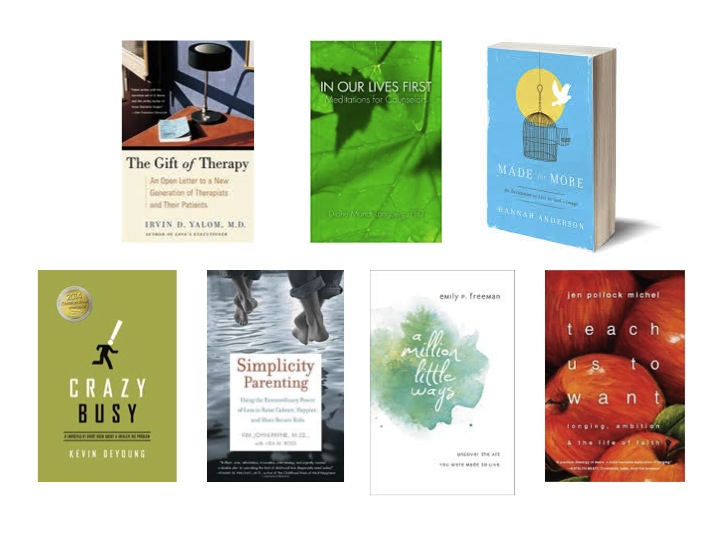
This is part two of my countdown to 2015 in book list form. Read part one here (#s 14-8), and then follow along below for #s 1-7. Happy reading! Slide2
#7 The Gift of Therapy by Irvin Yalom (2001) This book is quite simply a gift to therapists, counselors, psychologists, and all other helping professionals. Yalom draws on his vast experience, using stories and honest sharing to pass along what he’s learned to “a new generation of therapists.” His conversational tone makes it feel like you’re talking with an old friend, or better yet, a mentor who’s been there and will guide you in your practice of caring and counseling. 

#6 In Our Lives First by Diane Langberg (2013) Langberg is a professional long-distance mentor for me. Her work on helping victims of abuse and trauma has been formative for me as a counselor, and I’ve had the privilege to hear her speak a few times. She is a Christian psychologist in Philadelphia, and this book is a 6-week daily devotional written for helping professionals. It can be too easy to get lost in the problems of those I’m helping and neglect my own life and heart. Her words here called me back, with paragraphs like this one: 

Do we really believe we can lead another to freedom from bondage when we are enslaved to something ourselves? … How can we cultivate purity, holiness, patience, endurance, and self-control in the lives of those God brings to us when such things are not truly present in the recesses of our lives? .. We must be what we would have those who follow us become. … wherever you need to go, I must be willing to go first in my own life. If I do not, though I may bring skills and techniques that may be helpful, I will not bring them infused with the life of God.

The governance of our lives is not to be compassion, but rather the God who is compassionate. The difference is profound.

#5 Made for More by Hannah Anderson (2014) As my September book of the month, you’ve heard me rave about this book before. Her subtitle says it all: “an invitation to live in God’s image,” and her book delivers just that. I found on every page a call to reexamine what it means personally and relationally that we as humans are made to image God. To literally be a reflection of the divine. She takes what’s a basic theological truth and states it in new ways. 

…we are by nature image bearers. So when we turn from God, when we refuse to base our identity in Him, we are compelled to find it somewhere else because we must reflect something. … And as we image this false god, our very personhood crystallizes around it. … When we center our identity on these ‘lesser glories,’ we become defined by them, and we end up defining reality by them as well.

The paradox of personal identity is that once we accept that we are not what we should be, we are finally in a place to be made what we could be. … Once we admit the inadequacy of our lives, we are finally able to discover the sufficiency of His. And this is what Christ offers us. He offers us His identity; He offers us Himself. When we are joined to Him, when our lives are ‘hidden with Christ in God,’ we can finally die to our old selves because as His image bearers, we become whatever He is.

#4 Crazy Busy by Kevin DeYoung (2013) I picked up this book at the perfect time: in May of this year after an extremely season of being too busy. It is short, practical, and convicting. Full of zingers written not from “above” (meaning the place of “here’s my wisdom for all of you down there who struggle with overcommitment and lack of margin in your life”) – but right alongside. I found his honesty refreshing, and his insights convicting. For example, his one sentence diagnosis of the problem of our busy lives:

We are so busy with a million pursuits that we don’t even notice the most important things slipping away.

Not until they’re absent, that is. DeYoung speaks to this:

Most of us fall into a predictable pattern. We start to get overwhelmed by one or two big projects. Then we feel crushed by the daily grind. Then we despair of ever feeling at peace again and swear that something has to change. Then two weeks later life is more bearable, and we forget about our oath until the cycle starts all over again. What we don’t realize is that all the while we’ve been a joyless wretch, snapping like a turtle and as personally engaging as a cat. When busyness goes after joy, it goes after everyone’s joy.

He discusses the question of why with seven diagnoses, and presents  the quest to let go of “crazy busy” as a community pursuit. If you want 2015 to be less busy than 2014, I cannot recommend this book highly enough for you.

#3 Simplicity Parenting by Kim John Payne (2009) Close on the heels of “Crazy Busy” is this book on the value of simplicity in parenting. I wrote more about it here in a post on “white space, children’s edition.” In our more, more, more! culture, we need to read more about the power of less. This book provides a good, do-able starting point for that journey. It has already shaped what I’m doing with my girls’ toys (purging and storing more of them); how we are rethinking our schedules moving into 2015; and helped me to re-focus on what’s most important to me in this unique, short season of parenting young twins. 

Having done the hard work of simplifying, you’ll see when ‘must-have’ things or activities are really just new variations of ‘More!’, bound to be quickly forgotten or discarded. … Rescue their childhood from stress, and they will inevitably, remarkably, day by day, rescue you right back.

#2 A Million Little Ways by Emily Freeman (2013) Freeman continues to be a favorite author and blogger (see last year’s list – a previous book of hers was #1 for me in 2013), and this book was no different. She invites me to see myself as God’s poem – his artwork – and a fellow artist along with him in my world, whether my “medium” is setting the table, cleaning up preschoolers’ messes, counseling, writing, etc. All of us are artists, and our art will be expressed in “a million little ways.” 

Christ is in you and wants to come out through you in a million little ways – through your strength and also your weakness, your abilities and also your lack. … God calls us his poem. And the job of the poem is to inspire. To sing. To express the full spectrum of the human experience – both the bright hope that comes with victory and the profound loss that accompanies defeat. We must make art, even in our weakness.

Her teaching shaped and inspired my series that will be ongoing of “embracing imperfection.” Her 4-week art course based on this book is amazing, too, and available for free here

#1 Teach Us To Want by Jen Pollock Michel (2014) Desire and the life of faith – how often I’ve wanted a book that addressed this without minimizing the power of desire or God’s power to shape our desires. Enter this amazing book that is in my #1 place for 2014. She uses the Lord’s Prayer as a guide to discuss various aspects of, “longing, ambition, and the life of faith.” She does not shirk the hard, difficult parts of desire and faith, talking openly about her own struggles in her marriage and church, and her attempt to make sense of difficult tragedies in her life. She’s a brilliant writer, and I look forward to many more books from her in the future. I’ll end this incredibly long post (thanks for sticking with me!) with a few of the MANY underlined portions of my copy of this book:

Here is how desire becomes corrupt: wanting derails into selfishness, greed and demanding ingratitude when we’ve failed to recognize and receive the good that God has already given. Trust is at the center of holy desire: trust that God is good and wills good for his people.

And though it would seem that the forces of evil desire are strong, the Lord’s Prayer is one force of resistance: these words are the arms we bear, this prayer is ground we stand when the lure of east [of Eden] feels almost irresistible.

Lead us not into temptation, but deliver us from evil. Unlike a prayer of moral resolution, this is our white flag of moral surrender. We face our depravity, even in the face of our desires — and we embrace the good news of first-century miracle. Jesus has exchanged death for life, love for indifference, sacrifice for selfishness, innocence for guilt, and looking back at the moment of historic exchange and his faithfulness, we learn to pray, Lead us not into temptation, but deliver us from evil. To this prayer, Jesus joins his own faithful intercession: Father, forgive them, for they know not what they want. 

Our desires say something about us — who we have been, who we are and who we are becoming. They tell a part of the story that God is telling through us, even the beautiful and complicated story of being human and becoming holy.

*note: some affiliate links included (for the books – if you click on them and order them through Amazon, I’ll get a very, very small percentage of your order from Amazon)

my favorite 14 books read in 2014, part 1

I tried to pick out 10. I really did. Ten is such a beautifully poetic number … but I just couldn’t narrow it down. And so I offer to you my top 14 books of 2014, in countdown order (as is appropriate for New Year’s Eve). The first seven are featured today, and part two will follow tomorrow.

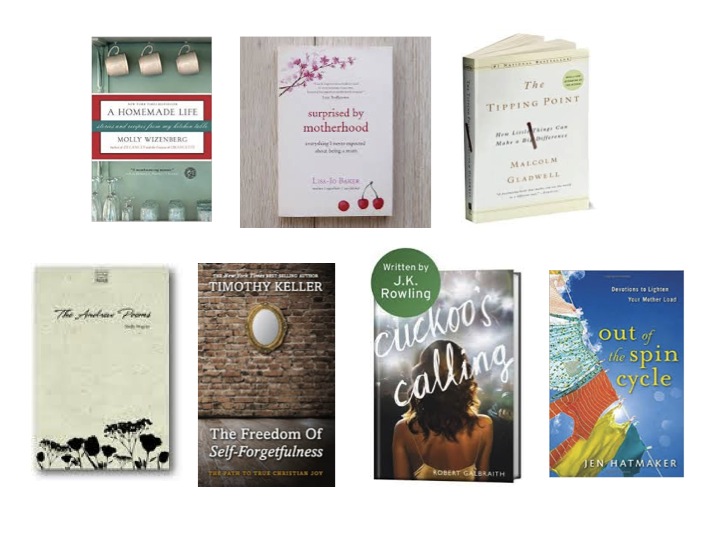
Slide1#14 A Homemade Life by Molly Wizenberg (2009) Reading her book of memoir/recipes made me nostalgic for family meals of childhood and newly resolved to offer similar meal-time rich memories for my family. Good writing, and recipes that made me want to get back into the kitchen (and typically I don’t enjoy cooking). Her chocolate cake recipe is amazing. Truly.  

#13 Surprised by Motherhood by Lisa-Jo Baker (2014) She writes with beauty and refreshing honesty about her experience of motherhood and the grief of losing her own mother. It’s full of pithy truths about motherhood that you’ll underline and star and want to share on Instagram and Twitter. Like the following:  

It’s a relief to know that motherhood is hard. This is the gift girlfriends can give one another – the 2 a.m. truth about parenting.

Becoming a parent is a lot like breaking up with yourself. … Children arrive and blow through what used to be your routine. It takes courage to say no to yourself and yes to someone else.

Motherhood is a sacred marriage of the mundane and the eternal.

#12 The Tipping Point by Malcolm Gladwell (2002) I am late to the Gladwell game, and I found this book of cultural commentary intriguing. He explores what causes a trend to pass the “tipping point” into mainstream, and his findings will surprise you. You’ll learn about the importance of “mavens,” the real reasons crime dramatically decreased in New York City, and what helps marketing to “stick.” 

#11 The Andrew Poems by Shelly Wagner (1994) Shelly is a dear friend and writing mentor for me, and I have the privilege of attending church with her. This collection of poems written after the drowning death of her 5-year-old son are heart-wrenching, therapeutic, and exquisitely beautiful – all at the same time. She gave words to what I was feeling as we communally grieved two tragic deaths of a mother and daughter this summer. 

#10 The Freedom of Self-Forgetfulness by Timothy Keller (2012) This short booklet packed a powerful punch, mainly to my pride, defined as: 

Spiritual pride is the illusion that we are competent to run our own lives, achieve our own sense of self-worth and find a purpose big enough to give us meaning without God.

Yet true to Keller’s style, the conviction comes right alongside the hope of grace found in Jesus. We can’t save ourselves, and God has saved us in Jesus Christ.

In Christianity, the verdict [of being justified and loved entirely] leads to performance. It is not the performance that leads to the verdict. In Christianity, the moment we believe, God says ‘This is my beloved son [or daughter] in whom I am well pleased. … In Christianity, the moment we believe, God imputes Christ’s perfect performance to us as if it were our own, and adopts us into His family.

#9 The Cuckoo’s Calling by Robert Galbraith (2013) My husband and I are huge Harry Potter fans, and so of course we had to also try Rowling’s books written for adults. Her first, The Casual Vacancy (2012), was a huge disappointment, but I loved this one. I saw that the next one in this mystery series, The Silkworm, came out a few months ago, and it will be on my 2015 reading list. 

#8 Out of the Spin Cycle by Jen Hatmaker (2010) A 40-day devotional on motherhood and grace that I cannot highly recommend enough to all my mom friends out there. She is witty, realistic, and calls us to savor God’s merciful love for us as moms in the midst of our experience of loving (and struggling to love) our children. Enjoy these gems – 

on discipline: Disciplining toddlers and preschoolers is like every mother’s personal, daily Armageddon. When we held our innocent babies, who knew we’d encounter a will of iron just fifteen months later? Who knew that they would dig their heels in and die on every hill? No one told us we’d put our children in time-out thirteen times in one day for the same offense. The obstinacy of a two-year-old can make a grown woman weep. [Can I get an Amen?]

on the problem with perfectionism: As mothers, many of us love our children exactly like we ‘love’ ourselves: critically. The standard of perfection by which we measure our own performance is automatically used on our kids.

on God’s love for us: The adoration you feel when you watch your sleeping cherubs? God has it for you. Your pleasure at fulfilling one of their little dreams? Jesus shares that feeling for you. Your bursting heart when your kids laugh? God feels the same way about your joy.

Part two will be here tomorrow – check back then. And happy New Year’s Eve!

Link to part two: My favorite 14 books of 2014, part 2

*note: some affiliate links included (for the books – if you click on them and order them through Amazon, I’ll get a very, very small percentage of your order from Amazon)