Five Minute Friday: tomorrow

We arrived home yesterday from a great several days’ getaway/conference in Orlando at The Gospel Coalition. More on that in a future post. Too much to process for now! Let’s say that returning home has been equal parts wonderful (twin 4-year-olds’ enthusiastic welcomes are the best!) and rough (where are the tropical breezes and the deep conversations?). Parenting is not for the faint of heart … I might have said that once or twice before?

I come here to Five Minute Friday, sliding in before midnight … to write in my favorite of regular blog activities. Five minutes of free writing on a given topic, hosted by Kate Motaung.

****

photo from macstuff.net

photo from macstuff.net

Tomorrow.

Cue the theme song from Annie here. No, really, let’s talk about tomorrow. Tomorrow is when I will not be plagued by the sin and shame of parenting struggles. Tomorrow I will get organized, and work out, and write more, and be more loving. It is the holding place for all of my attempts at self-improvement and hoped-for answered prayers. 

No wonder tomorrow can feel so uncertain. Yet it is also hope-filled.

I lost it tonight when she kept crying uncontrollably, insisting on her way when I kept telling her she could not have it. I was patient and calm for about all of one minute, and then I unleashed my anger in a tirade of frustrated words. A parent at her wit’s end. A parent who feels out of control, as out of control as her daughter does. She was tired, up way past her bedtime; and I was tired of parenting (as was my husband). I just wanted her in bed and out of the way. And yikes, that sounds awful. That is (and was) raw emotion.

But I stepped away for a minute. Prayed, took a deep breath, and came back to her forgiving arms. We cuddled in close and I heard her whisper “‘give you” in response to my request for forgiveness. And I whispered to her about the promise of mercies that are new tomorrow. Strength for obedience that we both need. Grace to forgive that we’ll both need, too. And freedom not to be tied to today’s failures. 

Only in that hope can I face any of life’s tomorrows.

***

Jesus is your cure for loneliness, not Facebook

It’s an all-too-familiar scenario. I feel bored with my life, or my house, or my clothes, and so I check Instagram or Facebook. Perhaps I think I’ll find affirmation or connection in how many likes or reposts I’ve received. Maybe I pop over to Pinterest to get inspired with a DIY project for my home or with my kids. I’ll then see how many Twitter followers I have, and whether my blog stats are booming (or not). The result is that I either feel temporarily elated, or in a state of deeper discontentment than before. The pull of social media is strong, not only because it is always accessible, but also because it seems to promise what we are all craving: a place to belong. … [Read the rest over at iBelieve.com, where it’s featured today]

Five Minute Friday: relief

My favorite of Friday activities: Five Minute Friday, hosted by Kate Motaung. Five minutes of writing on an assigned prompt each Friday – a lovely community of writers across the world gathering to reflect and encourage each other this day.

For this week: “relief.”

****

It feels like water on a hot summer day; like sleep after another weary day when you’re running, running, running without resting; like the comfort of a hug from a friend or a shared laugh with one who’s known you for decades. Relief is hard to come  by in our desert-weary world. There is brokenness everywhere, and my heart is covered in scars. So is yours.

We need relief. A break. A time-out. A respite.

We have it. Freedom to rest from what plagues our hearts most deeply – questions of am I enough? Does my life matter? Will this suffering ever end? Yes, yes, and yes. You are more than enough. You have dignity and mission and purpose perhaps beyond what you can understand. Suffering is always terminal. The cancer that’s terminal? Well, it doesn’t have the end of the story. There is Life beyond Death. We have One who went before us, who walked the hard, long road of suffering without relief. So that we would never have to. 

photo from theguardian.com

photo from theguardian.com – from Haiti relief efforts in 2010

There is no better hope. No better relief. It’s the motivation for us who have so much to share with those who have so little. It’s what keeps me listening when it feels my heart may break with your sorrow. It’s what sends you into the war-torn places of homes and countries, risking harm as you offer the relief that your presence brings. 

Relief. It’s certain. Let’s offer it to one another.

****

The perplexity, fear, and joyful disbelief of Easter morning

Perplexed. Frightened. Startled. Disbelieved for joy. Alarmed. Astonished. Afraid.

All of these describe the response of those who witnessed Jesus’ resurrection. Joy is our primary emotion on Easter morning, but fear overshadowed all else on that first Easter morning. Fear and astonishment. Nestled in the middle of the gospel accounts is this, “disbelief for joy,” and that seems to make the most sense to us. It’s what we can connect to as ones who eagerly proclaim resurrection hope.

I wonder what it would be like to stop and sit in the other responses: perplexed at how this could be – at what this could mean. Frightened, startled, alarmed, astonished to find the tomb empty. This shook those first witnesses to the core. We expect it because we know the end of the story, and we can’t bear to sit with the weight of the grief of Good Friday for long. (I was all too happy that we did a pre-Easter celebration with my daughters yesterday – like skipping the uncomfortable scenes of a movie, we press fast-forward to today’s joy.) But what would it have felt like to go to the tomb early on a Sunday morning, while it was still dark, fully expecting to pay homage to the memory of beloved Jesus, and to find instead that it was empty? Of course Mary’s first response is that someone has stolen the body (John 20:2):

“They have taken the Lord out of the tomb, and we do not know where they have laid him.”

That makes sense. But that Jesus is alive? It is too good to be true. If it’s true, everything changes. And that is perplexing, frightening, and alarming. What will happen next if resurrection has happened? It interrupts with discomfort the order we depended on (even the grief inherent in the old order of things can feel comfortable because it is familiar). If Jesus is alive, what else will change? Do we dare to hope that freedom from Roman oppression will also happen? What does this mean for our mission? Will we die, or will Jesus bring us with him to heaven immediately?

No wonder there are numerous letters written to the early church discussing the implications of Jesus’ resurrection. It changes everything.

What has it changed for you, and for me?

I have hope that I will meet again those who have died. Bethany, Nancy Leigh, Beverlee, Uncle Ashby, Grandmother and Grandfather Davis, Papa, a sister-in-law I never knew (Sarah), Lynn, Karla, Katharine. And you who have lost beloved family and friends will see them again, too – Nan; Liz; Jill; Megan, Kelli, & Patti; Mike & Shelby; the Rodriguez family; Kimberly & Erick; John – thinking and praying for each of you particularly this Easter morning.

I have courage to enter into the messy and broken places of my heart and others’ lives as we grieve to live in between resurrection and full restoration when Jesus returns. I can weep with those who weep, who miss their beloved ones, whose hearts are breaking because of the brokenness of this world. I can sit and mourn without having answers. I can listen and be impacted by the grief of life in a world that’s not yet what it should be. 

I can ask my questions and doubts, and create space for you to do the same. Jesus compassionately showed doubting Thomas his scars. He did not berate him for his disbelief. (For disbelief might be one of the most honest first responses to the reality of resurrection.)

sad untrue quote

photo from poetrystoryteller.blogspot.com

I can choose joy (belief in a bigger purpose, a deeper reality) in the middle of suffering and heartache and frustrations. I have an unshakeable hope waiting for me, guaranteed by the Resurrection. “Everything sad will come untrue,” writesSally Lloyd-Jones in The Jesus Storybook Bible.

I’ll close with one of many teachings on “what now, in light of Jesus’ resurrection?” This one penned by the apostle Paul in 2 Corinthians 4:16-18

“So we do not lose heart. Though our outer self is wasting away, our inner self is being renewed day by day. For this light momentary affliction is preparing for us an eternal weight of glory beyond all comparison, as we look not to the things that are seen but to the things that are unseen. For the things that are seen are transient, but the things that are unseen are eternal.”

beauty in darkness: what’s good about Good Friday

Another repost from a year ago. It still stops me in my tracks to slowly traverse the painful path filled with shame unimaginable – and to realize that Jesus walked this path for ME. For me who too often tramples on the gift of redemption I’ve been given by taking it for granted, or thinking that I did something to earn it. Love led him through the agony we remember today. Don’t forget that love is behind all of the horror of “Good” Friday. (And don’t forget that our sanitized, decorative crosses are far from its original horror – public execution of the most shameful kind.)

***

I had skimmed over the verse countless times in the 30+ years I’ve read and meditated and studied this familiar account. Good Friday is the time to read the crucifixion story. A story of horror turned beautiful. Yet if you’re like me, too often I jump to the “turned beautiful” part without staying with the horror of what Jesus endured. It’s uncomfortable to sit with the events that culminated in the most gruesome of deaths on a Roman cross. But this week – this Holy Week – asks us to do just that. To sit. To see. To hear. Because in the horror, we are saved. We are deserving of all that the King of Glory endured innocently. And we who bear his name are called to endure similar suffering for the sake of love. Love enters into the messy, the broken, even the so-gruesome-you-can’t-bear-to-hear-it and Love takes it. Love endures. It does not run away. It stays. It shows up.

What feels impossible for you to endure today (and yet you must because of Love)? How can Good Friday become truly “good” for you today? What brokenness do you run from in your own heart and in the lives of those around you?

In my calling as a counselor, I often sit with those who have endured stories of abuse that are too difficult to name. And to think that what I have a hard time hearing is what they lived through. Well, that causes you to pause. To pray. To beg for redemption, for healing, for a Justice to make it all right. 

On Good Friday, we are given just that. Not only in the cross, but in the events leading up to the cross. Here’s the verse that stopped me in my tracks this morning (from Matthew 27:27):

Then the soldiers of the governor took Jesus into the governor’s headquarters, and they gathered the whole battalion before him.

Do you know how many soldiers are in a battalion? I didn’t either, so I checked the footnote and saw that a battalion is “a tenth of a Roman legion; usually about 600 men.” 600 men. Quite different than movies who portray this portion of the scene with a couple soldiers kicking Jesus around. That’s bad enough, but this has an arena quality to it. 600 soldiers. That’s a very full auditorium hall. And what did they gather to do? Well, read on:

And they stripped him and put a scarlet robe on him, and twisting together a crown of thorns, they put it on his head and put a reed in his right hand. And kneeling before him, they mocked him, saying, ‘Hail, King of the Jews!’ And they spit on him and took the reed and struck him on the head. And when they had mocked him, they stripped him of the robe and put his own clothes on him and led him away to crucify him.

Utterly shameful. Shameful if it’s an audience of one, but for these horrors to happen before an arena-size audience of 600? Shame magnified. Shame too great for words. Twice he was stripped of his clothes. In addition to the emotional abuse of this mockery, there was the physical abuse of being “crowned” with thorns and beat on the head with a reed. What is striking is Jesus’ response. Nothing. The one who was God incarnate – who could have called down fire from heaven to devour these fools – stayed still and endured. That is the miracle. The miracle that turns bad into good, abuse into redemption, mockery into honor.

Centuries before, a prophet called Isaiah wrote about this and puts words to the what and the why of all that Jesus endured on “Good” Friday:

Surely he has borne our grief
and carried our sorrows;
yet we esteemed him stricken,
smitten by God, and afflicted.
But he was wounded for our transgressions;
he was crushed for our iniquities;
upon him was the chastisement that brought us peace,
and with his stripes we are healed. …
He was oppressed, and he was afflicted,
yet he opened not his mouth …

Because Jesus did not open his mouth when enduring abuse, we can open our mouths and beg for healing and redemption. Healing from our own abuse and from the ways we have abused and oppressed others through our sin – through our brokenness seeking false healings.

In the place of your abuse, there is healing. Because he took the shame for you.

In the place of my sin, there is peace. Because he carried the guilt for me.

In the places where you and I have been silenced, our voice is restored. Because his was silenced this Good Friday.

So go. Walk as one who is healed, who is at peace, who can speak up and speak out and speak of darkness turned beautiful on this most good of Fridays. 

Holy Week: Wednesday (and a repost from 2013)

Everything I wrote two years ago is still true. Not the specifics of my Lenten fast, but my heart exposed through the season of Lent. I offer it to you again as a call to repentance, an invitation to come and feast on the good news of a body broken for you and a body raised to life for you during the next concentrated days of Maundy Thursday and Good Friday.

****

Lent.

The period of 40 weekdays that in the Christian Church is devoted to fasting, abstinence, and penitence.

I chose what I thought would be four hard but do-able items for my Lenten fast this year. Call me an overachiever, or more accurately, an over-estimator of my own strength. A month ago I posted about my hopes for Lent. How hard could it really be? And how refreshing and empowering could it be! In taking away many of my heart’s distractions – phone apps, Target, sweets, t.v. – I assumed that God would replace my heart’s misplaced affections with a renewed love for Christ and the people around me.

About three weeks in, I broke Lent. Fully and completely. Not just one day, but I think it was about every day of the week and I broke every single “fast” multiple times. I rationalized why for each of them.

  • Going to Target will help me stick to our family budget on some key grocery items like Kashi cereal and goldfish.
  • “Non-essential” phone app category expanded dramatically. I started Lent with 6 icons on my home screen that I deemed “non-essential.” I’m ending Lent with twice as many.
  • Television is the only way that my husband and I can really share down time together after busy days in the midst of a busy week
  • I really just “need” a quick pick-me-up. Nothing like a bite of chocolate to do that.

My response to breaking Lent? First, my typical pull-yourself-up-by-your-boot-straps approach: “Just try harder, Heather. Get it together. You can do it!” As this failed, I descended to self-blame, punishment, guilt and shame. “This is really not that hard. There are millions of people in the world who LIVE without these things daily, and you can’t just go without for 40 days?? What is wrong with YOU?” That also got me nowhere fast.

And then I realized that maybe this is the real purpose of Lent. To reveal (again) that I cannot fulfill the Law. Any law – of God’s eternally perfect law, other people’s expectations, or my own standards. Maybe Lent is meant to show me how little I can do in my own strength, and therefore how MUCH I need Jesus and His life, death, and resurrection that we celebrate at Easter. Truth echoed in these verses from Romans 3:19-20 –

Now we know that whatever the law says it speaks to those who are under the law, so that every mouth may be stopped, and the whole world may be held accountable to God. For by works of the law no human being will be justified in his sight, since through the law comes knowledge of sin.

Breaking Lent is one way that the law breaks me. It’s a beautiful breaking, for it leads me to the One who restores and makes new. If I didn’t practice a Lenten fast this year, I would be that much less aware of my helplessness to gain eternal life and a relationship with God on my own strength or efforts. And so, in an upside-down backwards way, breaking Lent has broken me of trying and pointed me in desperate hope to Jesus whose death we remember this week and whose life we celebrate next Sunday. Listen to this hope found in Romans 5:6 and 21 –

For while we were still weak, at the right time Christ died for the ungodly. … so that … grace also might reign through righteousness leading to eternal life through Jesus Christ our Lord.

As we round the final corner of Lent, walking into Holy Week’s somber reflections, let us remember that we cannot earn Easter on our own merit. Our best trying leaves us hopeless. Let us fall in our weariness and allow Jesus to pick us up and bring us with Him to the cross and then the hope of the empty tomb this week and always.

Holy Week: Monday

It sits just on the other side of triumphant Palm Sunday, and days before the remembering, mourning, and celebrating of Thursday through Sunday. It can feel lost – this “Holy Monday.” (And is that an oxymoron? How can Monday ever be holy? More often “mundane” is an adjective of choice.)

I wonder if “Holy Monday” (and “Holy Tuesday” and “Holy Wednesday”) are needed so that our hearts are ready for the sobriety of Maundy Thursday and Good Friday. For something shifted in the crowd who welcomed Jesus with palm branches waving, surrendering their outerwear as a pathway for their donkey-saddled King. Something shifted between this “Triumphal Entry” and the angry crowds begging for his execution on Friday. It was the overlooked days of “Holy Monday/Tuesday/Wednesday.”

The days when I overlook – or fail to look – at my king, humbled and riding on a donkey, but riding nonetheless TO ME; the days when I overlook the tears Jesus wept over this city (and symbolically, over every city in which any of us dwell); these days are the ones when my heart can go rogue. It slips out beneath my notice and goes after its old lovers. The ones promising quick satisfaction without waiting for long promises to be fulfilled. The lovers who tell me I’m beautiful (especially if I use their line of clothing and beauty products). The ones who lure my restless heart with excitement and adventure (forgetting to highlight the fine print warning of: use only at great risk to your soul). It was these false lovers who won over the hearts of the crowds in the four days between Palm Sunday and Good Friday. The false lovers were clothed in religious garb. They planted questions like –

“How dare he claim to be the Son of God? Who does he think he is?”

“We were promised a Messiah to rescue us. We are still under Roman oppression. Jesus cannot be the promised one.”

“This Jesus is not what we really want. He is working too slow – or not at all.”

And these same religious leaders were at work behind closed doors making deals with an insider who would betray Jesus (Judas). They were plotting his death while the crowds went about their business on Monday, Tuesday, Wednesday, and Thursday. They were stirring up the crowds, with insidious doubts at first and then with explicit commands.

Holy Monday can become “Holy” only when I first admit how similar I am to these fickle crowds. I want a king who comes on my terms, to deliver me in my way, and to make me powerful with him. A king who calls me to follow after him, deny myself, and lose my life to save it? No, thank you. I think I’ll go find someone else. Holy Monday becomes holy when I look at the God who has won me wholly. Even (especially) in the days when my heart feels prone to wander.

Five Minute Friday: “real”

Our week in review: celebrated St. Patrick’s Day (and our 9-year engagement anniversary) by eating Lucky Charms (my daughters’ choice), wearing green, listening to Irish music; continued in the sometimes-overwhelming rhythm of our normal lives as a pastor-counselor/writer duo trying to manage our home and nurture our 4-year-old twins’ hearts and faith; laughed a little at the antics of our daughters along the way; rejoiced at God’s provision of a home for my in-laws to buy (they’ve been renting since moving here in the fall – and this home is just *perfect* for them!); saw depths of sin and depths of grace in my own heart as I love and counsel others through the same.

And then here – to Five Minute Friday. Aaahh. A resting place, of sorts. Writing on an assigned topic for five minutes, unedited. Here I go –

***

The Velveteen RabbitReal is so hard to become, isn’t it? Just ask the Velveteen Rabbit, or Eustace from The Voyage of the Dawn Treader who had to undergo a painful extraction of his dragon-like skin in order to discover who he was.

Real is paraded as what we are all going for these days – “real food” “authentic/real relationships” “real hope for troubled times” “reality TV shows (that are anything BUT real …)”.

But to be real? Well, it takes courage. It is hard to show up as I really am, without knowing how you will receive me. It can be excruciating to be the first one vulnerable in a group. Or to be exposed for my failings in front of anyone else. But empathy and connection and love cannot happen unless I risk becoming real.* Being vulnerable – showing up as I am unmasked by disguises or pretenses or what I think you want me to be. Oh, to be real! It will open up doors of belonging (and it has in my life), and it will also open up long-standing wounds. 

I’ve experienced both in my journey to become real. To show up because I know I am already loved, forgiven, accepted, delighted in, validated, dignified. To show up to others in the middle of my weaknesses because I am trusting that God’s grace is made strong here … in these very fissures of my cracked clay jar that let in (and out) the Light of hidden glory. 

photo credit: heuning.co.za

photo credit: heuning.co.za

*I am indebted to two courageous women who have shown me through their writings how to be real like this, and whose ideas I am paraphrasing and personalizing here: Brené Brown’s The Gifts of Imperfection and Daring Greatly and Glennon Melton’s Carry On, Warrior and blog at momastery.com.

why writers, ambiverts, and thoughtful living need both solitude and community

photo from belladepaulo.com

photo from belladepaulo.com

community

My husband’s staff team at church did a personality assessment this past week as part of a retreat day. His was confirmed as what I always knew (ISTJ) and what is exactly opposite of me (ENFP). The old adage, “opposites attract,” is proven true in our marriage. But that will be for another post.

The personality test stirred up my age-old frustration with who am I really? For although I tested as an “extrovert,” I have many introverted tendencies (and was just about equal on the two, with a slight preference for extroversion). It’s been suggested that I am what is termed “ambivert,” which is a combination of both. I would describe myself as an extroverted introvert, or an introverted extrovert. I’ve always enjoyed time alone to recharge, but then at the end of solitude, I’ve enjoyed nothing better than being in a group of friends or at a party. But after a day (like yesterday) of non-stop people time, I feel exhausted and in need of the comfort of a quiet activity – preferably reading a good novel, or writing, or painting, or some sort of solitary engagement.

I am also a writer. Writers are usually known as the quintessential introverts. It’s commonly thought that to do the best writing, you should be the most alone. When one has young children at home, and you’re trying to write a book for Crossway by September 1 (for example), there is great wisdom in that – and it’s true. So my husband sent me off on a 48-hour writing retreat last week, and it was blissful. I wrote to my heart’s content in perfect solitude. I took breaks in between finishing a chapter, and then I would go back for more writing. It was such a gift to my distraction-prone brain to be able to pick up exactly where I left off – without the intervening (normal) interruptions of finding that one lost princess shoe, or making sure that I started dinner on time, or answering the urgent work email/text.

And yet I found something interesting about the time away. First of all, it took me the entire first evening before I could write. I had to clear my brain of life’s distractions that accompanied me. To put to rest a few emails, and to call my mind back from all the places it scatters to in the normal course of life. Secondly, when I did begin to write, the first two-thirds of the day were prolific. I wrote more than what I had expected I could. But then – almost imperceptibly – I slowed down. The words began to drag. I was running out of steam by around 5pm of my big writing day.

writing bookMy writing mentor is currently Brenda Ueland, author of the 1938 classic, If You Want To WriteAnd she made sense of this experience:

I have come to think that there is irony in the lives of writers who sit at a desk always, tenderly or crossly protecting themselves from all disturbances, danger or uncomfortableness, so that they can work out a better literary style. … Instead of living a sedentary, literary life, assiduously polishing sentences and cultivating a prose style, he [T.E. Lawrence] lived a great life with supernatural standards for himself of courage, suffering, endurance and honor.

In summary, Ueland says that to be a great writer, you must be fully living a life outside of your writing. She proposes that your writing can only be as engaging and courageous as your life is. So perhaps motherhood is perfectly suited for writing, instead of opposed to it. And perhaps it’s not only ambiverts like me who need both total solitude and engaging company. Doesn’t a life lived thoughtfully and fully require both?

A Lenten prayer: prone to wander

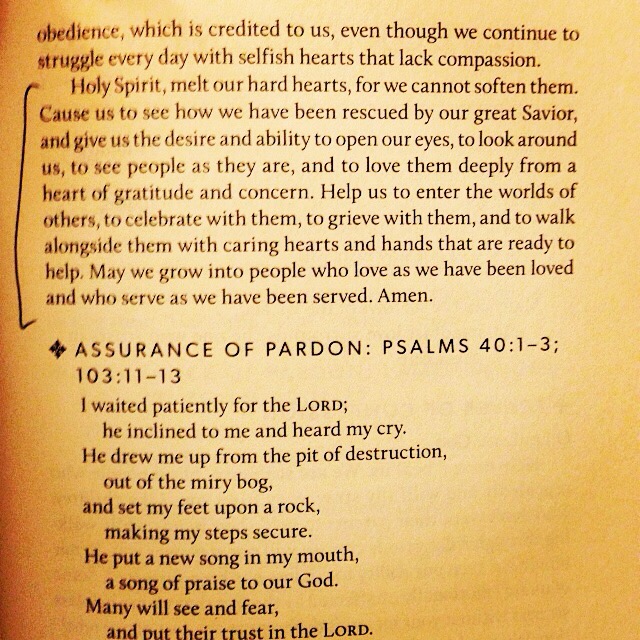
This prayer is from a favorite book that I “happened” to be gifted with by dear friends just as Lent was beginning: Prone to Wander, by mother-son co-authors Barbara Duguid and Wayne Houk. I have found its call to worship, specific gospel-saturated prayers of confession, and then assurance of pardon to be spot on for my heart this Lenten season (and really any time!). I also love that there are suggested songs listed at the end of each entry. It’s been a personal worship guide – although written to be for a church, there are multiple uses to be sure.

And having some bit of personal interaction with both Barbara and Wayne through CCEF courses we’ve been a part of together makes the writing sing even more so. They are both tremendously gracious, and incredibly gifted at putting gospel truth to words.