what keeps me from creativity

In reading through Brene Brown’s book, The Gifts of Imperfection, her chapter on creativity was particularly thought-provoking and inspiring. [The mark of a great author is to do both, and Brown does this so well!] I began last week with my thoughts on “why a non-crafty mom needs creativity” and wrote it as “part 1” of my creativity thoughts. Here is part two.

First, my experiments with creativity over the past week:

a “thankful” banner for this Thanksgiving season20131030-142731.jpg
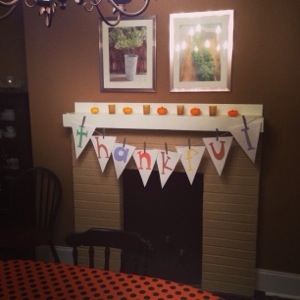
I ventured into the mess; bought craft paint for my girls to paint a pumpkin with; and let them go to it. We all had fun, and the mess was less than I thought it would be.

I also bought glue sticks for them. (yes, small step – but really a big leap forward for me) They are the look purple-dry clear type. Which meant my girls used them as paint. And while I sipped my morning coffee on Sunday, I looked up to find purple glue everywhere. On the tile floor, on the refrigerator … you get the picture. I was reminded why I often don’t venture into the arts and crafts realm with twin three-year-olds. The good thing is that they’re old enough now to consider it fun to clean up their mess. Which they did.

And then perhaps a less conventional expression of creativity happened when I stuffed the dirty pots and pans into the kitchen cabinets because I had 12 dinner guests from my neighborhood bunco group arriving in 2 minutes. When I texted my mom this picture, she said – “See, look! You are creative, Heather!”20131030-142809.jpg

But back to my original question – of what keeps me from creativity? Fear of mess is an obvious one, but that really isn’t the main obstacle. Brown speaks about creativity’s opposite as depression. And quite frankly, I think that depression can cause lack of creativity just as much as lack of creativity can cause depression. One is a symptom of the other. The motherhood season between 18-month-old and two-and-a-half year old twin girls was not my favorite. Along with living what felt like a depressed version of myself, there was an accompanying lack of creativity. Survival seemed to be all I could do day-in and day-out, trying to muster up enough energy to make it till naptime was my daily goal. Creativity? Forget it! I couldn’t even “creatively” choose anything besides the same exact lunch every day.

Yet slowly, surely, quietly, step-by-step, God brought me out of that hard season. And as depression dissipated, I noticed the resurgence of creativity. In small ways, like being spontaneous instead of needing to plan every minute of every day, and in returning to life-giving creative pursuits. For me, highest on that list is writing. And so I began to blog regularly, starting with my personal June challenge of daily blogging inspired by Grethen Rubin’s The Happiness Project. As I wrote more, I began to notice and savor life and those I love more. And then I had more to write about, and on and on it goes …

The one thing that still can threaten my creativity is what Brown identifies as the trap of comparison. When we begin comparing to others, we cease creating. I feel either false pride in being “better than” or (way more often) paralyzed by my perception of another’s creativity as much more inspired/better/talented than mine. Take this small example of doing a group craft project at a friend’s house a few weeks ago. We were painting wooden spoons, using painting tape to make stripes/etc. Overall, I had a great time. Making art is fun; getting to chat with other friends while doing so – even better. But then the insidious lie of comparison crept into my head. I looked at the other spoons and concluded that theirs were better – more creative – more beautiful. Mine just seemed so … plain. 

How ironic that is was the day after, in my “post-comparison hangover,” that I first read these words that Brown wrote in reflecting on how creativity slowly dissipated in her home as her parents shifted focus from living to acquiring:

My parents were launched on the accomplishments and acquisitions track, and creativity gave way to that stifling combination of fitting in and being better than, also known as comparison.

I’ll close here for today, as a poignant reminder to us that begs the question: am I focused more on fitting in with others or creating as an outflow of who I am, where I am?

Five Minute Friday: “together”

As kids, my two younger brothers and I would laugh at mom’s desire for “family together time.” We made fun of her for how much she wanted us to be together, even if that together time wasn’t filled with anything “special.” Now I admire her desire (shared and fostered by my dad, too) to be sure that we did share this most precious of commodity together as a family: time. Dinners every night; one weekend night that was devoted to “family fun,” even when I was in high school and rolled my eyes and copped a bad attitude. They were committed to us being together. Whatever that included.

[photo credit: image from inspiremeheather.com]

Now we live up and down the East Coast – literally from the coast of Maine down to the foothills of the Blue Ridge Mountains in the Carolinas. “Together” for the extended Davis family is a rare commodity. One we last shared in our annual May beach week; the next one yet to be scheduled since there are two December babies due (my sisters-in-law’s, not mine!); and we Nelsons will be celebrating what’s likely to be the last New Jersey Nelson Christmas since plans are in motion for my in-laws to move closer to us next summer.

Together is precious, as precious as ever, even more so because it is so infrequent. Together isn’t about what you do; it’s about who you are with and what we share: time, faith, emotions, joys, sorrows. Thank you, Mom and Dad, for teaching me the value of “together.”

******

Today I’m participating in Lisa-Jo’s “Five Minute Friday,” a chance to write unedited for five minutes on a word given by Lisa-Jo each Friday. Come join us!

why a self-described non-crafty mom needs creativity

“I just am not a craft-type mom.” I’ve said this many times, so many times that I actually believe it and actively avoid most art projects with my preschoolers (at home). But in reading Brene Brown’s book The Gifts of Imperfection, I was confronted with my suppressed creativity and my need to rediscover the creative side of my life as part of who I am. You see, I have been described as “creative” for most of my life, until about 10 years ago when I started seminary (no coincidence, I’m sure … ha!). I always loved our weekly art class in elementary and middle school, so much so that I chose to take a few years of art in high school as electives. All throughout growing up, I was usually cultivating some sort of project, whether a school project or one of my own making – like the time I bought a book on how to draw flowers and practiced all summer, or the scrapbook I made of important people and newspaper clippings as a 4th grader. [interesting to look back on these and read them!] Part of the appeal of my undergraduate elementary education degree was the opportunity to put creativity into practice with teaching children how to learn. Not to mention how many fun projects I got to work on (like preparing a unit on how to teach 4th graders about the rainforest) while my fellow college students labored in their organic chem labs and philosophy term papers.

But then I graduated from college, worked as a teacher, and lost some creativity amidst the work that it was to teach and to pay bills and to manage relationships. And then I went to seminary for a counseling degree, and creativity was further suppressed by deep thoughts on theology and the brokenness of our world and relationships. But it shouldn’t have been. Because this is exactly where creativity is most needed: at the intersection of God’s beauty and the world’s brokenness. How else do we bridge that gap without some redemptive creativity? How else can we image our Creator, who made light out of darkness and brought order and beauty from chaos?  I certainly had glimpses of this, through a few professors who creatively taught instead of rotely lectured; and in my “counseling children” course where we learned creative methods (even play) as a way to unlock a child’s emotions and thought life.

Personally though, I seemed to put creativity on the back burner once I became a mom to twins. Survival was the name of each hour of each day for the first six months especially, and probably up until the past six months (they are three years old now). I just didn’t have time. And then the MESS of getting my kids involved in creative pursuits? No, thank you. I was already sweeping up daily and spending more time than I wanted to in household chores. Add cleaning up paint or glitter or glue to this? I don’t think so.

Enter these words I read today:

‘I’m not the creative type ‘ doesn’t work. There’s no such thing as creative people and non-creative people. There are only people who use their creativity and people who don’t. Unused creativity doesn’t just disappear. It lives within us until it’s expressed, neglected to death, or suffocated by resentment and fear.

There will be more on this topic. Let’s call today “part 1 of Heather’s rediscovery of creativity.” Part 2 to follow. After I go do something creative … any suggestions? What do you enjoy as a creative pursuit?

finding words for my story

In my work as a counselor, the first place I start is in helping others find words for their story. Their story is there – they have lived it, the soul-shattering moments and the glory-filled ones alike, and yet finding words for their story can be hard. Not simply because it’s hard to speak of what you’ve never spoken out loud before, but also because you may not have the words to describe it. And so I will often suggest that they read something – the Psalms, for instance; or a book or memoir or a blog – to begin to find words for their story. I include these questions as prompts:

What stands out to you? What resonates with you? What do you say, “oh yes! That’s me!” about? Underline it; write that out; and begin telling your story.

In this month where I’m finding it hard to find words for my story (not because it’s difficult or painful, but it’s just busy and quite seemingly ordinary), I turned to a few favorite blogs this morning. And what I found put words to what I’m experiencing. My story of today. Enjoy …

Both are from Emily Freeman at “chatting at the sky,” my #1 favorite blogger and writer these days because of her grace-infused artful words.

First, from her post “one word that is sabotaging the art you live“:

But I’m just tucking them in to bed, you say.

I’m just cleaning the room.

I’m just filing the papers.

I’m just balancing the checkbook.

I’m just driving the carpool. None of this feels sacred to you.

Did you see the killer there?

Pay attention to when  you use the word just. Because whatever comes after that word is usually where you’re allowing the art to die.

Resist the urge to disrespect a task because it doesn’t feel important.

And in “the kind of movement that makes a difference“:

Rather than resenting my weakness, I believe Jesus is asking me to embrace my weakness. Being poor in spirit doesn’t mean despising self but releasing self from the expectation of being anything but poor. Small. Helpless. Worn.

My soul needs to remember the kind of movement that will make a difference:

Don’t try to handle your anxiety. Bring your anxiety into the presence of Christ.

Don’t try to fix your loneliness. Bring your loneliness into the presence of Christ.

Don’t try to hide your addiction. Bring your addiction into the presence of Christ.

Don’t try to change your attitude. Bring your attitude into the presence of Christ.

Don’t despise your humanity. Bring your humanity into the presence of Christ.

There is still responsibility, there is still action that comes from me. But my action is not to make right, to make whole, or to make better. My action is to usher my abilities, inabilities, failures and successes all into the presence of Christ.

Somehow, all of this weaves into what I’m living and learning right now as we study Romans together in our women’s Bible study and as we delve into gospel & community in our community group and as I counsel and write and tuck into bed and calm down tantrums in the in-between moments.

Thursday free write

I sit in a quiet, secluded room of the Y, looking out at the Norfolk skyline on the fourth rainy day (or so) we have had this week. A welcome respite for the dry ground, which has not received actual rainfall that counted since August 10.

And here is a picture of my soul this past month. There have been waterings occasionally, but nothing substantial. It’s been busy, busy with good and beautiful things like one last vacation at the beach and the twins’ third birthday and retreat speaking and community group and women’s Bible study and preschool. So I took a soul time out this morning, and I did a yoga class followed by this space. This space of breathing. Of noticing life rather than letting it rush me by. Yoga felt slow to my fast-paced world of efficiency. And isn’t that illuminating?

On a date with Seth last week, I realized a few things – that writing helps my soul to breathe and I haven’t been doing that enough this fall; that when exercise is pushed off my plate it means the plate is too full; and that weekends need to be empty when the weekday rhythm of a pastor and counselor’s family leaves us all coming up for breath at its end.

What am I doing about it? Well … this. Starting to get in the habit of writing again. Saying no to external demands to say yes to Christ’s whispered invitation to my soul to “Come … all who labor … and R E S T.” What helps you to rest? What keeps you from it? Do share. We all need reminders and ideas of how to pursue the rest for which we have been redeemed.

Five Minute Friday: “write”

For me, to write is to think. Ever since I received my first diary when I was in 5th grade from Aunt Becky, I have sought refuge for my thoughts and prayers through writing. Words make sense of the inner joy or conflict or anger or grief …. and to write is to feel as well as to think about feeling.

“Write” also feels like pressure. The command to write calls to mind memories of those awful blue books in AP exams or college or grad school, where you must write and then be graded and do so all within a confined, imprisoned amount of time. So I prefer not to hear the command, “WRITE!”

“Write” is an invitation to my soul. To come to the screen or the journal and worship. To worship with my words and invite you to do the same with yours. To focus on the One worthy of words and writing, and to find grace everywhere as I force myself to write about it. To write is to notice life, put it into a picture you can see and enter into some aspect of it with me. To write is to build bridges of relationship. To write is to appreciate the relationships built, to strengthen them as I grow thankful for the way writing makes me remember the way my daughter’s eyes twinkle when she’s laughing and the joy shared as friends and family connect in the very ordinary moments of life.

*****

Today I join Lisa-Jo Baker in her “Five Minute Friday” community. You can also join in here to write for five minutes on a different prompt each Friday.

when God’s wrath becomes beautiful

Yesterday I taught our women’s Bible study on the passage of Romans 1:18-32. It’s a tough passage. Nothing easy or pleasant or (at first glance) comforting here. The theme is God’s wrath revealed against human sin. And yet it comes not in fire and brimstone but in a gradual giving over to what our hearts desire. That’s what’s terrifying about it. There are four stages of this “sin anatomy” found here:

1. Worship exchange (verses 18-22) – Although evidence of God’s beauty exists around us in creation and within us in the form of eternal longings that can’t be satisfied by the world and a conscience, we suppress this and worship Beauty rather than its Author.

2. Truth exchange (verses 24-25) – Unmoored from a relationship with God, it’s easy to believe lies rather than truth. And it’s the only way my idolatrous worship can be supported – that I believe lies that arise from empty/futile/pointless thinking and a darkened heart. The darkness supports the lies and the lies build the darkness. To the point that I call evil good and good evil. It’s also evidenced in my guilt dysfunction – I feel guilty for what I shouldn’t, but fail to feel guilty for what I should.

3. Relationship exchange (verses 24, 26-27) – Inevitably, this leads me into using people around me to get what my heart craves (and worships) rather than lovingly serving them as fellow made-in-God’s-image beings. Sexual sin is a vivid example of this, and Paul does not skirt around this issue in Romans. Lest we begin to think we can judge another because “I don’t struggle with that …

4. Identity exchange – This is the deepest descent, the natural place we end up when first starting with exchanging God’s glory for creature and creation glory. I become what I practice, and the sin I dabbled in now owns and defines me. “Murder” is listed side by side with what follows, and all of us are caught in the net of practicing the unrighteousness that justly deserves God’s wrath:

  • gossips
  • slanderers
  • God-haters
  • insolent
  • haughty
  • boastful
  • inventors of evil
  • disobedient to parents
  • foolish
  • faithless
  • heartless
  • ruthless

When honest, we are left in despair by the end of this chapter in Romans. Where is the hope for any of us or for the world? And what do you do with this? Apparently, one common temptation would be to (still) try to self-justify and use this chapter to judge others, for Paul launches into the following warning at the beginning of chapter 2:

Therefore, you have no excuse, O man, every one of you who judges. For in passing judgment on another you condemn yourself, because you, the judge, practice the very same things.

But, thanks be to God, Romans doesn’t end with chapter 1, or even after chapter 2, or 3. [It gets more bleak before it gets better.]

For what all of this is leading to is the beauty of the great gospel exchange. In which God loved us so much that he was willing to enter into our messy world, messy because of us – corrupted by our fall from created intent – sent his very own Son, Jesus, to do the unthinkable. To exchange HIS holiness for our sin; to exchange HIS righteousness for our unrighteousness; to exchange HIS perfect record as the holy and beloved Son of God for our record stained with sinful idolatry – and pay what we deserve. The price of God’s wrath, which he alone experienced in all its furor on the cross. And the good news doesn’t stop there. Not only is God’s wrath paid for, but we are given Jesus’ life in exchange for our own – his beauty for our shame. And this is what we have been craving all along. All of our attempts to exchange glory for idols are merely attempts to run away from/cover/hide/escape the gaze of the all-knowing God, from whom we cower in fear because we know we aren’t worthy. But God, even in revealing his wrath, provides hope for rescue.

And this is how God’s wrath becomes beautiful for the one who is hidden in Christ through faith. This is the only way I could teach on such a topic yesterday and not leave in despair and hopelessness. I know that there is good news; but the good news implies that there is bad news. God’s wrath is real, but as a Christian, I will never have to feel its reality because Jesus took it all. This makes me weep for the mercy I’ve found … and this invites me away day after day after day to worship the Beautiful One instead of his gifts.