stories of shame, part 2

Read along for the introduction and part 1 here.

I’m writing this to give context to my book Unashamed: Healing Our Brokenness and Finding Freedom From Shame which is coming in June.

As I moved into middle and high school, shame became a familiar companion (though I couldn’t name it as such). As I feared exposure of weaknesses and social rejection, I began to withdraw. I presented as shy and quiet in the halls and classrooms of my high school. I didn’t date, not by choice but because of lack of opportunity. I distanced myself from my parents, believing that they were “uncool” and that I needed to create some space between me and them to socially survive high school. I tried to stay small and inconspicuous in high school. Don’t have the best grades, nor the worst; figure out what everyone else is wearing and copy it; do your work quietly, speak up only if necessary.

There was one oasis from shame – which for me was synonymous with the fear of rejection – and that was youth group. It was like I was a different person there. Not shy or quiet or in the background, but very much up front and involved. The difference was community – a community with shared values and a community who accepted me as I was. I had a strong group of friends, many of whom I am still in contact with today, and we were emboldened to do silly/crazy things together. We also prayed with and for each other, studied the Bible together, wrestled through hard things together – the death of classmates in a car accident, for example, and the opposition we faced as Christian high school students in public schools.
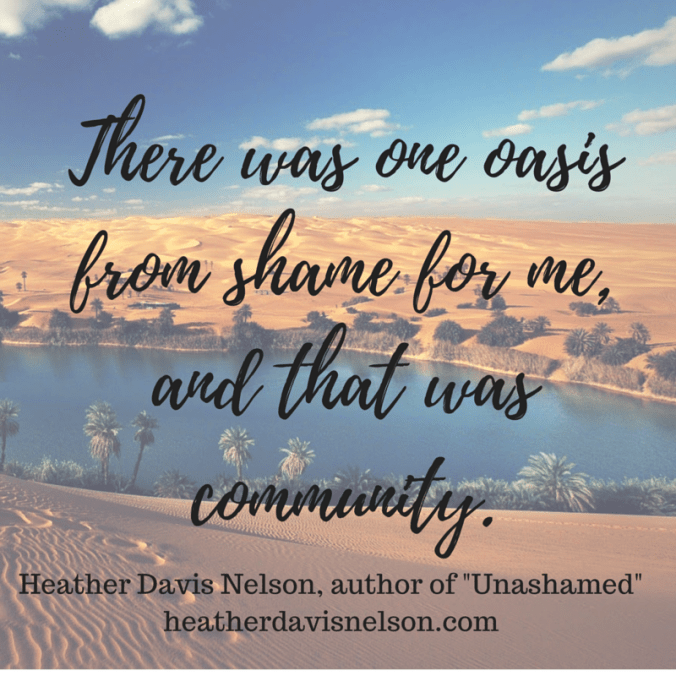
oasis from shameWhen I look back at high school, I cringe at the way shame held me back in many ways from living out of my confidence in Christ, especially in the way that I distanced myself from my parents. Yet I also am deeply grateful that I had a taste of the “unashamed” experience through youth group. This was a hint of more redemption that would come in later years.

A few things that I’d reflect on from this season as it relates to shame’s development:

  • Shame comes in the wake of some type of relational pain and brokenness. For me, it wasn’t connected with my sin but more like a result of living in a world where middle school girls can be mean and high school halls can be unkind.
  • Shame resilience happens through community. This community of my youth group strengthened me to be myself when I was with them, and to remember who I was and the strength God had given me through faith in Christ.
  • Shame can often only be named upon reflection. I had no category for “shame” while in high school, but it doesn’t mean I didn’t struggle with it. Any place in your life where you tried to be small and inconspicuous probably points to the presence of shame.

Questions to ask in reflection: 

-Are there seasons/aspects of your life where shame was present although you didn’t see it then?

-Were there tastes of community that helped fight shame? What was true about these communities?

stories of shame: a 10-part series

stories of shame blog button (1)

There is something about a story that draws us in – that engages us in a way that no other genre can. The power of a story hit me anew as we were driving back from South Carolina last Friday. It was getting late; it was rainy; and halfway into the 7-hour drive, I was already done. Then I started listening to a story (Serial Season 1 by This American Life), and I’m telling you, my driving experience transformed from monotonous to engaging. I found myself almost regretting the moment when we pulled into the driveway because it meant that I had to press pause on the story.

Isn’t that the power of a good story told well? More than mere entertainment or an academic lecture, it engages both our hearts and our minds.

I want to be a better storyteller. I want to tell the truth of who I am with all my heart (a paraphrase of Brené Brown/Glennon Melton Doyle). And especially to lead the conversation around shame that I hope to begin with my book’s launch next monthUnashamed: Healing our Brokenness and Finding Freedom From Shame.

I want to connect my story – and thereby your story – with The Story. The Story that makes ultimate sense of all of our stories, and which is the birthplace of each of our stories. The Story = humanity’s beginning, God’s eternity, Jesus’ salvation, + resurrection hope.

Don’t miss this series – subscribe now to my blog so that you’ll catch every part, delivered into your inbox [see sidebar where you can enter your email address].

And go ahead and pre-order my book if you want to hear more. I’d be so honored for you to join this journey with me!

Without further ado – part 1:

I remember life before shame. Neighborhood bike rides through streets as idyllic as their names – Sweetwater Court, Sugar Creek Road, Sun Meadow Road, Berrywood Court. Building forts in our wooded backyard with very little parental supervision because, well, it was safe, and we knew all of our neighbors. Family vacations with my two younger brothers. The rare joy of snow days as the main break from the normal, happy routine of church-school-home, repeat. Getting dressed in whatever I felt like. Being sad when I outgrew my favorite red sweater with panda bears on it. The worst “trauma” being a broken arm (or two) and a skinned knee.

Life felt secure, and so did I. Life wasn’t perfect, of course, and I fought a lot with my younger brothers – as well as trying to pin some of my misdeeds on them (which worked often, according to their accounts of growing up). But overall I felt very little shame in childhood.

shame part 1

Until, well, it began creeping up. The embarrassment of “liking” a boy who “liked” me back, and the complication of wanting him to know but not wanting to talk to him or even sit next to him in chapel. The sting of being rejected by said boy when a new girl moved to town. Getting really big plastic pink frames in fourth grade, and somehow connecting this fact to the boy’s rejection and the growing self-consciousness I felt. I dreaded having any attention brought to me, and I was terrified of any sort of public presentation in class. I began to wonder if my friends were true friends, or if I had any friends at all, after being socially rejected by most if not all of the girls in my eighth grade class.

I didn’t call it shame back then, and until a few years ago, I wouldn’t have labeled any of this growing self-consciousness, doubt, and fear of rejection as “shame.” Come along with me as I’ve learned how to better make sense of some painful aspects of my story, and how I’ve become free as well.

A few questions for you:

-Do you remember life before shame? What was it like?

-When did shame begin to enter your picture and how did it first show up?


The process of writing a book: my story

It all begins small, as most things do. Three years ago I was quoted in an article on body image at the Gospel Coalition’s blog. I submitted a few more articles in the next several months, and a couple more were published. One had a particularly large following – a Father’s Day post. I felt humbled and amazed to have been able to connect with so many people. And encouraged to keep on writing.

I attended The Gospel Coalition Women’s conference in June 2014, praying for a connection with a published author and direction for how to go about writing a book. God opened more doors than I could have imagined, through Collin Hansen inviting me at the last minute to a writers’ gathering where I met real-live-published-authors Hannah Anderson and Jen Pollock Michel. I heard a panel of writers talk about their writing – Gloria Furman, Jen Wilkin, Christina Fox, and Melissa Kruger. I took it all in.

And I also “happened” to meet a member of Crossway Publication’s marketing team, who later introduced me to an acquisitions editor at Crossway who walked me through the process of writing a book proposal in fall 2014. January 2015 brought the best news ever: my book proposal was accepted and I had a book contract for a book on the topic of shame and the gospel. I couldn’t believe it!

writing-a-bookFor the next six months, I wrote the book between the demands of life in stolen moments while our daughters were at preschool and early mornings and late evenings. Then began the editing process – which was probably my least favorite. But my editors Dave and Tara certainly softened the process for me and sharpened my writing significantly. I am so grateful for them, and for the entire team at Crossway who have been so kind and helpful and encouraging to this first-time author.


All of these efforts (plus asking for a foreword and endorsements) have coalesced into the advanced reader’s copy that was printed and mailed out in the past month to my fabulous launch team and influencers.

A graphic that describes my emotions throughout this process is this:

stages of writing a book

Unashamed: Healing Our Brokenness and Finding Freedom from Shame is available for pre-order at Amazon, with a June release date. And it will launch with this summer’s TGCW 2016 conference in Indianapolis. Then another stage of fun begins – having the privilege of connecting with readers and other audiences around the message of this book. I hope you’ll be part of this group!

5 Reasons Why We Need to Rest

Today I am a guest blogger at (en)Courage – a blog started earlier this year as “Gospel-Centered Hope to Fulfill Your God-Given Design.” Christina Fox, author of the upcoming A Heart Set Free (which you’ll be hearing more about from me soon), asked me to be a contributor, so I will be be writing semi-regularly there, along with a team of gifted women writers who also call the PCA  (Presbyterian Church in America) their denominational home.

***

rest

I’ve long viewed rest as a luxury that I couldn’t afford. I was too busy. I’m a part-time counselor/writer/speaker, pastor’s wife, and a mom of young children. When was there time to rest? Rest seemed indulgent, until it became a necessity when I hit burnout in the fall of 2015.

God stopped me in my busy performance-driven tracks, and forced me to be still. Psalm 46:10 has long been a favorite verse of mine – “Be still and know that I am God.” I know that being still is a precedent for part b of this verse, “I [God] will be exalted among the nations, I will be exalted in the earth!” I have counseled many others about the value of solitude, going away and being with God the Father as Jesus did throughout his ministry. The practice of Sabbath rest one day out of seven has long been a spiritual discipline which I’ve championed for others, while practicing it inconsistently throughout my life. Isaiah 30:15 is also a favorite verse for me – that in quietness and trust is strength; and salvation comes through repentance and rest. Yet for all my head knowledge, without the regular practice of holistic rest, I grew exhausted and weary as my heart and soul lost sight of rest.

What is Rest?

Before I give you five reasons we need to rest (especially as women), let me first define rest. Rest is the regular rhythm of taking a break from the usual demands and stresses of life and ministry. Rest includes all of these components: mental, spiritual, emotional, and physical. … [Read the rest of the article at (en)Courage here.]

Easter morning

{a repost from 2014}

cropped-232323232-fp5367-nu32-6-572-77-wsnrcg336548-63932-nu0mrj.jpg
“Hear the bells ringing, they’re singing that you can be born again!” That melody floats through my head this morning. The melody that drew me into salvation as a child of 4-years-old who inquired what it meant to be born again, and then was … Keith Green’s invitation set to music.

Another phrase that seems to capture what Easter means for me this year, today:

Be free and have fun!

I overheard these words spoken by a grandmother sending her grandson off to play at a park a few weeks ago. And they have reverberated through my mind and heart ever since. Not only as such a good (different) parenting focus, but the words I need to hear from a resurrected Jesus this morning, every morning.

Easter means I am free and so are you who are united to Jesus by faith. Free from sin, free from slavery to the effects of my sin and others’, free from anxiety and worry, free from performance on the treadmill of perfection, free from my past and my failings, free from others’ judgments or opinions, free to say “no” to doing too much, free to love – to serve wholeheartedly – to create.

Free to have fun in the truest sense of fun. To be creative, to delight in a world that can be as delightful as it is broken.  To have fun with my daughters and not only be a disciplinarian. To have fun with my husband and in so doing make both of our loads lighter. To take myself more lightly and laugh a little easier. To have fun doing what I don’t give myself permission to do in my quest for achievement and success: to have fun painting, reading novels, blogging, sharing a cup of coffee with a close friend, making life and our home beautiful.

What about you? What could it mean to live in the light of Easter morning? Of the empty tomb calling out to you – “be free! and have fun!”? Where are you still living under the weight of “Silent Saturday”? Of the agony of Good Friday?

Three posts I recommend for your perusal. “We are the Sunday morning people” by Lisa-Jo Baker, “Woman, Why?” at (in)courage, and “We Need All the Days of Holy Week” at Grace Covers Me.

Enjoy … be free … have fun! The tomb is empty; Jesus our Lord is risen; death has lost its darkness and sin has lost its power. 

Holy Monday

{repost from March 30, 2015}

It sits just on the other side of triumphant Palm Sunday, and days before the remembering, mourning, and celebrating of Thursday through Sunday. It can feel lost – this “Holy Monday.” (And is that an oxymoron? How can Monday ever be holy? More often “mundane” is an adjective of choice.)

I wonder if “Holy Monday” (and “Holy Tuesday” and “Holy Wednesday”) are needed so that our hearts are ready for the sobriety of Maundy Thursday and Good Friday. For something shifted in the crowd who welcomed Jesus with palm branches waving, surrendering their outerwear as a pathway for their donkey-saddled King. Something shifted between this “Triumphal Entry” and the angry crowds begging for his execution on Friday. It was the overlooked days of “Holy Monday/Tuesday/Wednesday.”

The days when I overlook – or fail to look – at my king, humbled and riding on a donkey, but riding nonetheless TO ME; the days when I overlook the tears Jesus wept over this city (and symbolically, over every city in which any of us dwell); these days are the ones when my heart can go rogue. It slips out beneath my notice and goes after its old lovers. The ones promising quick satisfaction without waiting for long promises to be fulfilled. The lovers who tell me I’m beautiful (especially if I use their line of clothing and beauty products). The ones who lure my restless heart with excitement and adventure (forgetting to highlight the fine print warning of: use only at great risk to your soul). It was these false lovers who won over the hearts of the crowds in the four days between Palm Sunday and Good Friday. The false lovers were clothed in religious garb. They planted questions like –

“How dare he claim to be the Son of God? Who does he think he is?”

“We were promised a Messiah to rescue us. We are still under Roman oppression. Jesus cannot be the promised one.”

“This Jesus is not what we really want. He is working too slow – or not at all.”

And these same religious leaders were at work behind closed doors making deals with an insider who would betray Jesus (Judas). They were plotting his death while the crowds went about their business on Monday, Tuesday, Wednesday, and Thursday. They were stirring up the crowds, with insidious doubts at first and then with explicit commands.

Holy Monday can become “Holy” only when I first admit how similar I am to these fickle crowds. I want a king who comes on my terms, to deliver me in my way, and to make me powerful with him. A king who calls me to follow after him, deny myself, and lose my life to save it? No, thank you. I think I’ll go find someone else. Holy Monday becomes holy when I look at the God who has won me wholly. Even (especially) in the days when my heart feels prone to wander.

Noticing Goodness

A few weeks ago I spoke at a local MOPS group (Mothers Of PreSchoolers). And one thing that really struck me was their themes for the year: “Noticing Goodness” being my favorite. Doesn’t simply that phrase refocus your thoughts today?  What I love about noticing goodness is that it means: 1/there is always goodness to see and 2/goodness needs to be noticed, some moments more than others. 

As a counselor and the author of a book on shame, I’ve trudged through some dark places in the past decade – both in my own heart and in the lives of others. In some ways, I’ve trained myself to notice the struggles in life – the places where someone is lonely, isolated, stuck. And I’ve been invited into these dark corners, to be part of the redemption of our God, leading us into places of light and beauty once again. I’m realizing anew that even here – especially here – there is goodness to be noticed. Not in a fake cliche type of way, because that backfires, but in a real way that seeks out the treasures found nowhere else but in darkness. 

Were it not for the winter’s doldrums, spring wouldn’t be so sweet – so life-giving. 

Without depression, it’s all too easy to take emotional health for granted. 

The hardest, most baffling parts of the story are where character is forged, perseverance is developed, steely hope emerges, and compassionate empathy grows. 

My shame stories give me the ability to connect with you authentically. (And even write a book about it.)

And then there are the thousands of small beautiful moments waiting to be noticed in our daily lives:

  • Pink and purple glory bookending each day through sunrise and sunset
  • The taste of a perfectly ripened sweet berry
  • A moment of calm in between the stress of a busy day
  • Music!
  • My kids’ excitement for new experiences and skills gained
  • Unexpected kindness
  • Humor
  • Witnessing a friend’s resilience through hard circumstances
  • Art created 
  • A blank page
  • Words that make your heart sing
  • A good story
  • A refreshing walk/run/yoga session

What goodness will you notice today? I’d love to hear about it! 


when words break your 5-year-old’s heart

My normally exuberant, bouncy and easily-excitable 5-year-old sat crouched on her bed when it was time for preschool. When asked why, she said, “I don’t want to go to preschool!” before bursting into tears. It baffled me for about 2 seconds before I remembered what happened the day before.

Someone told my daughter, “I hate you!”

She is five. FIVE. And what stings more than hearing this from my child is feeling the weight of it with her, in reliving my own past experiences of social wounding and exclusion. No one prepares you for this part of parenting. It is one thing to deal with my own burdens of being socially excluded and rejected – the wounds now healed into scars by God’s grace (which included counseling and writing!). It is a totally different thing when those wounds are happening to your child’s heart.

It is one thing to hope for the gospel’s power to heal and restore and bring forgiveness for yourself; it is quite another thing to hope for the same gospel’s power to heal and restore and bring forgiveness to my heart as a mother aching with my child’s pain.

The shield I usually cling to is anger, first and foremost. It’s the easiest one to grasp, and I feel most powerful with it in my hands. Close behind this would be despair and pity for my child – to a point where I give way too much weight to this incident and allow her not to be brave and courageous and kind and resilient. Holding this shield close to my heart would make me hold my daughter too close for comfort and seek to protect her from all possible hurt things ever. (An impossible, and ultimately, fruitless task!) If I’d allowed this shield to win the morning, I would have coddled my daughter and told her she never had to go back to school ever again. But where would she be? That would have given too much power to the unkind words. It would have increased the shame that would linger and the fear ready in its wake. 

Instead my faith in a God who is just and loving calls me to put down my shields of anger and despair/pity, and to courageously guide my daughter through the shards of a broken world. A world where this is only the tip of the iceberg of what she’ll encounter throughout her life. A world where she, too, will say things and do actions that are unkind to others. A world where the line between “bully” and “victim” can be hours, minutes, or days apart.

To guide her through this world on that particular morning meant embracing her firmly and feeling deeply with her and for her the pain of these rejecting words. It meant telling her my own story of being hurt by others’ words, and answering her sweet question, “how many days did it hurt?” with an answer that is a prayer. “Oh, sweetie, it hurt for awhile, but Jesus healed my heart. And the best way to fight against these hurtful words is to be brave and kind to others, and to go back to school today. Otherwise, those words win. And we can’t have that! Remember you are loved and you are brave – and we are with you.”

What happens when words break your 5-year-old’s heart? You cry and protect – and ultimately choose to entrust her heart into the hands of the same God who’s loved and protected and guided you through your own journey. He is faithful, trustworthy, and the ever-present protector who takes wounds and turns them into compassion. Markers in a story that will shape who she is becoming: neither the bully who self-protects and retaliates nor the victim who is perpetually withdrawn, but the brave and kind girl who knows she’s loved more deeply than any words of hate and courageously moves into what she fears. 


Lent as a rehearsal of the gospel

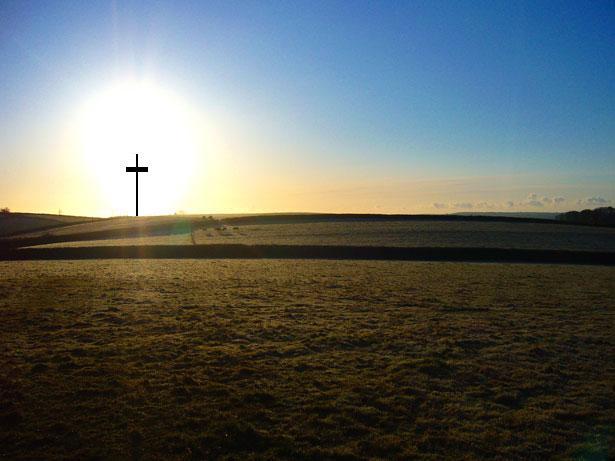
cross desert

For a contemplative – which is what I am in many, many more ways than I’ve been willing to admit – Lent is a season rich with treasures. There are worship services full of meaning: Ash Wednesday to launch Lent; Good Friday to meditate on the suffering of the cross; and then the glorious climax of Easter Sunday at its end. There are thoughtful devotional resources. This year I’m reading “Journey to the Cross” which I found here at TGC, written by Kendal Haug and Will Walker out of Providence Church Austin. The church worldwide is led into a season of denial leading up to Good Friday, and then the church universal celebrates joyously on Easter Sunday. 

It’s a rehearsal of the gospel story. Not only in the obvious way – the season of repentance, remembering, self-denial, that ends with a day of remembering Jesus’ suffering for our sake; and then three days later, celebrating resurrection life with the empty tomb on Easter – but also in our own hearts.

Each year I face the reality that the law cannot save me. Regardless of how low I set the bar for Lenten denial (“just” abstaining from sweets, or “just” not using non-essential phone apps) and repentant engagement (“just” loving my family better, or “just” noticing the homeless in our city and praying for them) – I can’t do it. On a “good” year I might last two weeks before I break Lent. Then I inevitably do what I try to do when I forget that Jesus did it all. I try to be better; I try harder; I invite more accountability; I set the bar lower or higher.

And my striving never works. It doesn’t produce the result of a more disciplined life. Instead, it produces a heart desperate for the rescue of grace. A heart that comes to Good Friday painfully aware of my inability to stay awake to repentance even for 40 days. A heart that cannot make itself righteous. A heart that needs resurrection hope. A heart that is rescued only by turning away from self-denial and embracing the life of the dying-now-resurrected Savior.

So this year, as I’ve been aware of my inability to sustain any sort of meaningful Lenten fast – I say, “help me, God!” And I thank God that he has. That he sent Jesus whose ministry started with the test (and the passing!) of the wilderness temptation. Jesus who followed the Spirit into this very wilderness testing, passing the test I will always fail.

True Lenten fasting uncovers the layers of our hearts where we struggle to trust this Jesus who did it all for us out of love. True Lenten fasting leaves us longing for more of Jesus and hopeful because in the Spirit through faith we have Christ within us – the hope of glory. (Colossians 1:27)

Five Minute Friday: morning

Five Minute Friday is my favorite of writing link-ups hosted by Kate Motaung. Her description draws me back every week, and the community of FMF keeps me writing – “This is meant to be a free write, which means: no editing, no over-thinking, no worrying about perfect grammar or punctuation. Just write.”

So I come this afternoon to write – feeling a bit rusty, and knowing that it is these very days where writing is necessary. For a writer without writing is like a fish out of water. And I am a writer who needs to write. Join me?

***

I never was much of a morning person, and that’s an understatement if there ever was one. You only need to ask any member of my family to verify its truth.

But now. Maybe it’s growing older; certainly it’s having less of a choice about the matter since becoming a parent; now – there is nothing I love more than a fresh, beautiful morning.

The day is a blank slate yet to be written. Yesterday’s foibles and sins are wiped clean – “new morning mercies” is what I love to remind my children and myself of after a particularly difficult day. Sunlight streams in as the sun peeks above the horizon; and the birds greet the dawning of a new day.

Last week my husband and I traveled to the Caribbean to celebrate our tenth anniversary, and I can say that (unlike our honeymoon 10 years ago) mornings were my favorite part. The sunlight breaking over the aquamarine horizon, palm branches filtering rays of light, lush green grass sparkling. God inviting his children to play. To come out – to wake up – and delight in the day that he had created. 

And isn’t this just as true even hundreds of miles away? When we’ve traded in palm branches waving in the breeze for barren branches shaking in the wintry wind? We still need – and are assured of – God’s love dawning with each morning’s light.

***